

Pool Tour - Pocket Billiards review
 Analysis by Appsdrops
When I want a quick pool game that feels more like an arcade pastime than a serious billiards simulator, Pool Tour - Pocket Billiards is the kind of game I reach for. Its appeal is easy to grasp: line up a shot, send the balls rolling, and settle into a series of compact table challenges. That focus makes it approachable, though it also means players looking for a faithful recreation of a real pool hall may want something more technical.
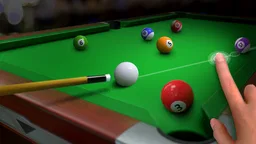
A bright table and an easy way in
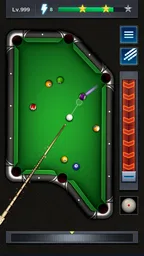
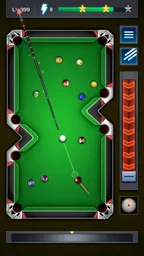
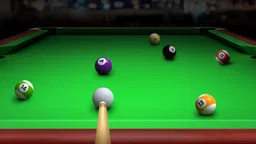
The game’s presentation points toward casual play. The pool table is the main event, and the overall framing suits a game meant to be picked up for a short session rather than studied like a sports simulation. I like that the basic premise needs little explanation. Even if you have not played a mobile pool game before, the familiar sight of a cue and a table gives you an immediate sense of what to do.
That directness is particularly useful when you have a few spare minutes: a break between tasks, a quiet moment on the sofa, or a short wait when you do not want to commit to a long match. Instead of asking me to learn a large cast of characters or master a complicated control scheme, it puts the attention on aiming and taking the shot. The trade-off is that the game’s identity depends heavily on whether that repeated action stays satisfying for you.
As a sports game from Candy Mobile, it takes an arcade-minded approach to pool. I would describe the mood as light and focused, not as a painstaking attempt to reproduce every detail of playing on a physical table. That distinction matters: the game works best when I treat it as a compact cue-sport diversion, not as a substitute for practicing real-world technique.
Visuals that keep attention on the shot
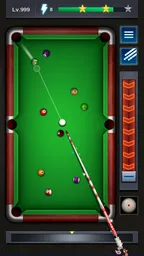
The table-centered presentation helps the game remain readable. Pool already asks players to think about angles, pockets, and the position of several balls, so a clean view is more useful than a busy screen full of distractions. Here, the visual language supports the immediate task: look over the layout, decide where to aim, and see how the shot changes the board.
That simple visual focus also gives the game a consistent setting. Rather than building a story around a tour, it uses the idea of moving through pool play as a reason to keep returning to the table. I find that approach appropriate for a game whose main pleasure is working out a shot. It keeps the atmosphere coherent without making me wait through narrative material before I can play.
There is a limit to this restraint. Players who want a richly detailed pool-room environment, a strong character presence, or a dramatic sports broadcast feel may find the presentation too plain. The game’s world is essentially the table and the activity on it. If that is enough for you, the uncluttered look is a strength; if you want the setting itself to be a major attraction, it may not hold your attention for long.
Sound and the pace of a casual session
Pool is naturally a game of pauses and decisions. A good mobile version needs to leave room for that small moment of thought before a shot, then make the result feel clear. Pool Tour is most appealing when I let that rhythm guide the session: inspect the table, settle on a line, take the shot, and reassess. It is an easy loop to fit around everyday interruptions because each turn gives me a natural stopping point.
The sound belongs to that same restrained mood. Rather than making the game feel like a loud sports spectacle, it supports the physical idea of balls meeting and play continuing. I prefer this sort of modest audio role in a pool game: sound can help a shot feel finished, but it should not overwhelm the visual information I need to plan the next one. If you usually play mobile games in quiet places, the game’s table-first nature also makes it easier to enjoy without needing a dramatic soundtrack to carry the experience.
One practical habit I recommend is treating each shot as a small decision rather than rushing through a sequence. It is tempting to aim only for the nearest pocket, especially when playing casually, but taking a moment to consider what the remaining layout will look like can make the game feel more like pool and less like tapping through targets. That extra thought is where the basic mechanics gain depth, even without turning the session into serious practice.
Arcade handling rather than a pool lesson
The central question for any mobile billiards game is how much control it gives the player and how much it smooths over the real sport. This one is best approached as an arcade-style experience. Its straightforward premise makes it approachable, but that same simplicity will not satisfy everyone. If you want detailed control over every aspect of cue technique or a close digital training tool for playing on a real table, a more simulation-focused alternative is a better fit.
For casual players, though, a lighter approach can be a benefit. The game is easy to understand, and the focus stays on aiming and judging outcomes rather than on a long list of rules or technical inputs. I would use it to enjoy the puzzle-like side of pool: finding a promising path through the balls, deciding which shot is sensible, and seeing whether the table opens up or becomes more awkward.
A useful way to keep sessions engaging is to vary what you pay attention to. Some turns can be about making the immediate pocket; others can be about leaving the remaining balls in a manageable arrangement. That change in focus adds a little self-imposed challenge without requiring extra systems or goals. It also makes the game more rewarding for someone who already knows the basics of pool and wants a low-pressure way to think through shots.
The limitation is that the same core action can become repetitive if you expect constant changes in pace or a broad range of activities. Pool is a deliberately measured sport, and an arcade presentation cannot remove that repetition entirely. I would skip this if I wanted fast action with frequent surprises, or if I prefer a competitive sports game built around teams, seasons, or a larger sense of progression. It is strongest when I want the table itself to provide the challenge.
Who will enjoy it, and when another choice is better
I would recommend it to someone who likes billiards but does not need a strict simulation, as well as to casual mobile players who want a familiar activity that can be played in brief stretches. It also suits people who enjoy spatial puzzles: a pool table is a compact problem, and every shot changes the options that remain. The game’s Everyone age rating reflects its broad, accessible presentation, and its free price makes it easy to try without making a purchase decision first.
On the other hand, players who care most about realistic cue control should compare it with a dedicated pool simulator. Someone seeking a social experience centered on live opponents should also check that a game offers the specific kind of multiplayer they want before choosing it; I would not pick this title solely on the assumption that it provides a particular online mode. The same caution applies if you expect a deep career structure. Its strongest, clearest appeal is the act of playing pool in an arcade-friendly format.
For an everyday scenario, I can see it working well during a short lunch break. I can focus on one table at a time, pause naturally after a shot, and return to the next decision without needing to remember a complicated story or a long chain of objectives. It is less suited to a commute where I cannot comfortably concentrate on aiming, since the game’s core pleasure depends on looking closely at the table rather than playing almost automatically.
The practical question of device compatibility is worth checking before installing: the current release is version 2.0.1 and requires Android 6.0 or later. It has been available since April 13, 2020, and has reached over five million installs. Those details make it a well-established option in mobile pool, but popularity alone does not change the basic choice: decide whether you want a relaxed arcade table or a more exacting simulation.
A measured mood with a clear purpose
Pool Tour - Pocket Billiards succeeds when I judge it on the experience it is built around: a clean, accessible pool session with an arcade sensibility. Its presentation keeps the table at the center, its pacing gives each shot room to matter, and its familiar sport makes the game easy to approach. I appreciate that coherence more than I would appreciate extra decoration that distracts from the angles and choices on the table.
There is also a substantial audience for it: the game has a 4.6 average from around 131,000 ratings, with roughly 11,000 written reviews. I see those figures as a sign that many players have found its simple pool focus appealing, not as a promise that it will suit every taste. A casual fan can settle in quickly, while a billiards enthusiast may notice the limits of an arcade-oriented design sooner.
My recommendation is straightforward. Try it if you want a free, easy-to-enter pool game for short sessions and enjoy thinking through shots at a relaxed pace. Choose a more simulation-heavy alternative if realism and detailed cue technique are your priorities, or a different sports game if you want more varied action than a table can provide. For the right player, the appeal is not an elaborate world but a focused little routine: read the table, take your shot, and see what the next one asks of you.
What we like
- Quick matches make it easy to play in short sessions.
- Aiming guides help beginners learn shot angles.
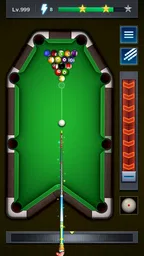
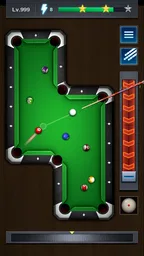
- Different table layouts keep challenges varied.
- Offline play is useful when an internet connection is unavailable.
- Simple touch controls are easy to pick up.
What could be better
- Some advanced shots require precise touch control.
- Progress can feel slow without regular play.
- Ads may interrupt the experience.
- The physics may take time to feel familiar.
- Limited social features reduce interaction with other players.







