




Tennis Clash: Multiplayer Game review
 Analysis by Appsdrops
The first thing I notice about Tennis Clash is how quickly it gets to the point: I’m looking at a court, an opponent, and a chance to return the ball. That makes it easy to pick up for a short break, but the simple presentation hides a game that asks for timing and positioning, not just quick taps. I’d recommend it to someone who wants a compact sports match on a phone, especially if they enjoy learning an opponent’s rhythm. I wouldn’t choose it as a substitute for a full tennis simulation or a relaxed offline game.
Bright courts, clear visual language
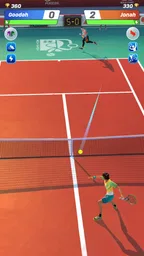
Wildlife Studios gives this free sports game a polished, colourful look. The courts and player animations make the tennis setting immediately legible on a small screen: I can follow the ball, read where a rally is going, and focus on my next response rather than deciphering a busy interface. Its style is more lively than realistic, which suits quick mobile matches better than a slow, broadcast-like presentation would.
The visual clarity matters because the action depends on recognizing a shot and reacting in time. A match can turn on whether I move into a useful position or commit to the wrong side of the court. The clean framing helps me understand what just happened, even when a rally moves quickly. At the same time, this isn’t a game whose appeal rests on detailed tennis simulation. I’d come for readable, energetic play, not to study court surfaces or reproduce the full strategy of a professional match.
The setting stays focused on tennis and its competitive arenas rather than building a broad sports universe around the matches. That restraint gives the game a coherent identity: the court is the main event, and the visual presentation keeps returning my attention to it. If you prefer sports games with a story, extensive exploration, or a strong single-player world, this concentrated approach may feel thin. For a player who wants to get into a match without a long preamble, it’s a sensible trade-off.
A mood built for quick attention
The overall mood is upbeat and competitive without making each match feel like a solemn tournament broadcast. That works well on a phone, where I might open the game between errands or while waiting for a friend. It also means the game’s personality comes largely from the pace of play and the visual energy of the court, rather than from a deep narrative or a distinctive fictional setting.
That focused atmosphere is one of its strengths, but it sets expectations. Tennis Clash is best approached as a head-to-head mobile game with a tennis theme, not as a comprehensive tennis encyclopedia. The category is sports, yet the experience is shaped by short, direct contests and touch controls. If that is what you want, its presentation gets you into the right frame of mind quickly.
Sound and the pace of a rally
Sound in a sports game should support the action rather than compete with it, and here I find the rhythm of a match more important than any single audio cue. The back-and-forth of a rally gives each point a natural rise and release: I wait, react, and then have a moment to reset before the next exchange. That cadence is a good fit for mobile sessions because it gives a match shape without requiring a long stretch of uninterrupted attention.
I’d still treat this as a game where concentration matters. A quick interruption can make me lose track of the rally, and a match against another player is less forgiving than a casual puzzle that can sit untouched. If you’re playing in a noisy place, the visual cues and the flow of the ball are more useful to focus on than expecting sound alone to guide you. For a quiet, relaxed session, a slower single-player game may be a better fit; for a short burst of active competition, this one has a clearer purpose.
The pacing also explains why “just one match” can become a few. Each contest offers a compact goal, and the immediate feedback makes it tempting to try again after a close point. I like that sense of momentum, but it can be frustrating if I’m looking for a game I can pause at any instant without consequence. My practical advice is to start a match when you have enough time to finish it, rather than opening the game in the middle of something that needs your attention.
Touch controls reward deliberate choices
The central appeal is the mix of movement and shot timing. I can’t treat every exchange as a reflex test; I have to pay attention to where the ball is headed and avoid reacting so early that I leave myself poorly placed. That makes the play more engaging than a simple tap-to-hit routine. A useful habit is to watch the opponent’s position as well as the ball: anticipating the open space can be more valuable than chasing every shot at full speed.
Another practical adjustment is to keep early matches exploratory. Rather than trying to win every point with an aggressive response, I’d use the first exchanges to learn how quickly the rally develops and how much time I have to move. This gives me a better sense of the controls before the pressure rises. It’s a small change in approach, but it helps separate a mistake caused by unfamiliar timing from one caused by a genuinely difficult opponent.
Because the game is online and built around player-versus-player competition, connection quality and the opponent’s behaviour can shape how a match feels. That is part of the appeal: another person’s choices make each contest less predictable than a fixed sequence of computer-controlled shots. It is also a limitation. If you want reliable progress without depending on a live opponent or a stable connection, a traditional offline tennis game is the safer choice.
The online focus also makes the game a better fit for players who enjoy repeated competition than for those who want a complete career mode or a long, self-contained campaign. I find its strongest moments in the immediate decisions of a rally: where to move, when to respond, and whether to aim for a safer return or take a risk. If your favourite part of sports games is managing a season, building a team, or following a story, you may find that this narrower loop doesn’t give you enough variety.
Progress, spending, and realistic expectations
The game is free to download, with in-app purchases ranging from $0.49 to $149.99 per item. I’d go in with a clear spending boundary, particularly if competitive progress is what keeps you playing. The presence of purchases doesn’t mean you need to buy something to enjoy a match, but it does make it worth checking what you’re choosing before confirming a transaction. Players who prefer a completely purchase-free experience may be more comfortable with a paid game that offers its content upfront.
For a newcomer, I’d focus first on learning the match flow instead of treating every setback as a reason to spend. Short rallies are useful practice: they show whether I’m late to move, choosing poor positions, or simply trying to force a difficult shot. That distinction makes it easier to improve through play rather than assuming a purchase is the answer. It’s also a more satisfying way to judge whether the game’s competitive style suits you before investing much time or money.
The scale of its audience suggests that this is an established mobile sports game rather than an obscure experiment: it has over 100 million installs, an average rating of 4.6 from around 2.3 million ratings, and roughly 34,000 written reviews. Those figures are useful context, not a guarantee that every match will be enjoyable. Individual preferences matter more here: someone who likes online rivalry may find the format compelling, while someone who dislikes competitive pressure may not.
Who I’d recommend it to
I’d suggest Tennis Clash to a friend who enjoys tennis, wants short online matches, and is happy to improve through repeated play. It can work especially well in a predictable pocket of free time: for example, I might play a match while waiting for a meal to arrive, then stop when the match ends. The compact format gives that moment a clear beginning and finish, provided I’m not in a situation where I could be interrupted mid-rally.
It is less suitable for young players who should avoid online competition, or for anyone who wants a quiet game without a live opponent. The content rating is Everyone, but that doesn’t mean every player will enjoy the social and competitive nature of online play. Parents may still want to consider whether multiplayer interaction and in-app purchases fit the way they want a child to play.
Compared with a more traditional tennis simulation, this feels more immediate and less concerned with recreating every detail of the sport. Compared with casual arcade sports games, it asks for more attention to positioning and timing. That middle ground is its clearest identity. I’d choose it over a slower simulation when I want direct mobile competition, but choose a dedicated offline title when I want a calmer session or a fuller tennis career.
A focused game with a clear audience
Tennis Clash was released on October 23, 2019, and its current version is 6.48.1. It runs on operating systems from version 7.1 onward. Those details make it straightforward to check basic compatibility, but the more important question is whether its online match loop is the kind of sports play you want. The age rating is Everyone, and its free entry point makes it easy to try before deciding whether the competitive format holds your attention.
My overall impression is positive, with a specific caveat: the game’s strongest qualities and its main limitation come from the same decision to focus on live, compact tennis contests. That focus gives the art direction, court setting, and pace a coherent purpose, and it makes each match easy to understand. It also leaves less room for players who want offline depth, a detailed simulation, or an unhurried experience.
I’d try it if the idea of reading another player’s shots sounds fun, but I’d skip it if online competition feels like a chore. The bright presentation helps the action stay readable, while the rallies reward patience and purposeful movement. For me, that combination makes it a strong pick for brief, focused sports sessions—not a universal choice, but a convincing one for the right kind of tennis fan.
What we like
- Quick matches make it easy to play in short sessions.
- Simple swipe controls are easy for new players to learn.
- Online matches add a competitive challenge.
- Different characters offer varied play styles.
- League progression gives players goals to pursue.
What could be better
- Progress can slow when upgrade resources run low.
- Matchmaking may pair players with stronger opponents.
- Some progression features encourage in-app purchases.
- Reliable internet is needed for online play.
- Limited stamina can restrict longer play sessions.







