







8 Ball Pool review
 Analysis by Appsdrops
I think 8 Ball Pool works best as a pocket-sized billiards room: you can drop in for a quick match, focus on lining up shots, and play against other people rather than only practicing against a computer. Its appeal is easy to understand, but the experience is not just about potting balls. Choosing when to play cautiously, learning how to judge angles, and deciding whether a competitive match is worth your time all shape how much you enjoy it.
This is a free sports game from Miniclip.com, and it has been around since January 23, 2013. It is rated for Everyone, runs on Android 6.0 or later, and its current version is 56.32.2. The scale of its audience is striking: it has more than a billion installs, around 32 million ratings, and close to a million written reviews, with an average rating of 4.8. Those figures suggest that the basic appeal has lasted, though they do not tell you whether its competitive style will suit you personally.
What you get without paying
The clearest point about cost is simple: you can install and play 8 Ball Pool for free. That makes it easy to try without committing money up front. The free starting point is meaningful for a game built around short matches; you can see whether aiming, turn-taking, and playing against people hold your attention before considering any optional purchase.
There are in-app purchases, with listed prices ranging from ten cents to $299.99 per item. That is a broad range, so I would treat the game as free to start rather than assume every part of its economy will feel free during extended play. The existence of purchases is worth knowing before you hand a device to a child or use the game as a casual time-filler. I would check the purchase prompts carefully and keep spending controls in mind.
I would not judge value by the highest listed purchase price alone. It does not tell you what you need to spend, or whether spending is necessary for the kind of play you want. If you are interested in occasional matches, the sensible approach is to begin without buying anything and see how the experience feels. If you dislike games that repeatedly invite you to spend, that possibility is a genuine reason to be cautious.
Why the billiards format works on a phone
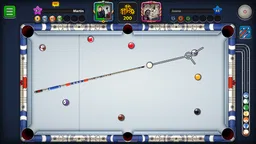
Pool is a natural fit for a touchscreen because the central task is easy to grasp: choose a direction, judge the shot, and take your turn. You do not need a long tutorial to understand the goal, but good play still asks for patience. A shot that looks obvious may leave the next ball awkwardly positioned, so I find that thinking one turn ahead matters more than tapping quickly.
The multiplayer focus is the main difference between this and a simple digital pool table. A match against another person gives each decision consequence: a missed shot can hand over an opening, while a careful safety-minded choice can make the next turn harder for your opponent. That back-and-forth creates tension that a solitary practice session cannot provide. It also means that the experience depends on whether you want competition, not just a relaxed way to pass a minute.
Compared with offline billiards games, this is better suited to someone who wants opponents and a reason to improve under pressure. A solo pool app is a better fit if you want to experiment with shots at your own pace or play without depending on another person being available. Compared with other quick competitive mobile games, pool is less about frantic reactions and more about spatial judgement. That makes it calmer than many action games, but not necessarily less intense when a match is close.
Small decisions that improve a match
One useful habit is to stop treating every turn as a chance to pocket the nearest ball. Before aiming, look at the next likely shot and ask whether the cue ball will have a workable position afterward. Even a successful pot can be a poor choice if it leaves the next ball blocked or forces a difficult angle. Thinking about position turns the game from a sequence of taps into a simple plan.
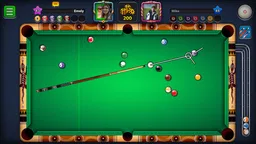
I also recommend using a moment before each shot to check the full table, not just the ball you intend to hit. Notice which balls are clustered and which paths might open after contact. This is especially helpful when a shot could either solve a problem or make it worse. A little restraint often pays off more than attempting a spectacular shot with no clear follow-up.
For a quick everyday session, I would play when I have enough time to finish a match rather than opening the game during a moment that may be interrupted. Online play is inherently less convenient if you need to put the phone down mid-turn. On a commute with an unpredictable stop, for instance, a pause-friendly offline game may be a better choice. At home during a short break, a match can be a satisfying change of pace.
Another practical trade-off is that a competitive game can feel different depending on your mood. When I want to focus, trying to read angles and anticipate the opponent keeps me engaged. When I am tired and only want something mindless, that same need to pay attention can make a match feel like work. It helps to treat the game as a small contest rather than background entertainment.
Where the experience can frustrate
The strongest feature—playing against other people—is also a limitation. You cannot shape every match around your preferred pace, and an opponent may make the game feel more demanding than a casual solo session. If what you want is a quiet table to practice without pressure, an offline pool game is likely the more comfortable alternative.
There is also a learning curve hidden inside the simple controls. Knowing where to aim is only part of making a good shot; judging how the cue ball will finish takes practice. Early matches can expose that gap, particularly if you expect the game to reward instinct alone. I would give yourself time to learn the feel of aiming rather than decide after one poor turn that the game is unfair or too difficult.
Competition can make losses feel personal, even though a missed shot is just part of learning. I find it healthier to focus on one improvement at a time—such as planning the cue-ball position—rather than treating each match as a test of whether I am good at pool. If you tend to get annoyed by close losses or prefer games with predictable outcomes, the multiplayer format may not be relaxing for you.
The purchase range is another reason to set expectations early. Free access is a genuine way to try the game, but optional purchases mean that someone who is sensitive to spending prompts may prefer a one-time paid game with a simpler cost model. I would not buy anything simply because a match went badly; first work out whether the game itself is something you want to keep playing.
Who is likely to get the most from it
I would recommend it to people who enjoy billiards, like short head-to-head contests, and are willing to learn through mistakes. It is particularly suitable if you want a familiar sport translated into quick mobile sessions and enjoy the added uncertainty of facing another player. The large audience may make the game feel established, but the more important question is whether you like competitive pool on a touchscreen.
It can also work for friends who want a simple shared activity. The idea of challenging someone to a pool match is easy to understand, so it takes little explanation. Just remember that a game with another person asks both players to be available and attentive; it is not as flexible as a single-player puzzle that you can abandon at any moment.
I would steer away from it if you want a completely offline experience, dislike competitive play, or need a game that never presents optional spending. Likewise, someone looking for a full simulation of playing pool in person may find a mobile match too simplified or constrained by the screen. A dedicated billiards table—or a slower, practice-focused game—would better serve those expectations.
My verdict on its value
For me, the value is in getting a recognisable pool match without paying to begin. The game makes sense as a free try for anyone curious about mobile billiards, and its online competition gives each session a purpose beyond simply clearing balls. I would start with the free experience, learn whether the aiming and opponent-driven pace suit me, and leave purchases alone unless I had a clear reason to spend.
The trade-off is that free access does not make the game ideal for every player. Online competition brings pressure, the controls reward practice, and in-app purchases may be unwelcome if you prefer a straightforward paid game. My recommendation is therefore specific: try it if you want social, turn-based pool and can enjoy improving gradually; skip it in favour of an offline alternative if you want quiet practice, guaranteed flexibility, or no purchase prompts. With those expectations, 8 Ball Pool is an easy game to sample and a worthwhile choice for the right kind of casual competitor.
What we like
- Quick matches make it easy to play during a short break.
- Practice tables help beginners learn aiming and spin.
- Online play offers opponents from around the world.
- Clubs give players a way to compete with friends.
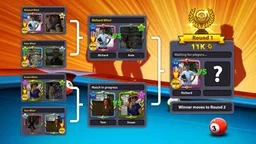
- Regular events add variety beyond standard matches.
What could be better
- Internet access is needed for most matches.
- Higher-stakes games can cost many coins to enter.
- Cue upgrades may encourage frequent spending.
- Random matchmaking can pair players with much more experience.
- Ads and promotional offers can interrupt the experience.







