


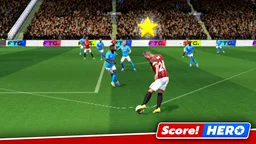

Score! Hero review
 Analysis by Appsdrops
I like football games that let me make the decisive pass or shot without asking me to manage an entire club, and Score! Hero is built around exactly that appeal. It is a free sports game from First Touch Games Ltd. in which you guide a player through match situations by choosing how a move unfolds. That makes it easy to understand at a glance, though the precision involved can be less comfortable than the simple premise suggests.
Following the action on a small screen
The central idea is refreshingly direct: read the scene, decide where the ball should go, and try to turn the chance into a goal. I found that focus helpful when I wanted a short football session rather than the wider responsibilities found in team-management games. You are not spending your time arranging a squad or watching long stretches of play; attention stays on the next attacking decision.
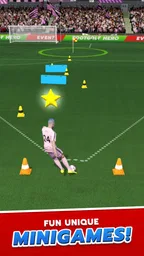
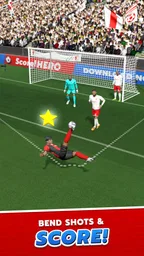
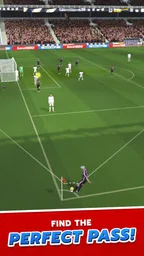
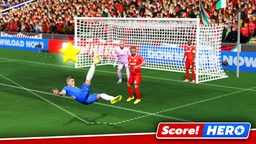
The visual action gives you a useful starting point for understanding each situation. You can look at where players are positioned and consider a route through the defense before committing to a move. The game’s appeal depends on that moment of interpretation: a promising line may open a passing lane, while a more ambitious choice can make the attempt harder to complete. For players who enjoy solving a small tactical puzzle, that is more engaging than simply tapping a shot button.
Navigation and readability matter particularly in a game where the important information is presented during play. I would approach each scene by pausing long enough to scan the position of teammates and opponents rather than rushing at the first apparent opening. That simple habit makes the action easier to follow and helps separate a deliberate decision from a guess. If you are new to this style, it is worth treating early attempts as practice in reading the screen, not just as tests of reflexes.
Its reception suggests that the format has broad appeal: the game has a 4.5 average from around 8 million ratings and more than 100 million installs. Those figures do not tell me whether it will suit every player, but they do put it among the widely played mobile football options. It was released in 2015, and version 4.740 is the current version. The rating is Everyone, a useful point for households considering a sports game for younger players, while individual comfort with touch controls will still vary.
What the controls ask of you
The key motor challenge is aiming accurately. Choosing a route or attempting a shot involves more deliberate touch input than a game built around broad, forgiving taps. I found that this creates a satisfying sense of authorship when a move works: the result feels connected to the line I chose, rather than to an automatic animation. The trade-off is that small slips in a gesture can matter, especially when the scene is crowded or the intended path is narrow.
That makes the game a better fit for someone who can comfortably make controlled touches on a phone or tablet. Players with tremor, limited fine motor control, or difficulty sustaining precise gestures may find repeated attempts tiring. I would not assume that a simple interface means low physical demand; the screen may be uncluttered while the input itself still asks for accuracy. A larger device could make the scene easier to inspect, though it does not remove the need for controlled input.
There is also a useful distinction between reaction speed and considered play. The game’s central pleasure comes from choosing a move, so it can suit people who prefer to think through a moment rather than continuously react to a fast, full-field match. But that does not make it universally low-pressure: if a player feels stressed by failed attempts or by having to repeat a challenge, the puzzle-like structure may become frustrating rather than relaxing.
Sensory comfort is similarly personal. Football imagery and changing on-screen action are part of the experience, and the player needs to keep track of the ball and the developing play. Anyone sensitive to busy visual scenes should try a short session first and see whether the movement and screen presentation feel comfortable. I would also recommend playing in a setting where the display is easy to see; trying to judge a passing route in glare or while distracted works against the game’s core skill.
Making it work in everyday moments
One practical use case is a brief break between errands or during a commute when you are seated and have a few minutes to focus. A single attacking situation is easier to fit into a spare moment than a full match simulation, and the game gives football fans a way to engage with decisions rather than simply watching highlights. I would save it for moments when I can look at the screen properly, however. Walking, crossing a street, or splitting attention between the game and another task makes accurate choices needlessly difficult.
For a first session, I suggest resisting the urge to draw the most dramatic route. Look for the straightforward pass that keeps a teammate involved, then use the next moment to judge whether a shot is genuinely open. This is a practical way to learn how the game responds to your choices without turning every situation into a high-risk attempt. When a line fails, inspect what the defense was covering and adjust; repeating the same gesture without reconsidering the scene is unlikely to teach much.
Another helpful approach is to use the game as a low-stakes way to practise visual planning. Before touching the screen, identify the nearest defender, the teammate with the clearest route, and where a shot might become possible. That three-part scan can make the screen feel less overwhelming and gives players who need extra time a repeatable routine. It is not an accessibility setting, but it is a player-controlled strategy that can make decision-making more orderly.
Compared with conventional mobile football games that emphasize direct control over a full team, this one concentrates on authored attacking moments. That focus is its strongest distinction and its main limitation. If you want to move players around continuously, defend across the pitch, or manage a team in depth, another football game built around those activities will be a better match. If you mainly want to decide how a chance develops, this tighter format avoids much of that overhead.
Where the experience may fall short
The same precision that makes a successful move rewarding can create friction. A player who expects an easy, automatic goal after choosing a plausible direction may be disappointed; the scene asks you to read what is happening and execute the idea. Repeatedly missing a route can feel like a test of touch accuracy as much as football judgment. I would be cautious about recommending it to someone who wants a consistently forgiving game or who dislikes retrying a challenge.
There is also an important difference between being free to start and having no spending decisions. The game is free, but it includes in-app purchases priced from $0.99 to $59.99 per item. That range is worth keeping in mind if you are setting spending limits, particularly for a child. The age rating is Everyone, but that does not replace a conversation about purchases or the use of device-level spending controls where appropriate.
Before installing, check that your device runs Android 7.0 or later if you are using Android. Beyond that basic compatibility check, I would consider the physical setup: a clean screen, a comfortable grip, and enough quiet attention to inspect each scene are more useful than playing at top speed. If those conditions are hard to arrange, a football game with simpler one-touch actions may be a more comfortable choice.
For players with low vision, the most relevant question is whether the on-screen players and ball are easy enough to distinguish on their own device. I would test a short session rather than assume that the game’s focused layout guarantees comfortable viewing. Similarly, someone who relies on audio cues should not choose it on the assumption that sound alone will communicate the state of play; the central decisions are visual. These are practical fit questions, not claims about formal accessibility support.
A thoughtful football option, with clear limits
I would recommend Score! Hero to football fans who enjoy planning an attack, making precise touch decisions, and fitting a focused game into short stretches of free time. Its structure can be easier to approach than managing an entire side, and its emphasis on individual moments gives each choice a clear purpose. The game is especially appealing if you like learning from a missed pass and trying a more considered route next time.
I would skip it, or at least try it cautiously, if fine touch control is difficult, visual action is uncomfortable, or you want a broad simulation of every part of football. It is also not my first choice for distracted play: the game rewards attention to positioning, and a rushed gesture can spoil a good idea. A slower, more forgiving title may be preferable for players who need larger margins for error or more time to inspect a scene.
For me, the best way to judge the fit is to play a few situations with deliberate pauses between decisions. If tracing a route and seeing an attack come together feels satisfying, this is a distinctive sports game to keep around. If the aiming feels like work rather than part of the fun, its focused design will not overcome that barrier. That honest divide is what makes the recommendation useful: it offers a clear kind of football play, but it asks you to be comfortable with the way that play is controlled.
What we like
- Swipe controls make shots and passes easy to direct.
- Short levels suit quick play sessions.
- Replay options help you improve your performance.
- Star ratings give each level a clear goal.
- The story adds context to the football challenges.
What could be better
- Energy limits can interrupt longer play sessions.
- Some levels require precise timing to earn all stars.
- Progress may feel slow without in-app purchases.
- The game focuses on individual moments rather than full matches.
- A network connection may be needed for some features.







