
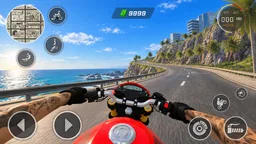
Moto Wheelie: Traffic Bike 3D review
 Analysis by Appsdrops
I went into Moto Wheelie: Traffic Bike 3D expecting a straightforward motorcycle game, and that is the right way to approach it. Its appeal is the feel of balancing a bike and attempting wheelies, rather than the broader progression or varied race formats I would look for in a full-scale racing game. When I want a brief hands-on challenge, that focus makes sense; when I want a long, structured career, it may not.
It is a free racing game from KangBang Games, with an Everyone age rating. The 4.8 average from around 23,000 ratings and over 10 million installs suggest that the simple bike-riding premise has found a substantial audience. I would treat those figures as context, though, not a guarantee that its handling will suit every player. The main question is whether controlling a wheelie-focused ride sounds fun to you.
What the speed feels like—and what it asks of you
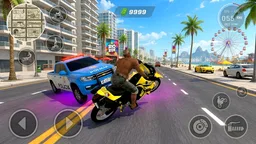
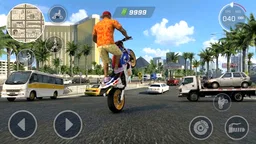
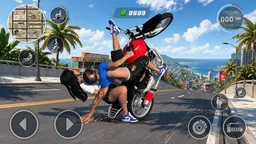
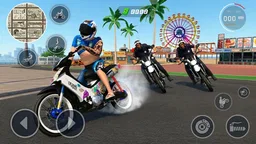
The game’s speed is best judged by how carefully you manage a ride, not by expecting a conventional race against a field of rivals. The central attraction is performing wheelie tricks in a bike-driving simulation, so the satisfying moments come from keeping the motorcycle under control while trying to hold the front wheel up. That makes the experience feel more deliberate than a racer where the only goal is to go flat out.
In practice, I’d approach each attempt as a small control exercise: make a measured input, watch how the bike responds, and resist the urge to overcorrect. Wheelies are inherently about balance, so a little patience is more useful than treating every run as a sprint. If you’re new to this style of game, give yourself a few attempts to understand the response before deciding that the handling is too sensitive or too slow.
The word “realistic” in the game’s premise points toward a simulation-minded feel, but it shouldn’t be taken as a promise of a detailed real-world riding course. This is still a mobile game built around a clear, playful stunt idea. If you prefer the immediate spectacle of arcade racers, the measured control may feel less exciting at first. If you enjoy learning a small skill and repeating it until it feels natural, that same restraint can be the draw.
A useful way to decide whether the pace works for you is to think about what you want from a racing game. For a quick diversion centred on one distinctive riding challenge, this is a more specific pick than a generic traffic racer. For varied tracks, a wide selection of race objectives, or an elaborate career structure, I’d look elsewhere rather than assume those elements are part of this experience.
Making short sessions count
This is the kind of game I’d reach for during a short break when I want to focus on one clear task instead of committing to a long event. A practical routine is to make a few attempts with the same approach, changing only one part of your timing or input at a time. That makes it easier to tell whether a run improved because of better control, rather than because you changed several things at once.
That approach also helps if the first few tries feel awkward. A wheelie challenge can be unforgiving when you rush, and repeatedly making the same hurried correction is unlikely to teach you much. I’d pause briefly after an unstable attempt, consider what happened, then try a smaller adjustment. It is a simple habit, but it turns retries into practice instead of a string of frustrating restarts.
For a casual player, the focused premise is a benefit: you don’t need to learn a complicated racing format before you can engage with the core idea. The trade-off is that anyone who needs constant novelty may find the central challenge repetitive. I’d recommend it most to people who enjoy refining a specific bit of handling, not to someone who measures a racing game by how many different modes it offers.
When repeated play puts the handling to the test
The most demanding moments are likely to be the ones where you’re trying to keep a wheelie controlled rather than simply getting the bike moving. During a longer string of attempts, small errors can become irritating if you keep pushing for a better run without changing your approach. I’d use short practice bursts and reset my attention between them; that is often more productive than playing on autopilot.
For younger players or anyone sharing a device, the Everyone rating makes the game broadly approachable in terms of its age classification. That doesn’t mean every player will enjoy the same control challenge. A child who likes bikes and repeated experimentation may be a better fit than someone who expects a guided story or a set of easy wins. I’d let the person trying it spend a little time with the handling before judging whether it suits them.
It is also worth separating difficulty from reliability. If a ride goes wrong, that may simply be part of trying to balance a stunt, rather than a sign that the game has failed. I can’t promise how every individual session will feel on every device, so I’d avoid interpreting one frustrating attempt as evidence of a technical problem. First try a calmer input and a fresh run; if trouble persists outside the gameplay itself, restarting the app is a sensible basic step.
Stability, recovery, and realistic expectations
For this kind of game, stability has two meanings: whether the bike feels manageable and whether the app behaves consistently. The first is directly tied to the challenge—an attempt can become unstable when your control is too abrupt. The second depends on the particular device and session, so I wouldn’t claim that performance is identical across all phones or tablets. Keeping the game updated is a reasonable habit, and the current version is 1.1.6.
When a run goes badly, the most useful recovery is often to start the next attempt with a different rhythm rather than immediately repeating the same input. Think of it as resetting your technique: take a moment, use a lighter touch, and pay attention to the bike’s response. That’s more actionable than trying to force a wheelie through a sequence that already feels out of control.
The game’s focused concept should also make your expectations clearer. You are downloading it for a motorcycle-and-wheelie experience, not because it promises to replace every other kind of racer on your phone. That distinction matters if you’re deciding whether to keep it alongside a more traditional racing game: it can serve as a different kind of quick challenge, while the other title handles structured competition or variety.
Device fit and the trade-offs of a focused game
The minimum operating system requirement is Android 7.0, so it is intended to support a range of Android devices that meet that baseline. Meeting a minimum requirement does not tell me exactly how smoothly it will run on a particular phone, especially if the device is older or already under heavy load. If you notice sluggishness, close other demanding apps and try again before deciding the game itself is the cause.
Because the central appeal depends on responding to the bike, a screen that feels comfortable to hold and interact with is more important than chasing the newest hardware. I’d try it in a relaxed setting first, where you can concentrate on the controls, rather than during a crowded commute or any moment when attention needs to be elsewhere. A quick game can still demand focus when a stunt depends on timing.
There is a wider trade-off here: a tightly defined idea can be easier to enjoy in small doses, but it can also limit how much a player wants to return once the novelty wears off. I’d choose this over a broad racer if I specifically wanted to practise wheelie-style control. I’d choose a more varied alternative if I wanted different race types, a stronger sense of progression, or a change of scenery from one session to the next.
Since it is free, trying it is an easy way to find out whether that particular handling loop clicks for you. Free does not automatically mean frictionless, however, and I wouldn’t assume anything about purchases or connectivity beyond what is established here. I’d install it because the core bike challenge appeals to me, not on the assumption that every extra convenience or progression feature will be present.
Who should pick it up—and who should pass
I’d recommend Moto Wheelie: Traffic Bike 3D to someone who likes motorbikes, stunt attempts, and getting a little better through repetition. It can also suit a casual player looking for a distinct alternative to standard lap racing, especially when there is only time for a handful of attempts. The game’s 10M-plus installs show that it has reached a broad audience, but personal preference still matters more than popularity.
I’d skip it if your main priority is a deep racing campaign, a large choice of event types, or a relaxed game that asks almost nothing of your timing. Its identity is narrow by design, and that focus is exactly what some players will appreciate and others will tire of. If you’re unsure, compare your usual favourites: do you enjoy practising one manoeuvre, or do you need a steady supply of new objectives? Your answer is a better guide than the rating alone.
The game was released on June 4, 2026, and the combination of a specific stunt focus with a high average rating has helped it stand out to players looking for this kind of ride. I wouldn’t read that as proof that it is the best choice for every racing fan. It is a better match for someone who wants to work on wheelie control than for someone seeking the broadest or most realistic motorcycle package available.
My performance verdict
My overall impression is that this is a focused mobile racing game whose enjoyment depends on whether its wheelie challenge feels rewarding to you. The perceived speed matters less than how well you can keep the ride composed; the most useful improvement is usually a more considered input, not simply trying harder. Short sessions, deliberate practice, and a comfortable device are the sensible way to get a fair feel for it.
KangBang Games has built the experience around a recognisable motorcycle stunt idea rather than a promise of endless racing variety. That gives it a clear use case: pick it up when you want to practise a bike-control challenge, and switch to another racer when you want a fuller set of events. If that sounds like the balance you’re after, I think it’s worth trying. If you want speed without the need to manage a wheelie, this is probably not the right ride for you.
What we like
- Responsive steering makes weaving through traffic satisfying.
- Short sessions suit quick play breaks.
- A range of bikes gives players clear unlock goals.
- Three-dimensional traffic adds a sense of speed.
- Simple controls are easy for newcomers to learn.
What could be better
- Frequent crashes can make progress feel repetitive.
- Traffic patterns may become predictable over time.
- Some bikes may require considerable grinding to unlock.
- Small screens can make distant vehicles harder to judge.
- The experience may feel limited for players seeking a story.







