

Hill Climb Racing 2 review
 Analysis by Appsdrops
I like racing games that make a mistake entertaining rather than instantly ending a run, and that is the central appeal I find in Hill Climb Racing 2. Its focus on driving over uneven ground turns each race into a small exercise in timing: keep the vehicle moving, manage its tilt, and avoid letting a bump or jump turn into a tumble. It is a free racing game from Fingersoft, and its huge audience—over 100 million installs and roughly 4.7 million ratings—makes sense once you feel how quickly a short race can become a personal challenge.
Why the uneven tracks make every race a balancing act
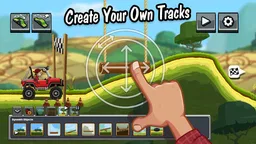
This is not the sort of racer where I simply hold acceleration and look for the cleanest line through a smooth circuit. The terrain is part of the opponent. Rises and dips can lift the vehicle, and the way I handle the landing matters as much as the speed I carried into the jump. That gives the game a physical, slightly comic quality: a run can look controlled one moment and become a scramble to recover the next.
The key skill is restraint. On a steep section, pressing hard may help me climb, but it can also leave the vehicle badly pitched when the ground drops away. In the air, I pay attention to the vehicle’s angle rather than treating a jump as free distance. A quick adjustment can make a landing feel deliberate; a late correction can leave me bouncing awkwardly and losing momentum.
The best part of the driving is that speed and control are competing priorities. I am rarely asking only, “How fast can I go?” I am also asking whether this particular slope is safe to attack, whether I should ease off before a crest, and whether I can recover if the landing is poor. That makes the races readable without making them automatic.
Learning to read a hill instead of fighting it
At first, the easiest response to a difficult stretch is to keep pushing and hope the vehicle sorts itself out. I found that approach unreliable. A more useful habit is to look a little ahead: notice the next rise, anticipate when the vehicle will leave the ground, and avoid carrying a wild angle into the landing. Even small changes in timing can make a run feel less chaotic.
This is also why repeating a race does not feel exactly like repeating a flat course. I can recognize a troublesome section and experiment with a different approach, but I still have to react to the vehicle’s movement. The challenge is not a complicated set of controls; it is learning what the controls do when the ground changes beneath me.
For a practical tip, I try not to use every jump as an invitation to accelerate harder. A controlled landing often matters more than squeezing out a little extra speed in the air. When I am repeatedly losing control at the same kind of crest, easing up before it is more useful than blaming the vehicle or making frantic corrections after takeoff.
How that focus feels in multiplayer
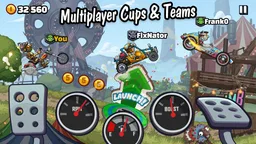
The game presents itself as an online multiplayer racer, and that framing gives the hill-driving skill a competitive purpose. Instead of treating each run as a solitary attempt to master a course, I can think about how cleanly I handle the terrain compared with other drivers. The same small decisions—when to push, when to steady the vehicle—become a way to gain an edge rather than merely a way to avoid a crash.
I appreciate that this kind of competition is easy to understand even if I am not a devoted racing-game player. I do not need to memorize complex racing lines to see why one run went better than another. A smoother landing, fewer awkward recoveries, or better judgment on a steep section are visible improvements. That makes the multiplayer premise approachable, though players looking for realistic motorsport simulation should not mistake the game’s playful hill racing for that experience.
The online angle is best for someone who enjoys a little pressure but still wants the moment-to-moment driving to stay light. If I want a purely calm solo experience, the competitive framing may be less appealing. If I want a serious simulation with detailed racecraft and a strong emphasis on realistic circuits, a conventional track racer is likely a better fit.
A useful way to spend a short break
My most natural use case is a brief pause in the day: I can play a race, notice one mistake, and try again with a specific adjustment in mind. For example, if I have a few minutes before leaving home, I can focus on keeping the vehicle steadier over a sequence of slopes rather than committing to a long session. That compact loop—attempt, learn, retry—suits the game’s central skill particularly well.
It is also a good choice for passing a short wait when I want interaction rather than a passive distraction. The terrain gives me something immediate to react to, and the possibility of losing control keeps a run from feeling like a button-holding exercise. I would be less likely to choose it when I want a deep narrative, a realistic racing career, or a peaceful game that asks very little attention; the need to watch the vehicle’s balance is part of the appeal, but it is still a demand on focus.
For younger players, the age rating is Everyone, which makes the broad, accessible racing premise easy to recommend to a family looking for a simple game to try. I would still talk through purchases with a child: the game is free to download, but optional in-app purchases range from $0.09 to $200 per item. That spread is worth keeping in mind on a shared device, even if a player can begin without paying.
Progress is more satisfying when I treat upgrades as support
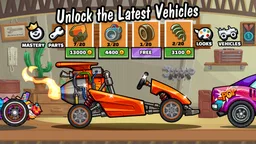
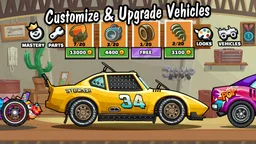
Vehicle upgrades are part of the game’s appeal, but I think it helps to treat them as a way to support better driving rather than a replacement for it. If I am struggling to handle a hill, I first pay attention to how I approach it. Better timing and a more controlled angle are skills I can carry into later runs; simply expecting an upgrade to erase every mistake is likely to be frustrating.
That distinction matters because it gives the game two kinds of satisfaction. There is the gradual feeling of improving a vehicle, and there is the more immediate pleasure of handling a tricky stretch more cleanly than before. I find the latter more rewarding when the goal is to get better at racing, while upgrades give me another reason to keep playing. The tradeoff is that players who dislike progression tied to vehicle improvement may prefer a racer where every car feels equally capable from the start.
As with any free game that offers in-app purchases, I would set expectations before starting: spending is optional, but the option is there. The listed purchase range reaches $200 per item, so anyone sharing a phone or tablet should use the device’s purchase controls thoughtfully. That is practical advice, not a reason to avoid the game outright; it simply helps keep a casual session within the limits a family intends.
What it offers beside a typical racing game
Compared with a standard circuit racer, this game puts less emphasis on following a smooth racing line and more on responding to the shape of the ground. That makes it feel approachable in a different way: I can understand a mistake immediately because the vehicle’s movement shows me what went wrong. The tradeoff is that someone who wants precise cornering, realistic car handling, or the atmosphere of a formal motorsport event may find the hill-climb focus too playful.
Against other casual racers, its particular strength is the balance challenge. The hills give me a reason to manage the vehicle even when I am not navigating a complex track. I would choose it over a simple straight-line racer when I want more hands-on reactions, but I would choose a gentler arcade game if I wanted something that can be played almost without looking at the screen. Here, a careless moment can turn into a clumsy landing, and that is both the joke and the source of tension.
The audience response is strong: the game has a 4.5 average rating and about 148,000 written reviews. I see those figures as a sign of broad appeal, not a guarantee that every racing fan will enjoy it. Its particular rhythm—push, balance, recover—will click most with players who like improving through repeated attempts and can laugh when a run goes sideways.
Who should give it a try—and who might pass
I would recommend it to someone who wants quick races with a clear skill to practice, especially if they enjoy games where small control choices have noticeable results. It suits casual players who want a few minutes of action, as well as competitive players who like the idea of testing their handling against others. The current version is 1.76.1, and the stated minimum operating-system requirement is 7.0, so it is worth checking device compatibility before installing.
I would steer away from it if your ideal racer is built around licensed-looking realism, long strategic events, or perfectly smooth handling. I would also hesitate to recommend it to someone who gets annoyed by retrying a section to learn its rhythm. This game asks for that patience: a better run often comes from noticing one poor landing or one overenthusiastic burst of acceleration, then changing the next attempt.
Overall, Hill Climb Racing 2 works best when I approach it as a playful test of balance rather than a conventional car simulator. Fingersoft has built the experience around a simple, memorable challenge: keep control while the road refuses to stay level. If that sounds fun, the free entry point makes it easy to see whether the hill-racing rhythm suits you. My advice is to focus on steady landings first, save the hard pushes for ground you can manage, and enjoy the occasional ridiculous recovery along the way.
What we like
- Races load quickly and are easy to restart.
- Vehicle upgrades give players a steady sense of progress.
- The 2D tracks make jumps and hazards easy to read.
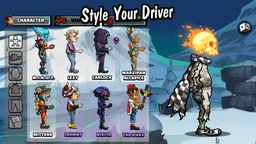
- Custom outfits add personality without changing race controls.
- Offline play is available for many solo activities.
What could be better
- Frequent ads can interrupt the flow between races.
- Some upgrades take substantial time to unlock.
- Vehicle physics can feel unpredictable on rough terrain.
- Online events may depend on a stable connection.
- In-app purchases can speed up progress for paying players.







