






Hidden Folks: Scavenger Hunt review
 Analysis by Appsdrops
When I want a game that rewards looking closely rather than reacting quickly, Hidden Folks: Scavenger Hunt is the sort of board game I reach for. Its appeal is simple to explain but surprisingly easy to underestimate: you search busy scenes for requested objects, then use what you find to make progress through a light mystery. I find it best when I have a few quiet minutes and feel like paying attention, not when I want a demanding puzzle or a fast burst of action.
That distinction matters when choosing among mobile games. Hidden-object searches can be soothing, but they can also become frustrating if targets blend into the scenery or clues leave you guessing. Here, the pleasure comes from scanning a scene methodically and noticing details you initially overlooked. The central question is whether that gentle, visual kind of concentration sounds enjoyable to you.
What the search asks of you
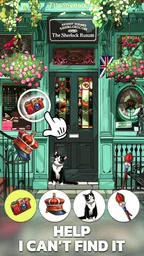
The game is a free board title from LifePulse Puzzle Game Studio. Its basic routine is to inspect a scene, look for particular things, and use your discoveries to help solve a mystery. That makes it closer to a visual scavenger hunt than to a traditional board game built around turns, a board state, or direct competition. If you enjoy searching illustrations for tiny details, the premise is immediately understandable.
I would not approach it as a test of speed. The useful skill is changing how you look: instead of sweeping the whole image again and again, divide it into sections, check unusual shapes and crowded areas, then move on. That small habit makes a hunt feel more deliberate and helps prevent the familiar experience of staring at one part of a picture until everything seems to blur together.
The mystery gives the search a reason to continue beyond simply spotting objects. That is a welcome framing device if a bare list of targets feels repetitive to you, though the game’s core pleasure still depends on whether you like visual observation. Someone who wants a deep narrative first and puzzles second may find the balance too light; someone who likes a story-shaped reason to keep searching may find it a comfortable fit.
How to tell if its pace suits you
Think about what you want from a short play session. If your ideal break is a calm activity that can hold your attention without demanding quick reactions, this is a sensible candidate. I can imagine opening it while waiting for an appointment or winding down at home, completing a search at my own pace rather than needing a long, uninterrupted stretch.
It is less suited to moments when you are distracted or in a hurry. Searching works best when you can give the image a little attention, and repeatedly glancing away can make it harder to remember which areas you have already checked. For a commute or a noisy waiting room, the game may still be playable, but I would choose it only if I had enough focus to enjoy looking carefully rather than tapping at random.
There is also a useful difference between relaxing and effortless. A calm visual puzzle can still be demanding when an object is easy to miss. If you usually enjoy finding hidden details in illustrations, that challenge is part of the appeal. If you tend to dislike scanning large pictures or feel annoyed when a target does not jump out, a more direct logic puzzle may be a better match.
Where this scavenger hunt earns its place
For me, the strongest reason to try it is that the goal is clear without requiring a long tutorial: inspect the scene, find what is being sought, and follow the mystery forward. That makes it approachable for casual players and for people who do not usually choose complex strategy games. The board-game label describes its broad store category, but the moment-to-moment experience is more about observation than planning moves against an opponent.
It also offers a different kind of break from the usual match-three or word-game routine. Those formats often ask you to combine pieces, form answers, or chase a score. This one asks you to slow down and read an image. That contrast is its main advantage, especially if you already have several games that rely on matching or quick rounds and want something that exercises attention in another way.
A practical tip is to search with a repeatable route. I would start at one corner, work across a row, and then move down rather than bouncing between distant parts of the picture. If I get stuck, I would pause and look for the target’s defining shape or color instead of staring harder at the whole scene. This is not a hidden mechanic; it is a simple way to make the game’s visual task more manageable and less tiring.
Another useful approach is to treat a missed item as a cue to change perspective. After checking the obvious objects, I would look at overlaps, edges, and small details that are easy to dismiss as background. The value of this habit is broader than completing a hunt: it helps distinguish an object that is genuinely hard to see from one that I have simply not searched for systematically. That makes play feel less like random tapping.
The title has drawn a sizeable audience: it has over ten million installs, with an average rating of 4.9 from around 209 thousand ratings. Those figures are encouraging context, not a guarantee that every player will enjoy the same pace. I would still choose based on whether picture-based searching sounds satisfying to me, rather than treating popularity as proof that it will suit every taste.
When another kind of game is the better choice
If you want head-to-head competition, a traditional board game with turns and tactical decisions will likely fit better. This experience is centered on finding objects, not outmaneuvering another player. Likewise, players looking for rapid action, precise timing, or a high-pressure challenge should consider an arcade or reflex-based alternative; a careful search is intentionally a different mood.
Compared with hidden-object games that emphasize elaborate scenes and a long sequence of clues, this title’s appeal is more straightforward: look carefully and make discoveries that contribute to a mystery. That can be a strength when you want a low-friction activity. It may be a weakness if you need a strong plot, a complex chain of deductions, or a constant stream of new systems to stay interested.
It is also not the obvious pick for someone who prefers puzzles with a single clean answer reached through logic alone. In a visual hunt, progress can depend on noticing a small detail in a crowded image. If you find that kind of search arbitrary rather than satisfying, a number puzzle or a word game may offer a more predictable sense of reasoning. The right alternative depends on what you want to exercise: visual attention here, or deduction and language elsewhere.
For younger players, the Everyone age rating makes the game broadly suitable by its content classification. I would still consider the child’s patience and comfort with searching images: a gentle rating does not mean every child will enjoy the same kind of concentration. It can work as a shared activity if an adult joins in and you take turns suggesting where to look, but it is just as reasonable to pass if the child wants faster feedback.
Trying it without overcommitting
Because the game is free, trying it does not require paying upfront. That makes it easy to test whether the search style clicks before deciding whether it deserves a place on your device. I would give it a brief, focused session rather than judging it after a distracted minute: the core activity is looking, and it is difficult to evaluate that fairly while barely attending to the scene.
The current version is 1.3.4, and the listed minimum operating system is Android 7.0. If you are considering it on an older Android device, checking your system version before installing is a practical first step. The game was released on December 15, 2023, and its developer is LifePulse Puzzle Game Studio; those details help identify the specific title when you are browsing a crowded app store.
There is little to learn in terms of a complicated control scheme, but there is a small adjustment in expectations: success is not about tapping quickly or guessing what the game wants. Give each search a route, pause when your eyes stop registering details, and return with a fresh look. This is a better workflow than repeatedly scanning the entire scene at random, especially during a longer session.
One trade-off is that visual searching can become mentally tiring before it feels difficult in a conventional puzzle sense. If your eyes are tired after reading or working, even a relaxing hunt may not feel restful. I would keep sessions short when that happens, or switch to an audio-led or word-based game. Choosing the right moment is part of getting the gentle experience this kind of game can offer.
Another point to consider is replay value. A search game’s satisfaction depends on encountering targets you have not already found and on caring about the next discovery. If you enjoy that gradual rhythm, the mystery can keep the activity coherent. If you mainly value open-ended play, competition, or a score to beat, you may find the format less compelling than a board game with repeatable strategic decisions.
Who I would recommend it to
I would recommend Hidden Folks: Scavenger Hunt to anyone who likes visual puzzles, patient observation, and a low-pressure way to occupy a short break. It is also a reasonable choice for casual players who want something different from matching tiles or answering trivia, and for people who enjoy turning a picture into a little search plan. The large player community and strong average rating suggest broad appeal, while the actual deciding factor remains personal: do you like looking closely?
I would steer away from it if you want multiplayer rivalry, fast feedback, or puzzles where every step follows a clearly stated chain of logic. It may also be a poor fit if you find crowded scenes frustrating or want a story with more weight than a search-based mystery can provide. In those cases, choosing a strategy board game, a brisk arcade title, or a more deduction-focused puzzle is not a compromise; it is simply a better match for your preferred kind of play.
My overall view is positive, with a clear caveat: this is a game for people who enjoy the search itself. I like its focused premise and the way it turns a quiet moment into a small exercise in attention, but I would not recommend it as a universal puzzle pick. If you are curious, try it when you can give the images your attention, search methodically, and see whether finding the overlooked detail feels rewarding. If it does, the game has earned its spot; if not, you will know quickly that another puzzle style suits you better.
What we like
- Hand-drawn scenes reward careful observation.
- Distinctive sound effects make discoveries satisfying.
- Hints help when a target is difficult to find.
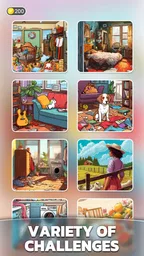
- Large scenes offer plenty of objects to uncover.
- Works well for short relaxed play sessions.
What could be better
- Small targets can be hard to spot on phone screens.
- Searching the same scene can become repetitive.
- Some objects blend into busy backgrounds.
- Progress may feel slow without using hints.
- The game is less suited to players seeking fast action.







