







Farkle Dice Roll review
 Analysis by Appsdrops
My first impression of Farkle Dice Roll is that its appeal rests on a familiar, satisfying decision: roll again for a better result, or stop and keep what I have. That tension makes it easy to understand without making every turn feel automatic. It is a board game from FunCraft Games, built around dice, strategy, and luck rather than a long tutorial or a complicated set of rules. I can see it working well for a short break when I want a game that asks for attention but not a major time commitment.
The basic attraction is the push and pull between caution and ambition. A roll can make me feel ready to bank my progress, while the possibility of improving it tempts me to take another chance. That small choice is the heart of the experience: the game gives each turn a clear purpose, then asks me to decide how much risk I am willing to accept. If you enjoy dice games where decisions matter even when chance is involved, this is a more engaging prospect than simply tapping through a sequence of rolls.
One roll, then a decision
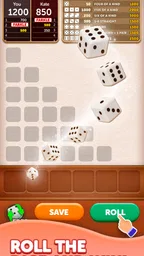
The first action is refreshingly direct: roll the dice, look at the result, and decide what to do with the opportunity in front of you. The rules are approachable enough that I don’t need to arrive as a dedicated board-game player. At the same time, the choice to press on or settle makes the turn feel like mine, not just a random outcome being played out on screen.
That makes the game easy to pick up in everyday situations. I might open it while waiting for a friend or during a quiet moment between tasks, take a turn, and put it down without needing to remember a complicated story or a chain of objectives. It also suits a casual game night: the basic idea is simple to explain, and the suspense comes from watching someone decide whether a promising turn is worth risking.
What I like about this format is that a good result does not automatically tell me what to do. A conservative player can value securing a respectable turn; a bolder player can chase a stronger outcome. Neither style is always right, because the dice keep uncertainty in the picture. That balance is the difference between a game that merely uses dice and one that gives the player a meaningful reason to think before rolling again.
There is a trade-off, though. The central choice is intentionally narrow, so someone looking for a board game with a large map, evolving character abilities, or a campaign to work through should look elsewhere. This is about making repeated decisions within a compact loop, not exploring a sprawling system. Its simplicity is a strength for quick play, but it also sets a limit on how much variety the basic premise can deliver over a long stretch.
How the turns build momentum
The feedback rhythm is easy to follow: a roll creates a moment of possibility, and the next decision either protects progress or extends the gamble. I find that rhythm more compelling than a purely passive dice game because I’m not only waiting to see what chance produces. I’m also judging whether the current result is good enough to keep. A turn can feel settled one moment and uncertain again after I choose to continue.
A useful way to approach that tension is to decide what kind of session I want before I start. If I only have a few minutes, I can treat each turn as a small self-contained challenge and avoid chasing a perfect result. If I have more time, I can be more adventurous and accept that a bold choice may not pay off. This doesn’t change the rules; it changes how I manage my own patience, which is a practical way to keep a luck-driven game enjoyable.
The game is also better suited to players who can accept swings in fortune than to anyone who expects skill to control every outcome. Strategy matters in deciding when to stop, but it cannot remove randomness. I see that as part of the fun when I’m relaxed, and a possible source of frustration when I’m trying to force a particular outcome. If losing progress to a risky choice would spoil your mood, a calmer puzzle or a turn-based game with more predictable planning may suit you better.
Compared with familiar alternatives in the board-game category, this has less setup and less to keep track of than a strategy title built around a board full of pieces and long-term positioning. It also asks for more judgement than a simple dice roller, where the main activity is generating a number rather than choosing what to do with a result. That middle ground is its clearest identity: quick to understand, but not entirely mindless.
One small but useful play habit is to treat a “good enough” result as a real option rather than a failure to be ambitious. When I’m playing casually, that helps me avoid turning every turn into a test of how much risk I can tolerate. Conversely, when I want a more exciting round, I can deliberately accept a gamble rather than blaming the game when chance goes against me. The same mechanics support both moods, but the experience is better when I choose my attitude instead of drifting into frustration.
Rewards, spending, and staying power
The reward here is chiefly the satisfaction of a decision paying off: I take a calculated chance, get a useful result, and feel that I earned the outcome through judgement as well as luck. That payoff is modest by design. Players who need unlock trees, elaborate collections, or a long progression path to stay interested may find the core loop too simple. I’d recommend it more readily to someone who enjoys replaying a compact challenge than to someone shopping for a game that constantly introduces new systems.
It is free to install, with optional in-app purchases priced from $0.99 to $49.99 per item. I’d treat those purchases as something to consider only if I already enjoy the game, rather than as a reason to download it. The range is broad, so it is sensible to check the purchase details in the app store and keep spending limits in mind, especially if a child will be playing. The game is rated for Everyone, but an age rating does not itself set household rules around purchases.
The audience response is strong: it has a 4.9 average from around 125,000 ratings, alongside roughly 9,000 written reviews. It has also passed one million installs, which suggests that this simple dice format has found a sizeable audience. I would still use those figures as context, not as a substitute for deciding whether the core activity fits my taste. A high rating cannot make a repeated risk-and-reward loop appealing to someone who would rather solve a fixed puzzle or build a strategy over many turns.
For a casual player, a practical use case is a short shared session where people can take turns weighing the same kind of choice. The game’s straightforward premise lowers the barrier to joining in, while the risk decision gives observers something to react to. If you are playing alone, the same moment-to-moment judgement can make a spare few minutes feel active. In either case, I’d approach it as a light diversion rather than expecting a deep social platform or a full-length board-game replacement.
When a fresh session makes sense
The reset is part of the attraction. Once a turn or round has run its course, I can start again without needing to carry a complicated plan forward. The next session begins with the same clear question—how far should I push this roll?—but chance gives the decision a fresh context. That repeatability is why I can imagine returning for another brief go, even though the underlying activity remains familiar.
It is also where the main limitation becomes most visible. Repetition can feel satisfying when I’m chasing a better decision or sharing the suspense, but it can feel samey if I play for too long at once. I would use it in short bursts and switch to something else when the repeated roll-and-decide pattern stops feeling lively. Players who prefer a steady stream of new rules, changing objectives, or a sense of lasting progress are likely to reach that point sooner.
The current version is 1.1.26656, and the minimum operating-system requirement is 8.1. Before installing, I’d check that my device meets that requirement. That is especially useful if I’m considering it for an older phone or tablet; a game that sounds lightweight is still only a good quick-play option if it runs on the device I plan to use.
As for who should skip it, I’d point first to anyone who dislikes luck influencing outcomes, anyone seeking a deep solo strategy experience, and anyone who wants a very different challenge every time they open a game. A traditional board game with more planning may be a better fit for the strategy-focused player, while a puzzle game may suit someone who wants success to depend more consistently on solving a problem than on accepting a dice gamble.
A compact loop with a clear reason to return
Farkle Dice Roll works best when I want a quick board-game-style decision rather than a huge package of features. Its loop is easy to grasp: roll, judge the result, choose whether to bank or risk it, enjoy the payoff if the gamble works, then reset and see what the next turn brings. The appeal is not complexity; it is the brief suspense of deciding whether I have enough or want to chase more.
I’d recommend it to casual dice-game fans, people who enjoy weighing risk against reward, and anyone who wants a low-friction game for short breaks. I would not choose it as my main game if I wanted deep progression or strategy largely insulated from luck. With a 4.9 average and a free download, it is easy to try, though optional purchases and the repetitive core loop are worth keeping in view. For the right mood, that loop gives me a simple, satisfying reason to begin another session.
What we like
- Simple rules make it easy for new players to learn.
- Quick rounds suit short breaks.
- Dice rolls add an element of chance to every turn.
- Risking another roll creates meaningful decisions.
- The familiar format works well for casual play.
What could be better
- Luck can outweigh careful choices in a single round.
- Repeated rolls may feel familiar over longer sessions.
- A poor run of dice can quickly erase progress.
- Players who dislike risk may find the push-your-luck format stressful.
- The game may offer limited appeal to players seeking deep strategy.







