




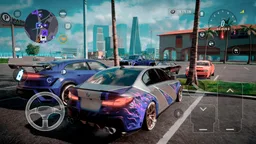



Drive Zone: Car Simulator Game review
 Analysis by Appsdrops
I can see why Drive Zone: Car Simulator Game might become the shared game on a household tablet: one person can drop in for a short drive, while someone else may want to spend longer exploring and tuning a car. My impression is that it works best when everyone treats it as an open-ended driving playground rather than a tightly structured racing campaign. That freedom is appealing, but it also means players need to agree on how they use a shared device and handle purchases.
One driving world, several ways to play
Drive Zone is a free racing game from Jet Games FZ-LLC, built around car simulation and online play in a large open environment. Its appeal is the ability to drive around without being locked into a single race after another. If I have only a few minutes, I can enjoy a quick spell behind the wheel; if I have more time, the open-world premise gives me room to make the session feel less like a checklist.
That flexibility suits shared use better than a game whose enjoyment depends on one person owning a long campaign save. A parent might take a short break, then hand the device to a child or another adult. The catch is that a shared screen does not automatically mean a shared game state or a shared account experience. Before passing the device around, I would make sure everyone knows which profile is active and whether progress or settings could be affected.
For an everyday example, imagine a family waiting for a meal to finish. One person can take a brief drive, then give the phone to the next person rather than committing everyone to a multiplayer race with a fixed start and finish. That is a practical use case for the open-world format. It is less suitable when the household wants a quick, clearly bounded activity with an obvious end point; in that case, a short level-based racer may be easier to manage.
Why the open-world format changes the session
Traditional mobile racers often make the next event the central question: choose a race, compete, collect a result, repeat. Drive Zone’s broader driving focus makes the question more personal: do I want to cruise, practice handling, or look for a social driving session? That is a welcome change if I tire of menus and repeated event structures. It can also feel directionless if I need the game to tell me exactly what to do next.
I would approach it with a small goal for each session. For example, I might explore one area, practice controlling a car, or arrange a drive with a friend instead of expecting every visit to deliver a dramatic race. This simple habit helps turn open-ended play into something satisfying without pretending the game is a conventional campaign. It is one of the most useful adjustments for players who are used to racers that constantly mark the next objective.
The multiplayer element is part of the game’s identity, but it changes what makes a good session. Driving with others can make a virtual road feel lively, while an online session may be less predictable than solo play: other people bring their own pace and priorities. If I want a calm, controlled experience, I would choose a solo-style activity when available rather than relying on strangers to match my mood. If I want spontaneous company, the online setting is the stronger reason to choose this game over a purely offline alternative.
Set sensible boundaries on a shared device
Because Drive Zone is free to download and includes optional in-app purchases, I would treat the device’s purchase settings as part of setup, especially if children use it. Purchases range from $0.99 to $99.99 per item, so the top end is substantial enough that I would not leave spending decisions implicit. I would make clear who may approve a purchase and use the device’s available purchase protections rather than assuming that a free game cannot lead to a bill.
There is also a practical account boundary to consider. On a phone shared between adults and children, I would avoid casually switching accounts or handing over a device while someone is signed in to a profile they should not use. That is ordinary household housekeeping, not a special feature of the game. Agreeing whose progress is being played and who can authorize spending prevents arguments later, particularly when several people take turns and each assumes the game is “theirs.”
A helpful routine is to end a session deliberately: check that the intended player is using the device, put the game away, and confirm that the next person understands whether purchases are off limits. This is more reliable than trying to resolve account confusion after a purchase prompt appears. Players who share a device frequently should also avoid treating another person’s progress as disposable; agree before changing settings or continuing a session that someone else has started.
Coordination matters more online
Online driving is most enjoyable when the people involved have similar expectations. One player may want to cruise and chat, while another is looking for intense racing. I would settle that before a shared session begins, particularly with younger players or siblings who may otherwise argue over what counts as fun. The open-world setup leaves room for different styles, but it does not guarantee that everyone will choose the same activity.
For friends or family members coordinating from separate devices, a simple plan is more useful than assuming everyone will join at the same moment. Decide who is starting, what kind of drive the group wants, and how long the session should last. That may sound basic, but it prevents the common frustration of one person waiting while another expects to wander independently. If coordination is the main purpose, a game with a clearly defined team mode may be a better fit.
On a shared household device, I would be especially cautious about letting one player’s session run into another person’s planned time. A lightweight turn-taking agreement can work better than trying to impose a complicated schedule: agree on whose turn it is, and hand over the device when that session ends. This is useful because open-world play can naturally stretch longer than a single race. The freedom is a strength, but it makes a stopping point something players may need to choose for themselves.
Age suitability and household trust
The game is rated for Everyone, which makes it broadly approachable from an age-rating perspective. I would still make the first session a shared one if a child is new to mobile games. That gives an adult a chance to see how the child handles driving, online interaction, and purchase prompts in practice, rather than relying on the label alone. A suitable age rating is helpful context, not a substitute for household rules.
For a parent, the key question is not only whether the driving theme is appropriate, but also whether online play and optional spending fit the child’s habits. I would explain that free access does not mean every extra is free, and that a purchase needs permission. If the household prefers games with no online component or no paid extras, this is not the most straightforward choice; a fully offline racer with a simpler spending model would be easier to supervise.
That does not make Drive Zone a poor family pick. It means trust works best when it is paired with clear expectations: who can play online, when the device is available, and whether any purchase is allowed. The game’s flexible format can be a pleasant way for different ages to enjoy cars together, but it does not replace those conversations or create household boundaries on its own.
What to expect from the car-simulator side
Drive Zone is a better match for someone who wants room to drive than for someone seeking the strict feel of a motorsport simulator. Its identity combines car simulation with a broad online driving space, so I would go in expecting a casual, accessible experience rather than a substitute for a dedicated console or PC simulation. That distinction matters: players looking for precise competitive racing may find a more focused circuit racer more rewarding.
Compared with the usual mobile arcade racer, it offers a different kind of appeal. An arcade game often gets to the point quickly, with short events and immediate goals. Here, the open-world emphasis can make the time between “starting” and “doing something specific” feel longer. In return, players who like to explore and choose their own pace get a less repetitive rhythm. Neither approach is inherently better; the right choice depends on whether freedom or structure is what you want from a drive.
I would also think about the device and connection before planning a group session. Online play depends on being able to participate in the connected experience, so it is not my first recommendation for a situation where reliable connectivity is uncertain. And if the device is shared, a long session can crowd out other uses. These are ordinary practical trade-offs, but they are worth considering before making the game a household default.
Scale, updates, and value
The game has an average rating of 4.6 from around 272,000 ratings, with roughly 5,000 written reviews and more than 100 million installs. Those figures suggest that it has found a wide audience, though they cannot tell me whether its open-world style will suit a particular player. I would read popularity as a reason to give it a look, not proof that every household will enjoy its pacing or online focus.
It first appeared on November 30, 2023, and its current version is 1.15.0. On Android, the stated minimum operating-system requirement is 7.1. I would check that a device meets the requirement before trying to install it, and keep in mind that a supported operating system alone does not promise the same experience on every device. For a shared phone, it is sensible to leave enough room for the game and avoid starting a session when someone else needs the device immediately.
As a free game, it is easy to try without paying upfront, which is useful when a family is still deciding whether open-world driving suits them. The optional purchase range makes spending discipline important, but it does not change the basic decision: first see whether the core driving experience holds everyone’s interest. I would not buy extras just because the game is popular; I would wait until the household knows who plays it and what, if anything, they actually want to add.
Who I would recommend it to
I would recommend Drive Zone to players who enjoy cars but do not need every session to be a formal race. It is particularly appealing for someone who likes to explore, change pace, or share an online drive with friends. It can also suit a household that wants one flexible driving game for several people, provided the device, account use, and purchases are managed with clear ground rules.
I would steer a different player toward another option if they want a tightly guided career, short rounds with guaranteed endpoints, or a carefully controlled offline experience. A focused racing game is a better choice for quick competition, while a dedicated simulation may better serve someone who values disciplined track driving. Drive Zone’s strength is breadth and freedom, not a promise that it will satisfy every racing preference.
For me, the best way to try it is to start with a brief solo session, learn how its open driving feels, and then decide whether online play adds something for the people who will use the device. That approach avoids making the whole household commit before anyone knows whether they enjoy the format. If the freedom clicks, it can be an easy game to return to; if you want constant direction, its open-ended nature may become the very thing that wears thin.
My household verdict
Drive Zone: Car Simulator Game is a worthwhile pick for a household that values flexible driving and can set sensible rules around shared use. I like that it does not force every session into the same race-shaped routine, and its free entry makes trying it straightforward. The trade-offs are just as clear: online play asks for coordination, open-ended sessions need a chosen stopping point, and optional purchases deserve adult attention when children share the device.
I would install it for a family or group of friends who want a casual car game they can approach in different ways, then let each person decide whether the open-world rhythm suits them. I would skip it for a household that needs a fully offline, highly structured, or spending-free experience. With the right expectations and a simple turn-taking agreement, it can be a fun shared drive; without those boundaries, its freedom can make play and spending less predictable than some families prefer.
What we like
- A wide selection of cars offers plenty of options for collecting.
- Open-world roads provide space to explore beyond standard races.
- Car customization lets players tailor vehicles to their preferences.
- Multiple driving modes help keep gameplay varied.
- Touch controls are easy to learn for casual play.
What could be better
- Large game downloads may take up significant storage space.
- Ads and optional purchases can interrupt or limit progression.
- Some cars and upgrades may require considerable grinding.
- Online play can feel less smooth with an unstable connection.
- Detailed graphics may strain older phones.







