




Daily Mahjong Match review
 Analysis by Appsdrops
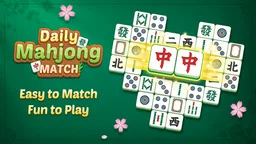
I like keeping a small puzzle game on hand for the quiet gaps in a day: waiting for someone, taking a break from a screen full of work, or settling down after dinner. Daily Mahjong Match is a board game built around that sort of casual session. Its appeal is straightforward: match tiles, take a little time to scan the board, and play without needing a group or a long stretch of uninterrupted attention. I’d consider it for a shared household device, too, as long as everyone understands that a casual game may still include purchases.
Easy to pick up, better in short turns
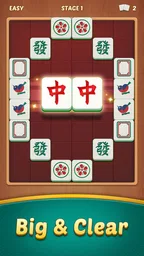
The central attraction is the familiar mahjong solitaire idea of finding matching tiles. That makes the game approachable even if you don’t know the rules of traditional multiplayer mahjong: this is a solo matching puzzle, not a table game that depends on opponents, betting, or a shared score. I find that distinction useful when choosing something for a quick break. You can focus on the visible puzzle rather than learning a complex ruleset first.
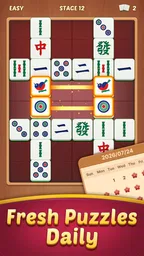
Its daily-play framing suits a routine better than a game that demands a long commitment. I’d open it for one puzzle while the kettle boils or when I want a calmer alternative to scrolling. The board asks for attention, but the basic objective is easy to grasp, so a new player can get started without arranging a group or coordinating a time.
That simplicity is also a limit. If you want a competitive match, a social game night, or a strategic board game with several players making moves against one another, this isn’t a substitute. I’d pick a multiplayer mahjong app or a conventional digital board game for that. Daily Mahjong Match is more suitable when the goal is a self-contained puzzle that can fit around other plans.
A shared device works best with clear turns
On a family tablet or a phone that people pass around, this kind of solo puzzle can be an easy activity to take turns with. One person can try a board, hand over the device, and let someone else have a go. That makes it more naturally shareable than a game built around one person’s live match, though I would treat the device itself as shared rather than assume that everyone has a separate personal space in the game.
Before handing it to a child or another household member, I’d make a simple agreement about whose turn it is and whether a puzzle should be finished before the device changes hands. It’s a small practical point, but it avoids confusion if people are using the same screen at different times. I wouldn’t rely on the game to manage household turns or keep everyone’s activity separate; those are coordination choices for the people sharing the device.
For a household with different attention spans, short solo turns are a real advantage. Someone can play briefly and stop, while another person can use the device later. Still, if the household wants a shared score, a head-to-head challenge, or a record of each person’s progress, I’d check that expectation before choosing it. The main experience is tile matching, not a family competition format.
Set expectations before anyone starts
The game is free to download, but it offers in-app purchases priced from $0.99 to $79.99 per item. That range is worth discussing if a child uses a shared device or if the household has a rule about purchases. I’d check the device’s purchase settings and make sure everyone knows to ask before buying anything. A free starting point does not mean every optional item is free.
There’s also a practical boundary between a puzzle and a device habit. A daily prompt can be a pleasant reason to return, but I would not turn it into a household obligation or treat a missed day as a failure. For children especially, it’s healthier to frame it as an optional pastime: play when there’s room for it, then put the device away when the break is over.
For adults sharing a phone, the same principle applies in a different way. Agreeing not to interrupt someone in the middle of a puzzle can prevent accidental taps or a lost turn, and it keeps the game from becoming a source of minor friction. These are simple habits rather than special game tools, but they make shared use more pleasant.
Offline play and the value of a quiet break
One useful part of the game’s positioning is that it is intended for offline mahjong solitaire. That can make it appealing when a connection is unavailable or when I want a puzzle without depending on a live opponent. I’d still avoid assuming that every surrounding app function behaves identically offline; the important point for choosing it is that the core idea is designed for solo play rather than a real-time table.
Offline-friendly play is particularly handy on a commute or in a waiting room, where a connection can be unreliable and a multiplayer game may be awkward. It also means the activity doesn’t need to become a conversation or a competition. If I have only a few minutes, I can concentrate on the tiles and then return to whatever I was doing.
There is a trade-off: a quiet solo puzzle can feel repetitive to someone who wants fresh social interaction or a changing challenge built around other players. Mahjong solitaire depends on visual scanning and matching, so the same general kind of attention remains central from one session to another. If variety of game modes is your main priority, I’d compare it with a broader puzzle collection before settling on this one.
Who it suits, and who may want another game
I’d recommend giving it a try if you enjoy tile-matching puzzles, prefer playing alone, and want something that can be picked up for a short break. It can also suit a household that wants a low-pressure activity to pass between adults or older children, provided the group is comfortable sharing one device and managing purchases through its usual rules.
I’d be less likely to recommend it to someone who expects traditional mahjong with several players, a deep competitive ladder, or a puzzle game that constantly changes its mechanics. The store description calls attention to daily mahjong matching, but that does not make it the right choice for every kind of board-game fan. If your favourite part of games is coordinating with friends, choose a social option instead; if you want a focused solo tile puzzle, this is a more natural fit.
It is made by Big Cake, and its broad reach suggests that many people have found the format appealing: the game has over 10 million installs, an average rating of 4.9 from around 239,000 ratings, and roughly 4,100 written reviews. Those figures are encouraging context, not a guarantee that it will match your taste. I’d treat the rating as a reason to consider it, then decide based on whether you actually want a simple solo puzzle.
Age, trust, and household expectations
The game is rated Everyone, which makes its general content suitable for a broad audience. That is helpful when choosing a casual game for a household device, but an age rating doesn’t answer every family question. I would still think about screen time, purchase boundaries, and whether a child should use the device independently. Those decisions belong to the household, not to the rating alone.
For a younger player, the tile-matching goal is easy to explain, and the solitary format means no one needs to coordinate with strangers to complete a session. For a child who gets frustrated by puzzles, though, I’d sit nearby at first and see whether the pace feels enjoyable rather than turning the game into a test. For an older adult, the familiar tile imagery and unhurried matching may be appealing, but individual comfort with small visual details is personal, so it’s sensible to try it on the actual screen they’ll use.
The app is free, and its current version is 1.0.45. It was released on February 4, 2025, and requires Android 7.0 or later. Those details matter when deciding whether it can be installed on an older device, while the purchase range matters for a shared one. I’d check compatibility and purchase settings before making it the household’s default puzzle.
My household verdict
For a shared device, I see Daily Mahjong Match as a pleasant turn-taking option, not a full family game system. Its strengths are the immediately understandable matching premise, solo sessions, and suitability for small pockets of time. The most useful household approach is to keep expectations modest: one person plays a puzzle, another can use the device later, and everyone follows the same purchase rules.
The main trade-off is simplicity: it makes the game easy to approach, but it also means people looking for multiplayer interaction or a broad set of distinct board games should look elsewhere. I wouldn’t choose it to organize a family contest or to replace a traditional mahjong night. I would choose it for a quiet break, a waiting-room distraction, or a calm activity someone can enjoy without needing a partner.
Overall, I’d recommend it to friends who like solo tile puzzles and want a casual game that can fit around ordinary routines. In a household, I’d install it only after checking the device’s purchase boundaries and agreeing how people will share the screen. With those small expectations in place, it offers an uncomplicated way to pause and focus on a board for a little while.
What we like
- Daily puzzles provide a fresh challenge to return to each day.
- Mahjong matching offers a calm way to unwind during short breaks.
- The familiar tile format is easy for new players to understand.
- Short sessions make it convenient to play on the go.
- Finding matching tiles can help exercise visual attention.
What could be better
- Some layouts may feel repetitive after extended play.
- Tile matching can become difficult when similar patterns blend together.
- Daily challenges may offer limited variety between sessions.
- Players seeking a fast-paced game may find the pace too slow.
- Small tiles may be hard to distinguish on compact screens.







