
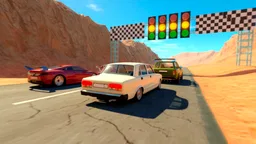
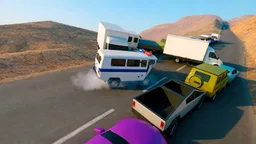

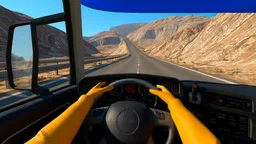
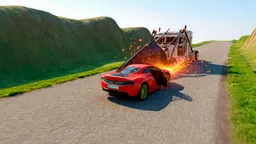
Crash X: Car Games Mobile review
 Analysis by Appsdrops
I enjoy racing games most when they give me a reason to try one more run, whether that means finding a cleaner line or seeing what happens when a collision goes badly. Crash X: Car Games Mobile takes a different route from a conventional lap racer: its appeal is built around speed, impact, and the spectacle of wrecked cars. That makes it easy to understand at a glance, but the real question is whether that focused kind of fun is worth your time—and whether its optional purchases change the value.
What the free download gets you
Crash X is a free racing game from Take Top Entertainment, released on June 5, 2025. The current version is 1.20.1, and it runs on Android 7.0 or later. The age rating is Everyone, so its crash-focused premise is presented in an accessible, non-graphic style rather than as realistic violence.
Free access is the clearest part of its value proposition: you can install the game without paying upfront. The game also offers in-app purchases, with items priced from $1.99 to $49.99 each. That range matters. A free download is a low-risk way to see whether the core driving and destruction appeal to you, but the upper end is a substantial optional spend. I would decide what you are comfortable paying before browsing purchase prompts, rather than treating the free entry point as proof that every part of the experience costs nothing.
The figures around the game give a useful, if mixed, impression of its reach. It has more than a million installs and an average rating of 3.4 from around 3,800 ratings, alongside 37 written reviews. That combination suggests plenty of people have tried it, while opinions are not uniformly enthusiastic. I would use the rating as a reason to approach it with measured expectations, not as a substitute for deciding whether crash-oriented racing is your kind of game.
What kind of racing is it?
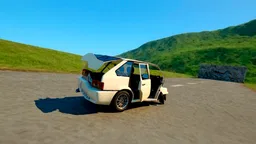
The central attraction is the collision itself. Rather than asking only whether you can take a corner neatly or beat a rival to a finish, Crash X frames damaged cars and high-impact driving as part of the entertainment. In my view, that is its most distinctive promise: a mistake is not necessarily just a lost second; it can become the moment you wanted to see.
That focus changes how I would judge a run. In a traditional circuit racer, I might restart after a poor turn because the clean lap is the point. Here, it makes more sense to treat a run as a short experiment: try a different approach, watch how a crash changes the outcome, and decide whether that attempt was entertaining enough to repeat. The best reason to play is the physical drama of a collision, not the expectation of a deep motorsport career.
The contrast with familiar racing alternatives is important. If you want orderly circuits, careful vehicle tuning, or a strong sense of progression toward a championship, a dedicated simulation or conventional arcade racer is more likely to satisfy you. If you mainly want speed and destruction in a lighter, less formal mood, this game is better aligned with that impulse. It occupies a narrower niche, which can be a strength when you are in the mood for it and a limitation when you want variety.
Where the value comes from
For me, the free entry is most valuable as a trial of a specific idea. You do not need to commit money before finding out whether the crash-centered style holds your attention. That is especially useful if you usually play racing games only in short bursts: a quick session can tell you whether the spectacle is enjoyable enough to return to, without asking you to buy a full-priced game first.
There is also a useful way to approach the game without turning every session into a purchase decision. Start by focusing on the driving itself and ask whether you enjoy setting up a run and seeing how it ends. If that loop feels satisfying, the free access has already delivered something. If it does not, paying for an item is unlikely to fix a mismatch between your tastes and the basic premise. Optional spending is better considered as an extra, not as an assumed requirement for enjoying the game.
One practical tip is to give yourself a simple goal for each session. On one run, prioritize speed; on another, try to avoid an early crash; on a third, deliberately see how a more aggressive approach changes the result. This kind of self-imposed variation helps a focused game stay interesting without assuming it has a long list of modes or systems. It also lets you distinguish whether you enjoy the driving, the destruction, or merely the novelty of a dramatic impact.
Another useful trade-off is how you define a “good” attempt. Players who feel rewarded only by clean execution may find crash-focused play frustrating, because damage is part of the attraction rather than simply a penalty to erase. I would go in expecting messy outcomes and judge the game by whether those outcomes are enjoyable to watch and repeat. If you keep measuring it against a perfect-lap racer, you may miss the point; if you want precision above all, that difference is a fair reason to choose another game.
Limits to consider before spending
The biggest limitation is the narrowness of the concept. Crashing cars can be immediately entertaining, but the premise may wear thin for someone who needs a sequence of different objectives or a detailed racing structure to stay engaged. The store summary emphasizes realistic crash physics, but that phrase alone does not tell me how much variety or long-term depth to expect. I would not buy an expensive item on the assumption that it will transform the game into a full simulation or a broad racing package.
The rating is another reason to keep expectations grounded. An average of 3.4 is neither a strong endorsement nor a clear warning that no one should try it. It points to a game that may work well for players who specifically want its destruction angle while leaving others unconvinced. For a free download, that makes a personal test sensible. For a purchase near the top of the listed range, I would want to be especially sure that the base experience already suits me.
There is a difference between seeing a purchase option and needing it. The game is free to download, while individual in-app items range from $1.99 to $49.99. That is enough to make checking the amount attached to any item worthwhile before confirming a purchase. I would also avoid spending simply because a prompt appears during a session: take a moment to ask whether the item solves a problem you actually have or adds something you already know you want. If you are only curious, the free version is the sensible place to begin.
Crash X is also not my first recommendation for someone who wants an involved driving lesson. Its crash-first identity suggests entertainment through impact rather than a promise of realistic competition or careful racing technique. A player looking to improve at circuit racing, compare precise lap times, or immerse themselves in structured motorsport would probably get more value from a game designed around those aims. This one makes more sense when the goal is to switch off and enjoy the chaos.
Who is likely to get their money’s worth?
I can see it appealing to casual players who like vehicle destruction, quick experiments, and the unpredictable payoff of a risky run. It may also suit someone sharing a phone or tablet with family: the Everyone age rating makes it broadly accessible, though an adult should still decide whether the crash theme is right for a particular child. Since it is free to install, it is easy to try together and judge the tone firsthand before considering any spending.
A realistic use case is a short break when you have a few minutes and do not want to keep track of a long race or campaign. You can open the game, focus on one run, and leave when the novelty has had its say. That kind of session is a better match for its immediate crash-centered appeal than settling in expecting a sprawling career. If you are looking for a game to occupy a long commute without a connection, or need to know about detailed offline behavior, I would not assume either from the basic description; make that decision based on what the app itself shows you before relying on it.
I would steer a competitive racer toward another option if careful control and consistent results are the main attractions. I would also suggest skipping Crash X if you dislike watching vehicles get damaged, even in a stylized game context, or if purchase prompts tend to tempt you into spending more than planned. Its free starting point is attractive, but value depends on enjoying the particular loop rather than merely wanting any racing game.
My verdict on whether to try it
My recommendation is to download Crash X if you are specifically curious about fast, destructive driving and are happy to treat it as a focused diversion. Start with the free access, play a few runs with different self-set goals, and see whether the collisions stay entertaining after the first surprise. That approach gives you a fair sense of the game without turning curiosity into an unnecessary expense.
I would skip paying for it—or choose a different racing game—if you want precision, substantial progression, or a broad set of racing challenges. Its 3.4 average rating suggests that the appeal is not universal, and the optional purchase range makes restraint worthwhile. For a player who simply wants to see what happens when a fast run ends in a wreck, though, the free download offers a reasonable way to find out. Try it for the crash-driven fun; spend only if you already know that fun is worth the price to you.
What we like
- Quick races make it easy to play in short sessions.
- Crash-focused challenges offer a different goal from standard racing.
- Simple controls are approachable for casual players.
- Unlockable vehicles give players rewards to work toward.
- Offline play is useful when an internet connection is unavailable.
What could be better
- Repeated crashes can make the gameplay feel predictable.
- Vehicle handling may take time to get used to.
- Progress can feel slow without frequent rewards.
- Ads may interrupt the flow of play.
- Limited track variety can reduce long-term appeal.







