



Click X review
 Analysis by Appsdrops
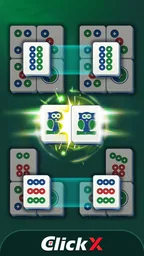
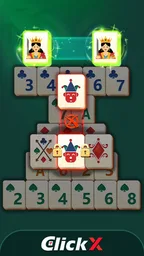
The first thing I notice about Click X is how directly it gets to its point: this is a mahjong tile-clearing game built to feel calm and easy to read. Its large, clear tile design is a practical choice, not just decoration. On a phone, where small symbols can turn a relaxing puzzle into squinting and second-guessing, legibility matters. I’d reach for it when I want a quiet activity that asks for attention without demanding a long commitment.
A clear look that supports the puzzle
As a board game from HeartsNet, Click X has a focused identity. The visual language centers on the tiles and the task of clearing them; that restraint suits a game meant for unwinding. I value that kind of clarity because mahjong-style puzzles rely on recognizing what is available at a glance. If the board is hard to parse, planning feels like work. Here, the emphasis on larger, clearer tiles gives the basic interaction room to breathe.
That simplicity also sets expectations. I would not pick this up looking for a richly developed setting, characters, or a story to follow. The appeal is in looking at a board, finding a sensible move, and watching the puzzle gradually open up. The setting is the board itself, and the visual mood is most useful when it stays out of the way. For a short break, that can be more inviting than a game that surrounds every move with extra information.
The name is brief and the presentation, as suggested by its straightforward premise, is easy to understand. A new player can approach it as a familiar tile puzzle rather than learning an elaborate world before playing. That makes it approachable for people who already enjoy mahjong-inspired games, as well as those who simply want a low-pressure way to exercise visual attention. I’d especially recommend trying it if busy interfaces make other mobile puzzles feel tiring.
Sound and the pace of a small break
For this kind of game, sound works best as support rather than spectacle. The central pleasure is visual: scanning tiles, deciding what to clear, and noticing how each choice changes what remains. I wouldn’t choose Click X for a dramatic soundtrack or a story-driven audio experience. Its intended mood is better understood as a quiet puzzle session, where the board—not a stream of effects—holds your attention.
That makes it a natural fit for gaps in the day: a few minutes while waiting for an appointment, a pause between chores, or a wind-down before putting the phone aside. A useful habit is to decide in advance whether you want one quick puzzle session or a longer stretch. With any simple matching game, the ease of starting can make “just a moment” expand into more time than intended. Keeping the game in a deliberate break slot helps preserve the relaxed quality I’d want from it.
I also think the clear tile design helps with pacing. When the board is readable, I can spend my attention on the decision rather than deciphering symbols. That does not mean every move will be obvious: tile puzzles are engaging precisely because the available choices can require a second look. But the visual emphasis gives the game a fair chance to feel thoughtful instead of needlessly fiddly, particularly on a smaller screen.
How the mechanics suit different players
Click X belongs to the broad family of mahjong tile-clearing games, so its appeal is easy to place. If you enjoy scanning a crowded layout and choosing tiles with care, the core idea should feel familiar. Compared with a word game, it asks less of your vocabulary; compared with a fast action game, it rewards patience more than reflexes. That makes it a sensible option when I want a little mental engagement without the pressure of reacting quickly.
There is a trade-off in that focused design. Players who want varied modes, competitive matches, a deep campaign, or a strong social layer should look elsewhere unless those elements are clearly part of the experience they are seeking. The available description presents the game around relaxing tile clearing, so I’d judge it on that promise rather than expect a broader package. For someone who finds repeated board puzzles monotonous, a strategy game with changing objectives may hold interest longer.
One practical way to play more thoughtfully is to pause before tapping a move and scan the whole visible board, rather than taking the first pair that catches your eye. In tile-clearing puzzles, an easy match can be less useful than a choice that leaves more options open. This is not a special feature; it is a simple decision-making habit that can make the puzzle feel more satisfying. I’d use it when I want the game to be a small exercise in planning, not just a sequence of quick taps.
Another useful approach is to treat the large tiles as an accessibility advantage for everyday play, while still choosing a comfortable screen setup. If you are playing on a compact phone or in bright surroundings, clear symbols can reduce visual strain, but glare and distractions still matter. I’d give myself a moment to settle the display before starting rather than blame a puzzle for a missed detail I could not see well. That is especially helpful during a commute or in a waiting room, where conditions are less than ideal.
Who will enjoy it—and who may not
I can see Click X working well for people who like calm, familiar board puzzles and want a game they can understand without a long introduction. It is also a reasonable choice for a shared household device: the content rating is Everyone, and its straightforward premise does not depend on following a complicated narrative. That rating is useful context for families, although each person’s comfort with screen time and puzzle difficulty is still a separate consideration.
The game is free to start, with in-app purchases listed from $1.99 to $9.99 per item. I’d keep that in mind if I were installing it for a child or trying to stick to a strict spending limit: check purchase controls on the device before handing it over. People who prefer a one-time purchase with no optional spending may find that model less appealing. The price structure does not change the basic fit question: it is worth trying if tile clearing is the activity you want, but not simply because it costs nothing to install.
Its audience is substantial: it has passed five million installs, with an average rating of 4.7 from around eighty-five thousand ratings and roughly 5,200 written reviews. Those figures suggest many players have found something to like, but they cannot tell me whether the game matches your taste. I’d put more weight on whether you enjoy uncluttered puzzle boards and a measured pace. Popularity is encouraging context, not a substitute for that personal fit.
The game was released on August 29, 2025, and its current version is 1.20.1. It requires Android 7.0 or newer. Those details are useful before installing: check your device’s operating system if you are using an older phone, and make sure you have the current version available through your app store. I would not choose it as a replacement for a more demanding game if what I really wanted was fast progression or a large variety of activities.
A considered verdict on its mood
What holds the experience together is the relationship between a readable board and an unhurried kind of attention. The design’s clearest strength is also its boundary: Click X keeps the focus on mahjong-style tile clearing rather than building a larger world around it. For me, that focus is welcome when I want a pocket-sized pause. It may feel limited if I expect fresh mechanics, a dramatic setting, or a reason to return beyond solving another board.
I’d recommend giving it a try if you enjoy sorting visual choices at your own pace, especially if tiny tiles in other games have been a nuisance. I’d skip it if you need a story, strong competition, or a wide range of distinct activities to stay engaged. That is not a flaw so much as a matter of fit: the game’s modest, calm approach is the point, and it will work best for players who genuinely want that.
My practical recommendation is to approach it as a small ritual rather than a game that must occupy an evening. Settle in, scan before each move, and stop when the break you wanted is over. If that sounds appealing, Click X offers a clear, approachable way to spend a few quiet minutes with a board puzzle. I’d keep it in mind for low-pressure downtime, while choosing a more varied game when I’m in the mood for a bigger challenge.
What we like
- Simple controls make it easy to start playing.
- Short rounds suit quick play sessions.
- The core gameplay is straightforward to understand.
- It can provide a casual challenge for puzzle fans.
- The lightweight format may work well for brief breaks.
What could be better
- The gameplay may feel repetitive over time.
- It may offer limited variety between rounds.
- Progress can depend on repeated attempts.
- The challenge may feel too easy for experienced players.
- Some players may want more levels or modes.







