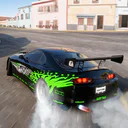
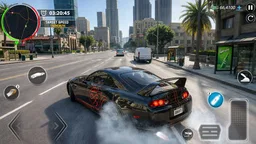
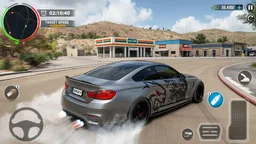
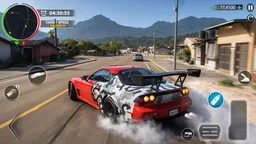
City Car Driving Drift Games review
 Analysis by Appsdrops
The first thing I look for in a drifting game is whether its central action feels inviting enough to try again after a messy corner. City Car Driving Drift Games is built around that simple appeal: take a car through a city setting, steer into a drift, and enjoy the sensation of keeping control as the vehicle slides. It is a free racing game from Gaming Mob, and its focus is easy to understand without a long introduction. For a quick driving break, that directness is a real advantage.
What matters here is the feel of the driving rather than a complicated racing framework. The game’s store description points to smooth controls and realistic city drifting, which sets an expectation of approachable steering with a little room to work on technique. I would come to it for short bursts of car control, not for a deep motorsport simulation or a lengthy competitive campaign. That distinction helps set the right mood before the first run.
Getting into the first drift
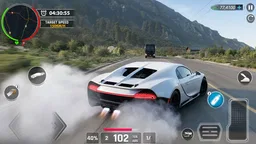
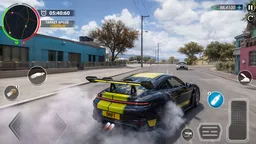
The appeal of the opening action is that it is immediately legible: move through the city and try to make a turn into a controlled slide. In a game centered on drifting, the satisfying moment is not simply reaching the end of a route. It is finding the balance between turning sharply enough to break traction and correcting smoothly enough to keep the car pointed where you want it. That gives even a basic drive a small skill challenge.
I find that kind of premise useful when I have only a few minutes to play. There is no need to reserve a whole evening for a race or to remember a complicated objective. I can pick up the game, focus on one stretch of driving, and decide whether I want another attempt. If you enjoy learning through repetition, the city-driving setup gives you a natural place to practice timing and steering without making the experience sound like a serious racing simulator.
The word “realistic” deserves a practical reading. It suggests an effort to make driving feel grounded, but it does not by itself promise the precision or depth of a dedicated simulation. I would judge the game by whether its controls let me understand what my inputs are doing and whether a slide feels manageable, not by expecting a full replica of real-world car physics. That is a useful distinction for anyone choosing between a casual drift game and a more demanding driving title.
For a first session, I would resist trying to force a dramatic slide on every corner. A steadier approach—turn in, notice how the car responds, then make smaller corrections—makes it easier to learn the control rhythm. This is a practical tip rather than a hidden feature: in a drift-focused game, restraint can be more useful than holding a steering input for too long. If the car starts to swing wider than intended, easing off and resetting your line is a better learning moment than treating every loss of control as a failed run.
Why the controls matter more than the premise
Drifting games can share the same basic idea while feeling very different in the hands. Responsive controls make a slide feel like something I caused and can correct; sluggish or overly sensitive steering can make the same turn feel arbitrary. The available description emphasizes smooth driving controls, so approachable handling is part of the game’s intended identity. For a new player, that points toward a gentler entry than a title whose main appeal is punishing precision.
There is a trade-off, though. Players who want to tune every detail of a car’s handling or chase a highly technical simulation may find a straightforward city-drifting concept too simple. I would choose this game when I want the act of steering to be the main event, rather than a long menu of setup decisions. If your ideal session is about comparing detailed vehicle settings, a more simulation-heavy racing game is likely a better fit.
Reading the feedback and finding a rhythm
A good drifting loop depends on feedback. I want to know whether a turn was too sharp, whether I corrected too late, and what I should change next time. The useful part of each attempt is that immediate connection between an input and the car’s response. Even without treating every run as a score chase, I can make a small personal goal—hold a cleaner line, avoid an abrupt correction, or carry a slide through a turn more calmly—and use the next corner to test it.
That approach also makes the game easier to enjoy in everyday situations. Imagine waiting for a friend or filling a short break between tasks: a quick drive gives you a self-contained activity, and you can stop when the moment is over. There is no need to turn casual play into a long commitment. If you have more time, you can keep refining the same basic skill; if not, the central action is simple enough to revisit later.
One useful way to keep sessions fresh is to change only one thing at a time. On one attempt, focus on starting the slide earlier; on the next, pay attention to how gently you bring the car back into line. Changing several habits at once makes it harder to tell what helped. That small practice routine is especially valuable in a game with a clear driving premise, because it gives you a reason to return beyond simply repeating the same turn.
The alternative is to play every drive as a test of how far you can push the car. That can be entertaining, but it also makes it harder to distinguish a deliberate drift from a correction that got away from you. I prefer mixing both styles: a few careful runs to understand the response, followed by a looser run where I try to be more aggressive. The contrast turns a basic driving session into a more satisfying feedback rhythm.
City Car Driving Drift Games sits within the broad racing genre, but its city-drifting emphasis gives it a different mood from a conventional lap racer. A lap-based game usually asks me to focus on pace, racing lines, and finishing ahead of rivals. Here, the attraction is the slide itself and the small adjustments that keep it under control. Compared with open-ended driving games, the drift focus also gives a casual session a more specific purpose.
What makes another attempt worthwhile
In a drift game, the reward does not have to be a grand unlock or a major victory. Sometimes it is simply seeing a turn go better because I changed my timing. That kind of personal progress works well for players who like a compact challenge, but it may not satisfy someone who needs a story, a long progression path, or a constantly changing set of objectives to stay interested. The game’s appeal is strongest when the driving itself is enough to motivate another run.
For me, the best reason to continue is the chance to turn an awkward corner into a more controlled one. The action is the attempt, the feedback is the car’s response, and the reward is a cleaner slide or a better understanding of when to correct. Then the session resets naturally: I see another chance to apply what I learned. The loop works when you enjoy improving by feel, rather than waiting for a large external reward to make the next drive worthwhile.
That also explains who may want to skip it. If you are looking for online competition, elaborate vehicle customization, a career structure, or a highly detailed simulation, you should compare it with games that are explicitly built around those priorities. I would not choose this one as a substitute for every type of racing game. It makes more sense as a focused, casual option for people who like the moment-to-moment challenge of steering into a drift.
Free to try, with purchases to consider
The game is free to download, while in-app purchases range from forty-nine cents to nine dollars and ninety-nine cents per item. That makes it possible to try the core driving experience without an upfront purchase, but I would still treat optional spending as a personal choice rather than a requirement. Before buying anything, I would first spend time with the basic loop and decide whether the handling is enjoyable enough to justify paying for extras.
There is no need to spend money simply because a game has purchase options. For a casual player, the sensible test is whether the free experience already provides the kind of short driving sessions they want. Someone who only opens a racing game now and then may prefer to keep spending at zero. A more committed player can consider purchases only after identifying what they would actually use, rather than treating payment as a shortcut to enjoying the controls.
The audience details also make the game accessible to a broad age group: its content rating is Everyone. It has an average rating of 4.3 from around 3,400 ratings, and it has passed one million installs. Those figures suggest that many players have tried it, but I would still use them only as context. A rating cannot tell you whether you personally prefer relaxed drifting to structured races, so the best decision is to match the game’s premise to your own habits.
Practical fit and expectations
City Car Driving Drift Games is at version 1.1 and requires Android 7.1 or later. That makes checking your device’s Android version a sensible first step if you are considering installing it. I would also think about when I expect to play: the straightforward driving focus suits brief breaks, while anyone hoping for a lengthy campaign should make sure that a drifting-centered experience is what they actually want.
Gaming Mob’s game is a good fit for players who enjoy car control as a small, repeatable challenge. It is especially appealing if you like experimenting with steering, learning from a rough turn, and trying again without needing a complicated setup. It is less compelling for someone who wants the variety of a broad racing collection or the realism of a simulation where fine technical detail is the main attraction.
My overall verdict is that this is a focused casual racer whose appeal rests on one clear question: can you make the next drift feel more controlled than the last? Its free entry makes it easy to test that idea, and its city-driving theme gives the practice a setting that feels more relaxed than a strict circuit race. I would recommend it to a friend looking for a simple way to enjoy drifting in short sessions, while being candid that the same narrow focus may not hold the attention of players who need extensive progression or competitive depth.
If you go in expecting an accessible driving game rather than a full racing simulator, the action-feedback-reward-reset cycle is easy to appreciate. Start with gentle corrections, set one small goal for each run, and let a cleaner turn be the reason to try again. That is where the game makes its strongest case: not by promising every kind of racing experience, but by giving drifting the spotlight and letting you decide whether the next attempt feels worth it.
What we like
- Drift-focused events give driving sessions a clear goal.
- A variety of cars offers options for different driving styles.
- City settings provide recognizable roads for practice.
- Short challenges suit quick play sessions.
- Drifting rewards careful control of steering and acceleration.
What could be better
- The driving focus may feel repetitive over longer sessions.
- Some cars or features may require in-game purchases.
- Touch controls can be difficult to use precisely.
- Performance may vary on older devices.
- Ads may interrupt play depending on the version.







