
Car Crash Simulator: Mountain review
 Analysis by Appsdrops
I went into Car Crash Simulator: Mountain expecting a straightforward wrecking game, and that is the right way to approach it. Its appeal is the physical challenge of driving along steep mountain roads, where a bad line or too much speed can turn a climb into a crash. I found the premise easy to understand: the pleasure comes from handling a car on difficult terrain and seeing what happens when control slips, not from the broader progression and polish of a traditional racing game.
That focus makes it a particular kind of racing game. It is better suited to short sessions spent testing a route, correcting a driving mistake, or deliberately pushing a vehicle past its limits than to players seeking a full motorsport career. If you enjoy driving challenges and crash physics, it is an easy game to try. If you want careful track design, realistic race strategy, or a long list of structured objectives, you may find the central idea wears thin.
Mountain driving is the main event
The setting changes how I think about speed. On a conventional circuit, the instinct is to carry momentum and aim for a clean lap. Here, a steep road makes balance and restraint more important: rushing into a bend can leave little room to recover, while easing off the accelerator can be the smarter move. That gives even a simple drive a small decision-making loop—judge the slope, choose a pace, and see whether the car holds its line.
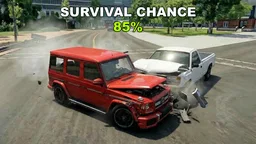
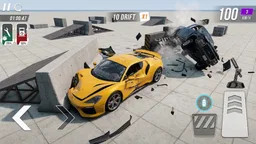
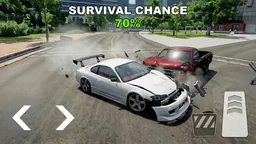
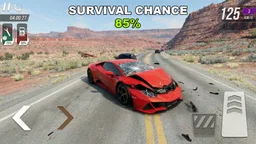
The crashes are part of that loop rather than a separate spectacle. The game’s soft-body damage concept gives a collision a physical, messy quality, which suits the mountain setting: a mistake can feel like the consequence of the route and your choices, not merely a penalty for touching a barrier. I would not treat it as a precision vehicle-damage simulator, though. The main promise is an entertaining driving-and-crashing experience, not a technical lesson in how real cars deform.
For a useful first session, I would resist the urge to drive flat out immediately. Take a route at a controlled pace, notice where the steep sections and turns demand more care, then raise the speed once you have a feel for the road. That simple approach makes a crash more informative: you can tell whether your trouble came from entering a bend too quickly, losing control on a slope, or simply testing the limits on purpose.
A good fit for quick, experimental sessions
One realistic use case is a short break when I want something more hands-on than a puzzle but do not want to commit to a long race. I can focus on one drive, see whether a different pace helps, and put the game down without needing to remember a complicated strategy. The appeal is especially clear for players who enjoy repeating a challenge to improve their own driving rather than chasing a detailed career structure.
It also works as a casual game to share in the sense of comparing reactions and approaches: one person may try to keep a vehicle upright, while another may be more interested in what happens when a steep road and a hard impact meet. That is a different kind of competition from comparing lap times. The fun depends on whether you and your friends enjoy experimenting with the same basic driving idea; it is not a substitute for a feature-rich multiplayer racer.
As an Android game, it is free to download and is rated for Everyone. Moon Star Games Yazilim is the developer, and the game has an average rating of 3.5 from around four thousand ratings, with more than a million installs. Those figures suggest it has reached a sizeable audience, but the rating is a useful reminder that broad reach does not mean universal appeal. The focused premise is likely to satisfy players who want crashes and mountain driving more than those expecting a polished, all-purpose racing package.
What the current version tells me—and what it does not
The current release is version 3.0.45t, while the game was released on November 29, 2024. That gives a reader concrete context for the product’s timeline and present version, but version numbering alone does not tell me which individual features changed or how the game has evolved between releases. I would not read a later version number as proof of a particular improvement. For someone installing it now, the practical point is to assess the experience available in the current release rather than assume that a number signals a complete redesign.
That distinction matters for returning players, too. If you tried an earlier build, it is reasonable to check the current app before deciding whether it feels different, but I would avoid expecting a specific new mode, vehicle, or control option based only on the version label. The verified facts establish the version and release date; they do not establish a feature-by-feature change log. My recommendation is to judge the game by the mountain driving and crash-focused play it offers now, and to treat any future updates as something to evaluate once their changes are clearly described.
The current version also gives prospective players a straightforward way to think about compatibility: it requires Android 10 or later. That is worth checking before installing, especially if you are using an older phone or tablet. I would also approach performance as something to judge on your own device rather than assume every Android model will feel identical; games with driving and collision effects can be more enjoyable when controls respond smoothly, and a stuttery session can make judging a tight turn frustrating.
Where it sits beside other racing games
Compared with a conventional circuit racer, Car Crash Simulator: Mountain is less about clean racing lines and more about navigating a dangerous-feeling road and accepting the consequences of mistakes. That makes it a poor choice if your main goal is close competition, disciplined lap practice, or a collection of race formats. A standard racing game is the better option when you want opponents, track variety, or a clear progression built around finishing events.
Compared with stunt or destruction games, its mountain-road focus gives the driving itself a reason to matter. You are not just looking at a crash; the route creates a challenge before the impact happens. That is the strongest distinction I see in its premise. The trade-off is that a focused concept can become repetitive if the basic act of driving a difficult road and testing collisions is not enough to keep you interested. I would choose it for that specific loop, not because I expect it to replace every other kind of racer on my phone.
There is a similar trade-off with driving simulators. The game presents itself as a hard-driving experience, but its crash emphasis points toward playful experimentation rather than strict realism. If you want a calm practice environment that rewards precise vehicle control without chaotic damage, another driving title may suit you better. If you enjoy the tension of trying to keep a car under control on steep terrain—and occasionally failing spectacularly—this one has a clearer reason to exist.
Small decisions that make a session better
My most practical tip is to separate learning the road from testing the crash behavior. On an early run, focus on staying composed and finding a pace you can manage. On a later run, deliberately take more risks. Mixing those goals from the start makes it harder to tell whether a bad outcome came from unfamiliarity with the route or from an intentional experiment. This two-pass approach gives the game a little more structure without pretending it has a deep campaign.
Another useful habit is to treat each collision as feedback, not automatically as failure. If you lose control, think about what happened just before it: your speed, the slope, and how sharply you tried to turn. That makes repeated attempts more satisfying because you are changing one decision at a time instead of simply replaying the same drive. It is a small but meaningful way to get more out of a game whose appeal depends on experimenting with vehicle control.
I would also keep expectations grounded around the optional purchases. The game is free, with in-app purchases priced at $2.49 per item. That means you can try its central driving-and-crashing idea without paying upfront, but anyone considering a purchase should decide whether the base experience already holds their attention. I would not spend money on the assumption that a purchase guarantees a particular vehicle, feature, or advantage; the price alone does not establish what an item provides.
Who should install it—and who should pass
I would recommend giving it a try if you like crash-focused driving games, steep-road challenges, and short sessions where the fun comes from testing limits. It is especially appealing if you enjoy making your own mini-goals—hold control through a difficult section, take a turn more smoothly, or see what happens when you push a car too hard. The free entry point makes that experiment straightforward for compatible Android devices.
I would skip it if you need a structured career, frequent changes of activity, or a highly realistic simulation of vehicle handling. I would also look elsewhere if repeated driving on mountain roads sounds more like a limitation than a draw. The game’s identity is narrow by design, and that is both its strongest point and its main risk: it knows the kind of moment it wants to create, but players who want variety may quickly want more.
Overall, I see Car Crash Simulator: Mountain as a focused, accessible pick rather than a complete racing package. Its steep-road driving gives crashes context, and the soft-body damage idea supports the playful trial-and-error that makes a short session worthwhile. The current version is 3.0.45t, and the game has been available since November 29, 2024, but I would look for clear details before expecting future updates to change its core appeal. If that core loop sounds fun to you, it is worth trying; if you are after a broad racing career, a conventional racer will be the better fit.
What we like
- Mountain roads create challenging driving routes.
- Crash physics make collisions entertaining to watch.
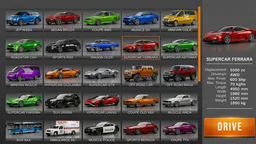
- A range of vehicles offers varied driving experiences.
- Short sessions make it easy to play casually.
- The mountain setting gives the game a distinctive look.
What could be better
- Repeated crashes can make gameplay feel monotonous.
- Vehicle handling may feel imprecise at high speeds.
- Some levels may offer limited objectives.
- Ads may interrupt the play experience.
- Progression can feel slow without frequent rewards.







