
Beach Buggy Racing review
 Analysis by Appsdrops
I can see why Beach Buggy Racing has stuck around: it makes kart racing feel lively almost immediately, with colorful tracks, quick races, and a playful sense of chaos. The important question for me is what happens after that first burst of fun. This is a free racing game from Vector Unit, and its bright, accessible style makes it easy to pick up. Whether it earns a regular place on your phone depends on how much you enjoy racing that prizes surprises as much as clean driving.
Why the first races are easy to enjoy
The game’s appeal is most obvious in short sessions. You can start a race without needing to learn a complicated simulation, and the kart format keeps the action readable: choose your line, steer through bends, and react when the pack gets rowdy. That makes it a comfortable choice for a few minutes while waiting for a ride or taking a break, rather than a game that demands a long, uninterrupted evening.
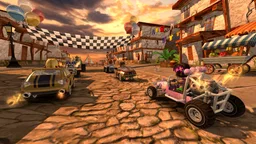
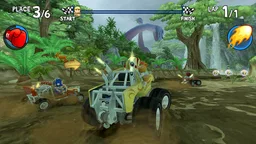
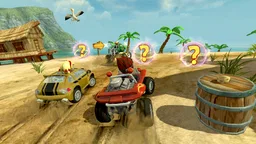
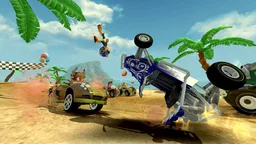
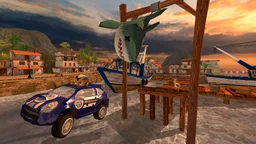
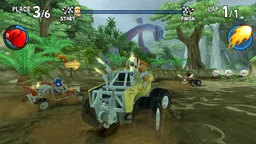
Its 3D presentation gives the courses a cheerful, holiday-like look, but the useful part is how that visual style supports play. Tracks are busy enough to feel distinct without turning every corner into a test of perfect precision. I found that the fun comes from recovering when a race goes wrong as much as from driving flawlessly. A missed turn or an opponent getting ahead can make the next stretch feel like a small comeback challenge.
The controls and pace are aimed at broad accessibility, which is a strength if you want a casual kart racer rather than a demanding driving game. It also means players looking for realistic handling or a serious motorsport feel should look elsewhere. This is built around an energetic, arcade-style race, not the careful braking, tuning, and track study that define more simulation-focused alternatives.
On a first visit, I’d suggest resisting the urge to treat every race as a grind toward the next unlock. Pay attention to how the game’s tracks handle and which parts of the race tend to disrupt your rhythm. That small shift makes the action feel less random: you start anticipating trouble instead of simply reacting to it. It is a modest but useful way to make early races more satisfying.
A casual racer with a clear audience
Beach Buggy Racing is best suited to people who want colorful kart competition without a steep learning curve. It works well for casual players who enjoy trying a race, improving a result, and returning later. Its Everyone age rating also makes its general presentation approachable for a wide audience, though a parent should still consider the game’s in-app purchases when deciding whether it is suitable for a child’s device.
It is less compelling for someone who wants every race to be a pure test of driving skill. The unpredictable, playful spirit is part of the appeal, but it can also be frustrating if you prefer a consistent result based only on careful steering. I’d choose a more precision-focused racer if close control and realistic car behavior matter more to me than spectacle and quick, accessible competition.
What keeps it useful beyond the novelty
The long-term value comes from having a reason to return that is not limited to seeing the tracks once. The game encourages collecting and upgrading, so races can serve two purposes: they are a quick burst of play, and they contribute to ongoing progress. That structure gives a casual session a sense of direction. I like that arrangement when I have only a short window to play, because I can still feel that a race has moved something forward.
The trade-off is that progression can shift attention away from the racing itself. If you enjoy improving a vehicle over time, the collection-and-upgrade loop can give the game staying power. If you want a level playing field every time you start, any system that asks you to build up progress may feel like a chore. Before settling in, it helps to decide whether you are here for the races or for the broader loop around them.
A practical way to keep the game from becoming repetitive is to set a small goal for a session: focus on learning a troublesome section, making a better run, or advancing your collection rather than trying to complete everything at once. This approach makes short play periods feel complete. It also gives you a natural stopping point, which is useful in a game that can otherwise invite one more race simply because each match is brief.
There is a meaningful distinction between a game that is easy to revisit and one that must become a daily habit. Beach Buggy Racing works better for me as an occasional, low-pressure option. Its arcade pace makes it convenient to open when I want something more active than a puzzle but less demanding than a long campaign. If you need a deep competitive ladder or an ongoing social routine to stay engaged, this may not become your main racing game.
Keeping the routine light
Maintenance is not the same as having to manage a complicated set of systems. The most useful routine is simply to return when you feel like racing, pay attention to what your current goal is, and avoid turning upgrades into an obligation. The current version is 2026.11.02, and it requires Android 7.0 or later. Those details make it easier to judge basic device compatibility, but they do not change the central question: do you enjoy the driving enough to keep coming back?
For a busy day, I’d use it in short bursts rather than plan a long session around it. A quick race fits a commute wait or a pause between tasks, while a longer stretch makes more sense when you want to work through progression. That flexibility is a genuine strength. It lets the game serve both as a brief distraction and as a more focused pastime, without requiring you to approach every session in exactly the same way.
The game is free to start, with in-app purchases ranging from $1.99 to $19.99 per item. I would treat those purchases as optional spending, not a prerequisite for finding out whether the racing suits me. If you are setting it up for a younger player, it is worth discussing purchase expectations beforehand and checking the device’s purchase controls. That is a practical precaution for any free game with paid items, not a reason to assume payment is necessary.
Where repetition and friction can set in
The same short-race format that makes the game convenient can eventually make its sessions feel alike. If the basic kart-racing rhythm stops being enjoyable, collecting more things may not solve that problem. Progression can add a goal, but it cannot replace a kind of driving you genuinely like. I would take a break rather than keep playing out of habit if each race starts to feel like another identical task.
Another possible source of friction is the balance between control and chaos. The playful tone asks you to accept that a race may not unfold like a clean time trial. For some players, that makes close finishes exciting; for others, it can make the outcome feel less earned. If you tend to get annoyed when a race is disrupted by surprises, the game’s lighthearted approach may wear thin faster than it does for someone who treats each run as a bit of arcade fun.
It is also worth being honest about what the game is not. It does not need to be your all-purpose racing fix. Players who want the depth of a serious driving sim, a realistic vehicle model, or a highly structured competitive experience may be happier with another kind of racer. By contrast, someone who values colorful courses, immediate action, and a manageable session length is more likely to find a lasting use for it.
Its broad reach is notable: Beach Buggy Racing has a 4.5 average from around 3.1 million ratings, with over 100 million installs and around 35,000 written reviews. Those figures suggest that its accessible approach has found a large audience, but they do not guarantee that its particular style will suit you. I would use them as context, not as a substitute for considering whether you prefer arcade unpredictability or controlled, realistic racing.
Does it earn a place on your phone?
After the initial novelty fades, I think Beach Buggy Racing earns its space for the right kind of player: someone who likes quick kart races, enjoys gradual collection and upgrades, and is happy to return when the mood strikes rather than follow a strict routine. The developer, Vector Unit, has kept the game current with version 2026.11.02, while its core appeal remains the straightforward pleasure of jumping into a lively race.
I would recommend it to a friend who wants a free, approachable racing game for spare moments and does not mind a little chaos. I would steer a friend toward a different option if they wanted realistic handling, a highly competitive structure, or a game that constantly introduces new depth. Its lasting value is not that it has to become a daily ritual; it is that it can remain a dependable choice whenever a short, colorful race sounds appealing.
What we like
- Easy-to-learn controls make racing accessible to newcomers.
- Creative tracks feature shortcuts and interactive hazards.
- Power-ups add variety and excitement to each race.
- Unlockable drivers and cars offer steady progression.
- Local split-screen racing supports friendly competition.
What could be better
- Power-ups can make race outcomes feel unpredictable.
- Some upgrades and unlocks require considerable grinding.
- The screen can feel crowded during hectic races.
- Progress may depend on in-app purchases.
- Local multiplayer requires compatible controllers or devices.







