



Basket Battle review
 Analysis by Appsdrops
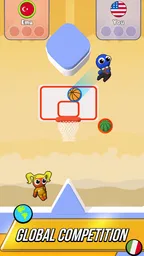
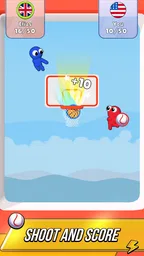
The first appeal of Basket Battle is that it gets to the point: you take a shot, try to score, and try to outplay the opponent in a compact basketball duel. I like that focus. Rather than asking me to manage a whole team or settle in for a long match, it frames basketball as a quick contest of aim and timing. That makes it an easy game to open when I have a few spare minutes and want an immediate goal.
It is a free sports game from Supersonic Studios LTD, with a Teen content rating. Its broad audience is reflected in its reach: it has passed 50 million installs, and its average rating is 4.5 from around 513,000 ratings. Those numbers tell me it has found plenty of players, but they do not guarantee that its pared-down style will suit everyone. The important question is whether a short, repeatable shooting duel is the kind of basketball you want.
One shot at a time: the action and its feedback
The central action is simple to understand: make a shot, score, and beat your rival. That gives each attempt a clear purpose, and the result is easy to read without needing to study a playbook or learn a set of team controls. In my view, this clarity is the game’s strongest entry point. A newcomer can grasp what they are trying to do quickly, while a returning player can get straight back to the contest.
The simplicity also changes what skill means here. This is not the place I would go for the layered decisions of a full basketball simulation, where spacing, passing, defense, and player roles shape a possession. Basket Battle narrows the focus to the duel itself. That makes every attempt feel direct, but it also means that players who want the texture of a complete match may find the experience too slight.
The feedback rhythm is built around action and outcome: take the shot, see whether it works, then respond to the state of the contest. That compact loop is useful on a phone because there is little setup between intention and result. If I am waiting for a coffee or taking a short break, I can pay attention to one brief challenge rather than commit to a longer session. It is a better fit for fragments of free time than for an evening when I want a substantial sports game.
A practical tip is to treat early attempts as a way to learn the game’s feel, not as proof that every shot should work the same way. In a timing-and-aim focused duel, small changes in how I approach an attempt can matter. Paying attention to what happened after a miss is more useful than rushing into the next shot without adjusting. That makes the simple control idea more engaging than it first appears: the action is easy to start, but playing with intention is what gives it a little depth.
Why the short rhythm works—and where it can wear thin
Basket Battle’s quick contest format gives it a clean rhythm: make an attempt, get an immediate result, and keep moving. There is no need for me to remember a long chain of decisions from earlier in a match. That lowers the barrier to picking it up again after a day away, which is a real advantage for a casual mobile game.
The trade-off is that repeated attempts can begin to feel similar. If you enjoy the anticipation of a close duel, the repeated shot-and-score focus can be satisfying. If you need frequent changes in tactics, a richer roster of basketball decisions, or the slower build of a full match, the narrow loop may start to feel repetitive. I would judge it by whether the basic contest itself stays fun for you, not by expecting it to turn into a simulation.
That distinction also helps when comparing it with the usual alternatives in sports games. A full-court basketball title is the better choice when you want possession management and a broader sense of team play. A purely casual arcade game may ask even less of you, but Basket Battle keeps a recognizable basketball goal at the center of its short duels. It sits between those options: more focused on the sport’s shooting contest than on the whole sport, and more deliberate than a game whose appeal is only a quick visual gag.
The reward is the contest, not a long-term commitment
The immediate reward is straightforward: a successful shot helps you get ahead, while a miss gives you a reason to adjust. That cause-and-effect is the part I find most satisfying. The game does not need a complicated explanation to make the next attempt matter; the rival and the score provide a clear reason to care about the outcome.
That kind of reward works especially well for players who like small, repeatable goals. You can decide to play one duel, see how it goes, and stop without feeling that you have left a long campaign unfinished. It is also convenient for casual play with someone nearby: the format invites a quick comparison of who can handle the shooting challenge better. I would not choose it as a substitute for a planned multiplayer sports session, but its short-form competition makes it easy to share a brief moment of play.
The game is free to start, with optional in-app purchases priced from $0.99 to $6.99 per item. I see that as a reason to be deliberate rather than as a reason to buy anything automatically. If the core shooting duel is already enjoyable, there is no need to spend just to find out whether the game suits you. If you are considering a purchase, first decide what you want from it and whether that would meaningfully improve your own play; the purchase range alone does not tell you what an individual item changes.
For younger players, the Teen rating is worth considering as part of the decision, especially if an adult is choosing games for a family device. For anyone else, the rating is a useful reminder to check that the game matches the household’s preferences. The format may look approachable, but I would still make that choice based on the age guidance rather than assuming every simple sports game is appropriate for every child.
When a session ends, the next one has an easy reason to begin
The reset is part of the appeal. A duel ends, the result is apparent, and the next attempt has a clean starting point. I do not need to reconstruct a long plan or wait for a complicated setup before trying again. That gives the game its “one more go” quality: a loss can feel like a prompt to correct a mistake, while a win can invite another challenge to see whether I can repeat it.
There is a useful way to keep that loop from turning into aimless repetition. Before restarting, I can pick one thing to change: be more patient, focus on a cleaner attempt, or avoid repeating the approach that just failed. That small personal goal gives the next duel a purpose without needing a deep progression system. It is a simple strategy, but it makes the reset feel like an opportunity to improve rather than just a button leading back to the same action.
On the other hand, players who dislike repeated short rounds should take the reset as a warning. Basket Battle is built around returning to the same essential challenge, not around steadily unfolding a long sports story. If you prefer to make progress through a season, control a complete team, or explore many different basketball roles, another game in the category will likely hold your attention better. The quick restart is convenient only if the core contest remains appealing.
The current version is 3.9.1, and the game supports Android devices running version 8.0 or later. That makes the minimum software requirement worth checking before installing on an older device. Since the game’s appeal depends on quick, responsive attempts, I would also try it in the setting where I actually plan to play: a short break, a commute with reliable attention, or a casual moment at home. Its format is most enjoyable when I can concentrate on the shot rather than divide my focus among several things.
Who I would recommend it to
I would recommend Basket Battle to someone who wants basketball-flavored competition in short bursts, enjoys trying to improve through repeated attempts, and does not need the full structure of a team match. It is particularly well suited to a brief everyday scenario: I have a few minutes before an appointment, want a clear challenge, and would rather play a compact duel than start a longer game I may have to abandon. The immediate objective makes that kind of use feel natural.
I would suggest skipping it if your main reason for downloading a basketball game is to run plays, manage a squad, or experience a more complete match. It may also be a poor fit if repeating a small set of actions quickly becomes dull for you. That is not a flaw that can be solved by expecting more from the format; it is the defining trade-off. Basket Battle prioritizes an accessible shooting contest over the breadth of basketball.
For a free game from Supersonic Studios LTD, with a large player base and a strong average rating, it is an easy one to try if that trade-off sounds appealing. My verdict is positive but specific: I like the fast route from attempt to feedback and the clean reset that gives each next session a purpose. I would not call it a replacement for a full basketball game, but as a compact sports duel it offers a clear, approachable loop—and it is worth keeping installed if that is the kind of challenge you actually want.
What we like
- Quick matches make it easy to play in short breaks.
- Simple controls are approachable for new players.
- Physics-based shots add variety to each match.
- Unlockable characters give players goals to pursue.
- The colorful visuals make the action easy to follow.
What could be better
- Ads can interrupt the flow between matches.
- Physics may make some shots feel unpredictable.
- Progress can depend on repeated play.
- Limited match variety may feel repetitive over time.
- Online competition can be frustrating against experienced players.







