



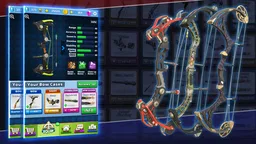
Archery Battle 3D review
 Analysis by Appsdrops
I’d describe Archery Battle 3D as a pick-up-and-play sports game built around lining up a shot, releasing at the right moment, and trying to outscore another archer. That makes it easy to understand before you have learned any complicated rules. My main advice for a newcomer is to treat the opening matches as practice: a small adjustment to your aim can matter more than rushing to shoot.
What to expect from an archery duel
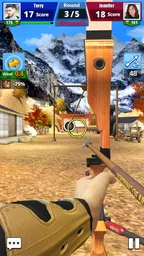
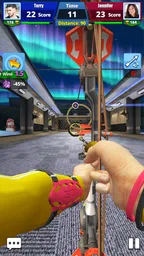
This is an archery game from Doodle Mobile Ltd., made for quick head-to-head play rather than a long, detailed sports simulation. Its central appeal is the compact decision in each shot: judge where to aim, account for the conditions shown during play, and decide when to let the arrow go. A good result feels earned because you have to make the shot, not simply select a winner from a menu.
The game sits in the sports category, but it feels closer to a focused skill challenge than to a full sporting career. If you are coming from a racing game or a team-based sports title, expect less variety in the basic action and more attention to repeated, small corrections. That narrow focus is a strength when you want a fast session; it can feel limiting if you expect several distinct sports or a broad range of activities.
On its own terms, the presentation aims for a three-dimensional archery feel. The important point for a first-time player is not to mistake that presentation for a guarantee of real-world training. The controls and match conditions are designed for a game, and I would approach them as a way to build timing and aim within the app, not as a substitute for using a real bow safely.
The game is free to install and is rated for Everyone, so it is easy to consider for a casual household device. It does offer optional in-app purchases, ranging from $0.99 to $99.99 per item, which is worth keeping in mind if younger players will use the device. I would set a purchase boundary before handing over a phone, rather than waiting until a tempting offer appears during play.
It has an average rating of 4.7 from around 312,000 ratings, with about 22,000 written reviews and over 50 million installs. Those figures suggest it has found a large audience, but they do not tell you whether its particular rhythm suits you. I would use a short first session to decide that for yourself: if careful aiming feels satisfying, the basic loop has a good chance of holding your attention.
Who is likely to enjoy it
I think it is a good fit for someone who wants a sports-themed game that can be understood quickly and played in short bursts. It also suits players who like a clear personal challenge: improve one shot, learn to make a calmer correction, then see whether that carries into the next duel. You do not need to follow professional archery to understand the goal.
It is less suitable if you want a deep management game, a long narrative, or a wide roster of sports to rotate between. A player who wants to plan tactics across a full team may get more from a conventional team sport game. Someone looking for a precise real-world archery simulator may also want a title specifically built around technical equipment and detailed training rather than brisk competitive matches.
Getting started without overthinking it
The app was released on April 9, 2019, and its current version is 1.3.19. It requires Android 5.0 or later. Before installing, I would check that the device meets that minimum, then make sure you have a few quiet minutes for the first match. You do not need to prepare a long setup routine; the useful preparation is simply being able to focus on the aiming controls instead of tapping hurriedly while distracted.
When you first enter a match, resist the urge to make large changes after every shot. Start by observing how the aiming response feels, then make one small adjustment at a time. This is a practical way to learn whether a miss came from your initial alignment or from releasing before you had settled. Changing several things at once makes it harder to tell what helped.
A helpful first-session habit is to pay attention to the full shot rather than only the score. Notice where the arrow lands, how your next aim differs, and whether a steadier release produces a more predictable result. Even if the first duel does not go your way, you can still finish with useful information about how the game responds to your input.
For a realistic everyday scenario, imagine opening the game during a short break. Play one duel at an unhurried pace, and use the next one to repeat the shot approach that felt most controlled. That is a better use of a few spare minutes than firing rapidly through several attempts and ending without knowing why the result changed.
Your first meaningful success
For me, a meaningful first success is not necessarily winning immediately. It is making a deliberate shot and being able to explain what you did differently when it lands closer to your intended target. That small feedback loop gives the game its most satisfying early reward: you feel that a better outcome came from a better decision rather than luck alone.
Try keeping one variable steady at a time. If you have been aiming too far to one side, correct that gently on the next attempt and avoid simultaneously changing your release timing. This is a simple method, but it turns an otherwise vague “I missed” into something you can work on. It also helps prevent a common beginner mistake: overcorrecting after a poor arrow and sending the next one just as far in the opposite direction.
When you do win a duel, take a moment to notice what felt repeatable. Was the useful change a calmer aim, a better read of the shot, or simply giving yourself time to settle? You do not need to build a complicated notebook; remembering one observation is enough. The point is to carry a working habit into the next match instead of treating each round as an unrelated try.
That approach also makes losing less frustrating. In a quick contest, the score can make every miss feel decisive, but a single result does not tell you whether your technique is improving. I would judge progress by whether your choices become more intentional and whether you can reproduce a good shot, not just by whether an opponent happens to make a mistake.
Common points of confusion
The first is expecting every shot to be a simple matter of pointing at the target and tapping. The game asks for judgment, so a shot that looks close may still fall short of your intention. Rather than assuming the controls are unresponsive, pause long enough to see what the current aim is doing and make a modest correction. That is usually more useful than repeatedly dragging or tapping in a panic.
The second is confusing fast play with efficient play. The matches are quick-fire, but speed is not automatically an advantage when you are still learning. A brief pause before releasing gives you time to check alignment and decide whether you are satisfied. Once the action feels familiar, you can naturally play more briskly without abandoning that check.
Another likely misunderstanding is treating a strong opening result as proof that the rest of the game will be effortless. Opponents and shot conditions can make later attempts feel different, and repeating the same motion without looking at what changed may not work. Keep your basic routine, but remain ready to adjust based on the situation in front of you.
It is also easy to assume that purchases are needed to enjoy a free game. I would first see how much you enjoy the core duel and whether the available progression feels worthwhile to you before spending anything. The listed purchase range is broad, so a cautious approach is sensible: do not buy something just because you have had one frustrating match or want to repair a single mistake.
Finally, do not confuse a game’s realistic-looking presentation with instruction for real archery. It can make aiming feel more engaging, but a phone screen cannot teach every practical detail of handling equipment. If your goal is to take up archery outside the game, use appropriate in-person instruction and safety practices; keep this app in the role of entertainment.
How it compares with other sports games
Compared with a typical football, basketball, or racing game, this one strips away much of the movement and team management. That makes it easier to start, but the trade-off is a narrower set of decisions. The appeal is concentrated in aiming and timing, so players who enjoy refining a single skill may find that focus refreshing. Players who need changing objectives and a steady stream of different activities may find the loop repetitive sooner.
Compared with casual target-shooting games, the duel format gives each attempt a competitive context. You are not only trying to hit a target in isolation; you are trying to perform well against another archer. That can make a close shot more exciting, but it can also add pressure. If competitive scoring makes you rush, slow your own routine down and treat the opponent as a reason to stay composed, not a reason to abandon your aim.
It is also a different choice from a detailed simulation. I would pick this when I want an accessible contest that gets to the action quickly. I would look elsewhere if I wanted extensive equipment tuning, a long-form training plan, or a broad simulation of the sport. The game’s value is its directness, not an attempt to cover every part of archery.
What to do after the first match
After your opening duel, decide which part of the experience you actually enjoy. If it is the aiming challenge, play another round with a specific goal, such as making steadier corrections. If it is the competitive pressure, focus on keeping your routine consistent when the score matters. If neither aspect feels appealing after a fair try, you probably do not need to push through; this game’s central loop is also its defining limitation.
I would also make a simple choice about spending before settling into regular play. Since the game is free and includes optional purchases, you can begin without paying, then decide whether any purchase would genuinely improve your enjoyment. That approach is especially useful if the device is shared or used by a child: the Everyone rating describes the content age category, while purchase decisions still deserve adult attention.
My recommendation is to try Archery Battle 3D if you want a compact, skill-focused sports game and enjoy improving through small adjustments. Give yourself time to learn how the shot feels, aim deliberately, and measure early progress by control rather than by an instant win. If you prefer a varied sports collection or a more technical archery simulation, another game will likely fit better; if quick duels and a clear aim-and-release challenge sound appealing, this is an easy one to test in a spare moment.
What we like
- Simple touch controls make aiming easy to learn.
- Short matches suit quick gaming sessions.
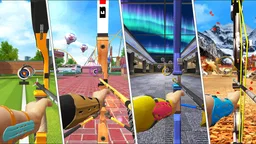
- Multiple arenas add visual variety.
- Online duels provide direct competition.
- Upgrade options give players goals to pursue.
What could be better
- Accurate shots can be difficult on small screens.
- Progress may depend on repeated matches.
- Online play requires a stable connection.
- Ads may interrupt the free-to-play experience.
- Matchmaking can pair players with stronger opponents.







