
Indeed Flex review
 Analysis by Appsdrops
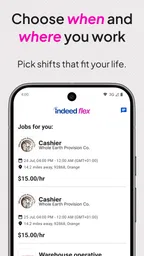
I see Indeed Flex as a practical option for people who want to find individual shifts rather than commit to one fixed schedule. It is a free business app from Indeed Flex, built around browsing nearby work and booking shifts. That focus makes it most useful when your availability changes from week to week, or when you want another source of work alongside a regular job.
It is not the same proposition as a general job-search app. Those are usually centered on vacancies, applications, interviews, and longer hiring cycles. Here, the appeal is the possibility of moving from checking available work to choosing a shift. In my view, that can save time for someone who already knows they want flexible, shift-based work, but it is less suited to someone looking for a salaried role or a broad career search.
What the app is built to do today
The central idea is straightforward: use your phone to find local shifts and book the ones that fit. I would approach it as a tool for managing potential work, not as a promise that a suitable shift will always be available exactly when I need one. Availability depends on location, timing, and the kinds of roles a worker is looking for, so the app’s value will naturally vary from person to person.
Indeed Flex has been available since June 23, 2017, and its current version is 76.45.0 (888). Those details show that this is an established product with continuing version updates, rather than a newly launched experiment. They do not, by themselves, tell me which features have changed or how a particular update behaves; I would treat the version as context, not as proof of a specific improvement.
The app has a 4.2 average from around 8,400 ratings, alongside 835 written reviews and more than a million installs. I take that as a useful sign that many people have tried it, not as a guarantee that every local job market will be equally active or that every person will have the same experience. For this kind of service, the fit between the app and the shifts available nearby matters more than a rating alone.
It is rated for Everyone and requires Android 8.0 or later on Android devices. Since the app is free, there is no purchase price to weigh before trying it. The more important cost is practical: time spent checking availability, planning around a shift, and making sure the work suits your schedule and travel options.
How I would use it in a real week
Imagine I have a changing timetable and can work a couple of days next week, but I do not yet know which days. I would check Indeed Flex when I can plan properly, compare the shift options with my calendar, and book only those I can realistically attend. If a shift starts before public transport is convenient or ends too late for a safe journey home, the apparent flexibility may not be useful after all.
That is one of the less obvious trade-offs: a shift can fit the hours on a screen and still be a poor fit once travel, preparation, and recovery time are included. I would judge each option by the whole day it occupies, not just by the time listed for the work. Keeping a simple note of booked shifts and travel plans can also help avoid accepting overlapping commitments through multiple work channels.
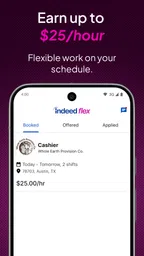
For someone balancing study, caring responsibilities, or another job, the ability to choose individual shifts may be more useful than a standard vacancy search. It can also suit someone who wants to explore shift work without first committing to a fixed weekly pattern. On the other hand, if income needs to be predictable every week, I would not rely on a flexible-shift app as the only plan until I had seen how consistently suitable work appears in my area.
Where it differs from ordinary job-search apps
Most job boards help people discover openings and then submit applications, often with several steps between finding a role and starting work. Indeed Flex is oriented toward shift booking, so the practical question is less “Which long-term vacancy should I apply for?” and more “Which available shift can I take on?” That distinction makes it a more direct fit for short-term scheduling needs, while conventional job sites remain better for comparing permanent positions, career paths, and employer descriptions.
It also differs from simply asking around or relying on a manager to offer extra hours. A dedicated app gives a worker a place to look for shifts rather than waiting for a personal contact to pass on an opening. But that convenience does not remove the need to check whether the work, location, and timing suit you. I would use it alongside other routes rather than assuming it replaces every relationship or job-search method.
A useful way to decide is to start with the kind of work you want. If you want to fill occasional gaps, the shift-based approach is a sensible match. If you need a permanent contract, a clearly defined progression path, or a particular profession that is not represented by local shift opportunities, a conventional recruitment site or direct employer search is likely to be more useful.
What the version history can and cannot tell you
The product’s release history and current version indicate that Indeed Flex has continued to be maintained since its 2017 release. For an existing user, that is reassuring in a limited way: the app has not simply remained frozen at its launch state. Still, a version number is not a changelog. I would avoid assuming that a recent update added a specific booking feature, fixed a particular issue, or changed how shifts are handled unless the app itself explains that change.
For people already using it, the sensible approach is to keep the app updated and review its current screens after an update rather than relying on old instructions or memories. If a workflow looks different, take a moment to confirm what the app is asking before committing to a shift. That is especially worthwhile when a booking affects a workday you have already arranged around other responsibilities.
For a first-time user, the current version is simply the version to evaluate now. I would spend the first session learning how to find relevant shifts and checking what information is presented before making a commitment. A little care at the start can prevent the common mistake of treating a quick booking decision as though it requires no further planning.
Practical limits to consider before depending on it
The biggest limitation is inherent in flexible work: the user cannot control which opportunities are available. A person in an area with few suitable shifts may find the app less useful than someone with several workable options. That is why I would check its relevance to my own location and schedule before building a monthly budget around it.
Another friction point is that a shift-based routine asks for active planning. A worker may need to check regularly, compare options, and keep personal commitments in view. This is not necessarily a flaw in the app; it is part of choosing work one shift at a time. But someone who wants a fixed schedule arranged well in advance may prefer a conventional job with established hours.
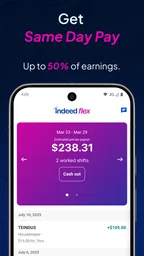
I would also be careful not to confuse easy access to a booking interface with certainty about future earnings. The app’s purpose is to help people find and book shifts, but personal income depends on the work actually available and the shifts a person can take. If financial stability is the priority, I would treat this as one possible source of work and keep a more predictable alternative in mind.
Indeed Flex is not the right choice for everyone. It is a weaker match for people who cannot travel to varying work locations, need guaranteed weekly hours, or are seeking detailed career development through a permanent role. It may also be frustrating if the times that work for you rarely line up with available shifts. In those situations, a direct search for fixed-hour employment is likely to be a better starting point.
Questions I would answer before making it part of my routine
Would I use it as my only route to work? Not at first. I would try it as one channel, see whether the local opportunities match my availability, and only then decide how much to depend on it. That lets the real experience in your area guide the decision instead of treating the app’s overall popularity as a promise of local supply.
Should I book every shift that looks convenient? I would not. I would check the full commitment, including travel and any other plans, before confirming. A shift that appears to fit a free morning may create a problem if the journey takes longer than expected or another responsibility runs late.
Is it a substitute for a regular job-search service? Only if the goal is specifically shift-based work. For permanent roles, broader career options, or a deliberate move into a particular field, I would use job listings and employer recruitment channels as well. Indeed Flex is best understood as a focused tool, not a universal employment solution.
Does its popularity mean it will work equally well for me? No. The overall audience is substantial, but the deciding factors are personal: nearby opportunities, suitable hours, and whether shift work matches the income pattern you need. I would judge it on those points after exploring what is actually relevant to my circumstances.
My take on its long-term usefulness
Indeed Flex makes the most sense when I want control over which individual shifts I take and am comfortable with the uncertainty that comes with flexible work. Its established history, current maintenance, free price, and sizeable user base make it a reasonable app to try if that is the kind of work I am seeking. I would still keep expectations grounded: the app can make searching and booking more convenient, but it cannot make every location or schedule equally well served.
My advice is to treat the first few visits as a practical test. Look for options that genuinely fit your week, consider the journey as part of the shift, and notice whether the opportunities appear often enough to be worthwhile for you. Its strongest feature is the freedom to pursue work shift by shift; its main trade-off is that flexibility depends on what is available when you need it.
If that trade-off suits your circumstances, Indeed Flex is worth considering as a focused addition to your work search. If you need steady hours above all else, or are looking for a long-term career role, I would put fixed-schedule vacancies first and use this app only as a supplement. That is the clearest way to get value from it without expecting a flexible-shift service to solve a different employment problem.
What we like
- Browse flexible shifts across a range of industries.
- See pay details before accepting a shift.
- Filter job listings by location and role.
- Track application and shift information in one place.
- Pick up temporary work without a long-term commitment.
What could be better
- Shift availability can vary greatly by location.
- Some roles require experience or specific credentials.
- You may need to complete onboarding before booking shifts.
- Short-notice schedule changes can complicate planning.
- Work opportunities may be limited outside major cities.





