
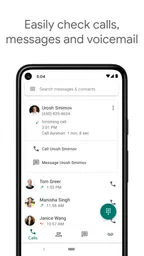

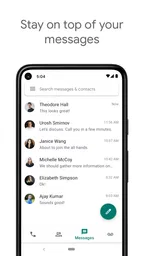
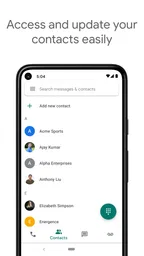
Google Voice review
 Analysis by Appsdrops
I can see why Google Voice might earn a place on someone’s phone quickly: it gives you a separate number to use for calls and messages, without asking you to make that number your main personal line. The useful question is whether that separation still helps after the novelty wears off. In my view, it can—especially if you regularly deal with customers, online listings, volunteer groups, or other people you would rather not give your everyday number. It is less compelling if you only need one dependable number and rarely have a reason to keep work and personal conversations apart.
What feels useful in the first week
Google Voice is a free communication app from Google LLC, built around the idea of using a number managed through the cloud. Rather than treating it as a replacement for every part of your phone service, I find it more useful to think of it as a separate contact point. That distinction makes the app easier to judge: its value is not simply making calls, but giving certain conversations a boundary from the start.
In the first few days, the appeal is straightforward. You can give the Voice number to a new contact or use it for a particular purpose, while keeping your familiar personal number for people who already have it. For someone selling a used item, arranging a home-service visit, or coordinating a short-term project, that can reduce the feeling that every new contact has a permanent route into their personal life.
A practical way to test the app is to choose one clear use before sharing the number. For example, I would use it for inquiries about a side project, then keep family and close friends on my regular number. This makes it easier to see whether the separation is genuinely useful instead of creating a second inbox with no clear job. If you hand the number out everywhere immediately, you may end up with duplicated conversations and no obvious reason to keep managing them.
Google Voice is rated for Everyone, and its current version is 2026.11.01.1019342246, with Android support from version 8.0. Those details make it accessible to a broad range of Android users, though an app’s suitability still depends on how well a separate number fits your habits. The app has an average rating of 4.1 from around 373,000 ratings, and more than 10 million installs. That level of adoption suggests it has a durable audience, but I would still base the decision on your own calling and messaging routine.
A boundary works only if you use it consistently
The most helpful early habit is telling people what the number is for. If it is your number for appointments, for instance, use it whenever you book one and avoid switching back and forth without a reason. That consistency helps you recognize why a call is arriving and whether you want to answer it. The separate number is a tool for organizing contact, not a magic filter that makes unwanted conversations disappear.
I would also decide how you want to handle replies before sharing it widely. A second number can make it easier to distinguish a work inquiry from a personal call, but the benefit fades if you forget to check the app or leave people waiting. A short daily check can be enough for occasional use; anyone who relies on quick responses should make the app part of their regular communication routine.
Where it can fit into everyday life
Consider a realistic example: you are arranging a repair at home while also trying to keep your personal number private. Giving the other party a Voice number creates a distinct contact route for that job. If another call comes in later, you have more context for deciding whether it relates to the repair or to your personal life. The benefit is modest but practical: less uncertainty about why a stranger has your usual number.
The same approach can suit a small side business, a community activity, or a temporary event. A volunteer organizer could share one number with participants rather than mixing every logistical conversation into a personal call history. Someone posting an item for sale can use a separate contact point for inquiries. In each case, the number is most helpful when its purpose is specific and its use is temporary or limited.
Does it remain worthwhile month after month?
After the first week, the novelty of having another number wears off. What remains is the routine: whether the app helps you recognize, sort, and respond to the conversations you intentionally route through it. If you make regular use of that boundary, Google Voice can keep earning its place without needing to be your main communication app. The value comes from a repeated, practical distinction between types of contact.
For occasional users, the recurring benefit may be smaller. If you only need a separate number once in a while, you may find yourself forgetting to check it, then reopening it only when you expect a response. That does not make the app useless, but it means the number may be better reserved for a specific project than treated as a second everyday line. A tool that you check only when you remember can create more friction than it removes.
This is where it differs from the usual alternative: simply giving everyone your standard mobile number. The regular number is simpler because all contact arrives through the same familiar channel. Google Voice adds separation, which is useful only when separation matters enough to justify another place to check. I would choose the simpler approach if I had few incoming contacts or no concern about keeping different parts of life apart.
It also is not automatically the right substitute for a dedicated business phone setup. A person who needs a carefully managed team line, formal call handling, or a shared workflow should compare options designed around those needs rather than assume a personal communication app will cover them. Google Voice makes more sense for an individual who wants a distinct number for their own conversations than for a group that needs coordinated phone operations.
Keeping the number useful without creating extra chores
The maintenance burden is fairly easy to underestimate. You have to remember that the number exists, check its conversations, and keep the purpose clear. A good rule is to review whether it still serves its original role every so often. If a temporary project has ended, continuing to monitor its number may not be worthwhile. If the number has become a useful contact route, keeping it in your routine is more sensible than letting it become an unattended inbox.
I would avoid sharing the number in places where you do not want ongoing contact simply because it is separate. A second number still creates conversations that need attention. The smarter use is selective: give it to people or groups who need a reliable way to reach you for a defined reason, and keep your personal number for your closer circle. That small bit of planning is more valuable than expecting the app itself to organize every boundary for you.
Another useful practice is to make the distinction visible in your own contacts or notes. If you have given the Voice number to a repair service, a buyer, or a project group, remember which context belongs to it. That helps when a message arrives later and you need to decide whether it deserves a prompt reply. The app can provide another route for contact; your naming and checking habits provide the organization.
What may become tiring
The main source of fatigue is the split attention. Some people already juggle messages across several services, and adding another place to check can make communication feel scattered. If you are likely to miss calls or messages unless everything appears in one familiar flow, maintaining a separate number may be a poor trade. I would not recommend creating a second line just because it sounds tidy; it should solve a recurring problem you can name.
There is also a social trade-off. A separate number can help with privacy and boundaries, but people may still expect you to respond quickly once they have it. The number does not establish your availability by itself. For a side business or volunteer role, it helps to be clear about when you usually respond, otherwise the new channel can become another source of pressure rather than a useful separation.
Finally, people who want a single, seamless phone identity may prefer to keep using their normal number. If you rarely share contact information with new people, do not need a dedicated route for work, and are comfortable with the calls you already receive, the extra habit may not repay its cost in attention. In that situation, a separate number is an option, not an upgrade everyone needs.
Who should keep it—and who should move on
I would recommend Google Voice to people who can name a recurring reason for a second number: keeping customer inquiries away from personal calls, handling a project, or sharing contact details in situations where they want some separation. It is especially appealing if you are comfortable checking an additional communication app and can keep its role narrow. The fact that it is free makes trying that routine easier, though time and attention are still costs.
I would skip it if you want every conversation in one place, rarely receive calls from people outside your close circle, or need a more formal phone system for a team. In those cases, your regular number or a service built for organized business calling may be a better fit. The app’s strength is a distinct number for an individual, not a promise that every communication problem will disappear.
After the first-week appeal fades, the lasting value comes down to one question: does the separate number help you make better choices about who can reach you and where those conversations belong? If you use it consistently for a defined purpose, I think it can earn a permanent spot without demanding much upkeep. If you find yourself checking it reluctantly or forgetting it exists, there is no reason to keep another channel alive out of habit. Google Voice is most worthwhile when the boundary it creates solves a real, repeated problem.
What we like
- Free calls to US and Canadian numbers from the US
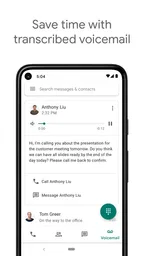
- Voicemail transcripts make messages easier to scan
- One number can ring across multiple devices
- Call screening helps identify unknown callers
- Web access lets you manage calls and messages from a browser
What could be better
- Availability is limited in many countries
- Some features require a US-based number
- Emergency calling may not work like standard phone service
- Texting and calling limits may apply
- Porting an existing number can involve a fee





