


DoorDash - Dasher review
 Analysis by Appsdrops
I think of DoorDash – Dasher as a work tool, not a general-purpose gig app: it is built for people who want to deliver DoorDash orders and choose when to make themselves available. That flexibility is appealing if I need to fit occasional shifts around another job, school, or family responsibilities. It is less compelling if I need dependable hours or predictable earnings. The distinction matters: the app can help organize delivery work, but it cannot make local demand, traffic, or the time required for a trip predictable.
Developed by DoorDash, this free business app is for Dashers rather than customers ordering meals. Its audience is anyone considering delivery work or already taking orders through DoorDash. The practical question is not simply whether the app is popular, but whether its on-demand approach fits my schedule, vehicle, and tolerance for work that changes from one shift to the next.
What the current app is best suited to
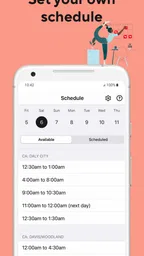
The core appeal is control over when to work. I would consider using it for a limited window after a main job, or for a few hours when I am already in an area where deliveries make sense. That is a different proposition from applying for a conventional shift: I can aim for flexibility, but I should not treat the app as a promise that work will be available whenever I open it.
A realistic example is someone with a free evening who wants to try delivery without rearranging the rest of the week. The useful approach is to plan around that evening, keep enough time for travel and unexpected delays, and judge the experience by the whole outing rather than a single delivery. If the area is quiet or a trip takes longer than expected, the flexibility remains useful, but it does not erase the cost of that time.
That trade-off is central to my view of DoorDash – Dasher: it gives drivers a way to pursue delivery work on their own schedule, while the actual value of a shift depends on circumstances beyond the app. I would use it as an option to supplement other income, not assume that it replaces a stable job. People who need fixed weekly hours or a guaranteed amount should compare it with employment that provides those commitments.
Compared with the usual alternatives in delivery work, this app is specific to DoorDash orders rather than a single dashboard for every service. That focus can be convenient if DoorDash is the platform I want to use. If I want to compare offers from several services in one place, or I would rather accept assigned shifts with more certainty, a different approach may suit me better. I would also check whether the work is practical in my own area before building a routine around it.
How to approach a first shift
I would begin with a short, low-pressure trial rather than treating the first outing as proof of what the work will always be like. Before setting off, I would check that my phone is charged, that I have time to finish the outing without rushing, and that I know where I can safely pause between deliveries. These are simple preparations, but they help separate app friction from problems caused by an unrealistic schedule.
During a shift, it is worth paying attention to the full route and not only the moment an order appears. A trip that looks straightforward can involve waiting, traffic, parking, or a longer return to a useful area. I would note how much time the whole outing takes and whether the driving pattern suits me. That personal record is more useful for deciding whether to continue than a single unusually easy or difficult delivery.
There is also a practical difference between spare time that can be interrupted and time that cannot. If I have to be home at a fixed moment, I would leave a generous buffer or choose another activity. Delivery work is a poor fit for a narrow gap when even a small delay would create a problem. The app’s flexible premise is most valuable when I can decide when to start and still leave room for the real-world parts of the job.
What the version history can—and cannot—tell me
The current version is 8.104.3, while the app’s release date is December 10, 2013. Those details show that this is an established product with an ongoing versioned release, rather than a newly launched experiment. They do not, by themselves, tell me which screens or workflows changed in a particular update, so I would not read a version number as evidence of a specific new feature.
For an existing Dasher, an updated release is most relevant when it affects everyday reliability: opening the app, getting through a work session, and handling the information needed to complete deliveries. I would install updates through the app store and pay attention to any changes in the interface before relying on a familiar routine. If a button or workflow looks different, taking a moment to review it before starting a busy period is more sensible than discovering the change while trying to move quickly.
That is also the fair way to think about product evolution. A long-running app may be maintained and revised, but a number alone does not establish that the experience has become easier, more profitable, or more reliable. I would judge updates by whether they make actual work clearer and less frustrating, not by assuming that a newer version automatically improves every part of the job.
For existing users, the main practical effect of an update is therefore something to verify in use, not a reason to change their work strategy on its own. I would keep my own notes about what matters—whether the app behaves consistently on my device, whether the steps I use remain easy to find, and whether a shift feels manageable. That keeps expectations grounded in the experience I can observe.
Popularity and the right expectations
The app has a 4.6 average from around 685,000 ratings, with about 145,000 written reviews and more than 10 million installs. I take that as evidence that many people have tried it and that it has a substantial user base, not as a guarantee that I will have the same experience. Delivery work depends on location, timing, personal circumstances, and the practical demands of getting orders from one place to another.
It is free to download, which makes trying the app less of a financial commitment than paying upfront for software. Still, “free” should not be confused with “cost-free work.” My time, transport, phone use, and the effort of working around traffic are part of the real decision. I would calculate whether the arrangement makes sense for me rather than deciding based only on the download price or a rating.
The content rating is Everyone, which describes the app’s audience rating, not the nature of delivery work. A person considering it should focus on the responsibilities and conditions of the work itself. If I am uncomfortable driving, navigating unfamiliar streets, or handling a schedule that may not unfold neatly, an all-ages app rating does not make those parts disappear.
Where the experience may fall short
The biggest limitation is that flexibility can be mistaken for certainty. Being able to choose when to work is not the same as being able to choose how much work is available or how long each task takes. Someone counting on a fixed amount for a specific bill may find that uncertainty stressful. I would not make essential financial plans around a new delivery routine until I had enough personal experience to understand how it fits my circumstances.
Another limitation is the narrow focus. The app is designed around DoorDash delivery work, so it is not the right answer for someone who wants one place to manage several gig platforms or who is looking for a broader business-management tool. If I want a conventional employee schedule, a different job-search route is a better match. If I want to deliver for another service, that service’s own driver app is the more relevant choice.
Phone-based work can also be tiring in ways a quick description does not convey. I would consider how comfortable I am checking an app while managing real-world travel and whether I can keep my attention on safety rather than speed. A delivery session should never be planned around hurried phone interactions. If the setup makes it hard to work safely or calmly, the sensible choice is to stop and reassess rather than push through.
Who I would recommend it to
I would suggest giving it a look if you want to explore DoorDash delivery on a flexible basis, can manage the practical demands of travel, and are willing to evaluate the work over several outings instead of expecting instant certainty. It may suit someone who values control over when to try working and wants to see whether delivery fits around existing commitments.
I would be more cautious if you need guaranteed hours, dislike navigating changing routes, or have very little room for delays. It may also be a poor fit if you are looking for a single app that coordinates work across multiple delivery companies. In those cases, a scheduled role or a platform that better matches your need for consistency may be more useful than a flexible but variable option.
Before making it part of a routine, I would set a modest trial period, choose times when I can stay unhurried, and keep track of the overall effort involved. I would also make sure my device runs a compatible operating system; the minimum OS listed for this app is version 9. That check is a small step, but it avoids discovering a basic compatibility issue only when I am ready to work.
My overall take is that DoorDash – Dasher is worth considering for people who want a direct route into DoorDash delivery and value choosing when to try a shift. Its long-running presence, free download, and large audience make it an established option, but they do not settle the personal question of whether delivery work is worthwhile in a particular place or at a particular time. I would approach it as a flexible tool, test it carefully, and keep a more predictable alternative in mind if steady hours matter most.
What I would watch in future versions is whether changes make the day-to-day experience clearer for drivers and reduce avoidable friction during a shift. That is an expectation, not a claim about what the current release includes. For now, the strongest reason to try the app is its scheduling flexibility; the strongest reason to be cautious is that flexibility does not guarantee a dependable workload. If those terms sound acceptable to you, it may be a practical way to explore delivery work without committing to a fixed schedule.
What we like
- Flexible scheduling lets Dashers choose when to work.
- In-app navigation helps guide deliveries to customers.
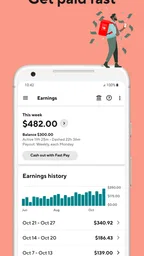
- Earnings details make completed deliveries easy to track.
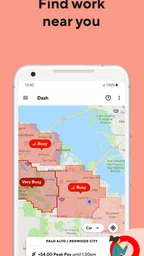
- Peak pay can increase earnings during busy periods.
- Delivery preferences help Dashers find suitable orders.
What could be better
- Order availability can vary widely by location.
- Vehicle and maintenance costs reduce take-home earnings.
- Some orders involve long waits at restaurants.
- Customer ratings can affect access to delivery opportunities.
- Support responses may be slow during busy periods.





