
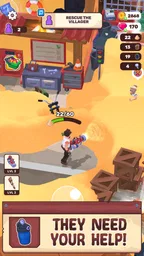
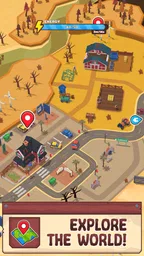
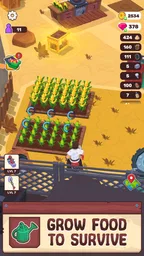
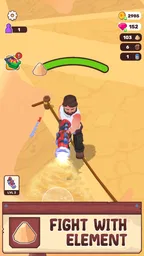
Wasteland Life: Survival Idle review
 Analysis by Appsdrops
I like survival games best when their setting changes the decisions I make, rather than serving as a backdrop for familiar chores. Wasteland Life: Survival Idle has a strong starting idea: turn a harsh, sandy world into a place where people can live again. It blends role-playing progression with strategy and city-building, so the appeal is less about surviving through constant danger and more about steadily making a damaged landscape useful. That gives it a clear identity, although the idle approach may feel too hands-off for players who want to direct every step.
Making progress in a world of sand
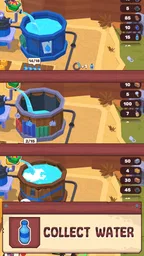
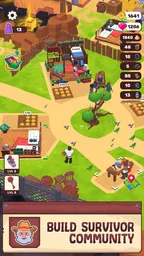
The central pleasure is watching a settlement take shape from a barren environment. Instead of treating the wasteland as scenery, the game frames rebuilding as the main goal. That lends ordinary progress a satisfying purpose: you are not simply collecting for the sake of a bigger number, but helping a community endure in a world that has become difficult to inhabit.
Its mix of role-playing progression and strategy is suited to short visits. I can imagine checking in between other tasks, deciding what deserves attention, and returning later to see how the settlement has developed. The idle structure is useful when I want the sense of a project moving forward without committing to a long session. It is not the same kind of survival experience as a game built around precise combat, hunger management, or moment-to-moment exploration.
That distinction is worth knowing before installing it. The premise suggests a broad survival adventure, but the more useful expectation is a gradual rebuilding game with a post-apocalyptic theme. If your favorite part of survival games is making tense decisions under immediate pressure, this may feel relaxed. If you like seeing a rough starting point become more organized over time, the slower rhythm is a better fit.
Why the rebuilding premise works
Sand gives the setting a practical identity. A ruined city or forest can make recovery feel familiar; a landscape defined by an overwhelming desert makes the idea of creating a livable settlement feel more focused. I find that kind of framing helps keep progression legible. When the environment itself communicates scarcity and hardship, even small signs of improvement can feel like meaningful movement toward the larger goal.
There is also a useful difference between rebuilding a town and merely upgrading a character. City-building gives progress a visible, shared destination, while role-playing elements provide a sense of personal advancement. Those two motivations can complement each other: one encourages me to think about the settlement as a whole, and the other gives a reason to keep engaging with the journey. The balance is the key question for each player. Someone who wants deep city-planning choices may want more control than an idle game typically emphasizes, while a casual player may appreciate not having to micromanage every detail.
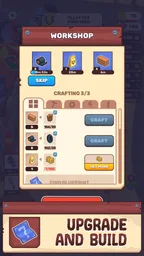
For practical play, I would approach each visit with one clear intention instead of tapping through everything automatically. Check what the settlement needs, make a deliberate choice, then leave the game to its gradual pace. That simple habit can make an idle builder feel less like a routine of collecting and more like a sequence of small planning decisions. It is especially helpful when playing in brief breaks, because it gives each session a purpose without requiring a long stretch of attention.
The friction behind the relaxed pace
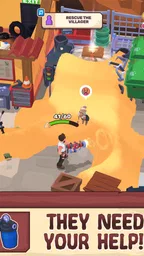
The biggest trade-off is that idle progress can reduce the feeling of agency. If you prefer to choose every construction detail, manage a complex resource chain, and react to frequent threats, a game that emphasizes gradual development may not give you enough to do. The same structure that makes it convenient for quick check-ins can also make a longer session feel repetitive if progress relies on returning to collect and continue.
That is not a flaw for every audience. I see it as a matter of matching expectations: Wasteland Life is better for steady, low-pressure progress than for demanding survival simulation. Players looking for a hands-on crafting sandbox or tactical combat should compare it with games centered on those activities. Here, the rebuilding theme and the convenience of idle play are more important than constant challenge.
Another point to consider is spending. The game is free to start, but it includes in-app purchases, with individual items priced from $0.99 to $99.99. That wide range makes it sensible to decide in advance whether you are comfortable with optional purchases. I would first see whether the ordinary pace suits me before paying for anything; the appeal of an idle game should come from enjoying its gradual loop, not from feeling obliged to speed it up.
For families, the age rating is Everyone 10+, which gives a useful baseline when deciding whether it is appropriate for a younger player. I would still consider the child’s comfort with post-apocalyptic themes and the presence of in-app purchases. For anyone who shares a device, keeping spending decisions deliberate is a good way to avoid turning a casual building game into an unexpected expense.
Who will get the most from it
I would recommend it to players who enjoy watching a settlement develop, like survival settings but do not need constant danger, and prefer games that fit around a busy day. A realistic use case is a quick break during a commute or while waiting for an appointment: open the game, make a couple of considered decisions about the community’s progress, and put it away. That is a better match than expecting a focused, hour-long session full of demanding action.
It may also suit someone who wants a gentler entry into survival-themed games. The setting supplies the fantasy of rebuilding after catastrophe, while the idle format avoids making every moment feel urgent. I would not choose it for a player whose main reason for playing is detailed city layouts, direct control over every survivor, or difficult resource optimization. Those preferences point toward a more hands-on strategy or survival title instead.
When deciding whether to try it, consider what you want to feel after a session. If you enjoy seeing a community inch toward stability, the premise gives you a clear reason to return. If you need precise objectives and frequent new decisions to stay engaged, the slower structure could wear thin. That is the most useful test: do you find gradual rebuilding calming, or does it feel like waiting?
Where it sits among survival and strategy games
Compared with conventional role-playing games, this one puts more emphasis on a community and its surroundings than on a character’s moment-to-moment adventure. Compared with management games, its wasteland setting gives the act of building a stronger survival context. And compared with active survival games, its idle approach favors convenience over constant control. That combination is distinctive enough to help players decide, but it also means it will not replace every kind of game in those categories.
The best way to judge it is on the experience it actually promises through its premise: gradual efforts to build a functioning city in a hostile environment. I would not approach it expecting a deep simulation simply because it has strategy elements, nor expect a conventional action role-playing game just because it belongs to that broader family. It is most appealing when treated as a relaxed progression game with a survival-world theme.
Made by SayGames Ltd, it has an average rating of 3.9 from around 88,000 ratings, with about 7,100 written reviews and over 10 million installs. It is free to play, rated Everyone 10+, and was released on November 21, 2023. Version 3.3.5 requires Android 8.0 or later. Those figures suggest a widely tried game with a mixed reception rather than an obvious universal favorite, which fits my own measured recommendation: the concept is easy to understand, but the pace will not suit everyone.
My verdict on the long-term appeal
For me, the strongest reason to try it is the clear connection between the setting and the goal. Rebuilding a city in a sandy wasteland gives the progression a more coherent mood than a generic upgrade loop, and the idle format makes it approachable for short sessions. Its weakness is the other side of that convenience: players who want active survival pressure or deep, continuous management may find it too passive.
I would give it a try if you want a low-pressure city-building game with a survival backdrop, especially if you like checking in briefly and seeing gradual change. I would skip it in favor of a more hands-on alternative if you want to control every decision or be challenged at every turn. The game’s appeal is not that it reinvents survival; it is that it offers a calm, purposeful version of rebuilding after disaster, and that is a satisfying niche when it matches your mood.
What we like
- Idle production continues while you are away.
- Short tasks make it easy to play in quick sessions.
- Exploration gradually unlocks new areas.
- Upgrades give a steady sense of progress.
- The post-apocalyptic setting gives the game a distinct look.
What could be better
- Progress can slow when upgrade costs rise.
- Energy limits how much you can explore at once.
- Repeated resource gathering can feel monotonous.
- Some rewards and upgrades may encourage optional purchases.
- Later progression may require extended waiting.







