
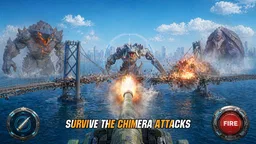





Titan Rush review
 Analysis by Appsdrops
I’m cautious about recommending a strategy game before I know what its moment-to-moment decisions feel like, and Titan Rush gives me a reason to look closely at both the appeal and the spending context. It is a free strategy game from RATING GAME, with a Teen content rating. The central promise is a contest under pressure: the store tagline evokes retreating tides and holding ground, but that alone doesn’t tell me how a match plays or what a player must do to progress. My recommendation, then, is measured: it may suit people drawn to strategic competition, but the purchase range makes it worth approaching with a clear budget.
What the price and purchase range mean in practice
There is no upfront price to download, which lowers the barrier to trying it. The important distinction is that free to start does not mean every part of the experience is free. In-app purchases range from $0.99 to $199.99 per item. That is a broad spread, and the high end is substantial enough that I would decide my own spending limit before opening the shop or responding to any purchase prompt.
That range does not, by itself, reveal what an item does, whether it is optional, or whether spending changes the pace or outcome of play. I would not treat the largest price as proof that purchases are necessary, nor assume that every purchase is cosmetic. Those details matter to fairness, and they cannot be settled from the price range alone. If you are choosing a game for a household, it is sensible to review purchase controls on the device and agree on a budget before playing.
The game is currently at version 4.11.0, and it has an average rating of 4.5 from around 37,000 ratings, alongside roughly 900 written reviews. That is a substantial body of player response, though an average cannot tell you whether the experience matches your preferences. I would read recent comments for recurring discussion of progression and purchases rather than relying on the score as a guarantee.
Starting with a sensible spending boundary
My practical approach to a free strategy game with this purchase range is to play first and postpone buying anything until I understand what problem the item is meant to solve. If a prompt appears when I am stuck or impatient, I would pause instead of treating the purchase as the obvious next move. That simple delay helps separate a genuine convenience from pressure created by wanting to advance immediately.
It is also useful to notice whether a purchase is a one-off choice or part of a pattern of repeated prompts. The listed range tells me the possible cost of individual items, but not how frequently offers appear or whether purchases recur. I would check each confirmation screen carefully, especially if children or other family members use the same device. For players who prefer a fixed, once-paid price and predictable spending, that uncertainty may make a premium strategy game a better fit.
Progress without assuming how the game works
The title and tagline suggest a game built around resistance and momentum, but they do not establish its rules, modes, resource systems, or session length. I can’t honestly claim that it has a particular unit roster, base-building loop, campaign, or multiplayer format. That distinction is important: strategy fans often choose games based on exactly those systems, and guessing would give you a false picture of what you are downloading.
Instead, I would use the opening sessions as a structured test. Pay attention to what the game asks you to decide, how clearly it explains the consequences, and whether a mistake teaches you something useful. In a strategy game, a satisfying loss usually points to a decision you can change next time; a frustrating one leaves you unsure whether planning mattered. That is a better early test than simply asking whether the first match was easy.
A useful tip is to avoid spending during the same session in which you first encounter a difficult obstacle. Come back later and see whether a different approach works. This gives you a chance to judge whether the challenge rewards learning or merely encourages a shortcut. It does not assume that Titan Rush sells a shortcut; it is a practical way to evaluate any purchase prompt without confusing frustration with value.
Who may enjoy the pressure, and who may not
I would consider trying it if you like strategy games that frame play around holding firm and adapting under pressure, and if you are comfortable investigating the rules as you go. It may also suit someone browsing free-to-start games who wants to judge the basic experience before deciding whether it earns more time. The game has over a million installs, which shows that many players have tried it, but popularity alone does not establish how well it serves a particular kind of strategist.
I would be more hesitant if you need a clearly described, self-contained campaign, dislike purchase offers, or want to know in advance exactly how much time a match takes. The information available here doesn’t establish those qualities, so I would not promise them. If you need a fully transparent progression plan before committing, a strategy game with a detailed explanation of its modes and economy may be the more comfortable choice.
For an everyday test, imagine having a short break and wanting one focused game rather than a long evening session. Install it only if you are happy to use that first break to learn the controls and basic decisions, not to judge the whole experience. If it leaves you wanting to plan another attempt, that is a good sign. If the session feels confusing or a purchase prompt dominates your attention, there is little reason to push through just because the download cost nothing.
Fairness is a question to check, not assume
Competitive fairness depends on details such as whether paid items affect strength, whether players are matched by ability, and whether free progress remains viable. None of those points can be concluded from the price range or rating. I would therefore avoid calling the game pay-to-win, but I would also avoid assuring you that spending has no competitive effect. The fair conclusion is that the purchase structure is visible while its effect on competition remains unclear.
If you do find competitive play in the game, compare what determines a result across several sessions: decisions, timing, familiarity with the rules, or access to purchased items. One match is not enough to identify the cause of a win or loss. This is a concrete way to assess fairness without assuming a particular mode exists or treating a single opponent as representative.
For players who care strongly about an even playing field, I would make that a deciding question before investing time. Look for clear explanations within the game of what purchases provide, and consider community reviews for repeated, specific accounts rather than isolated complaints. If the answer remains unclear, a strategy title with an explicit competitive model is a safer recommendation for serious ranked play.
Details worth checking before you commit
The age guidance is Teen, so I would treat it as a signal to check whether the game’s themes and purchase flow suit the person who will play. It is not a substitute for looking at the experience yourself, particularly if a younger player uses the device. The purchase range makes family spending settings especially relevant, even though the presence of in-app purchases does not tell us how often offers appear.
The listed minimum operating-system version is 7.0. Before downloading, check that your device meets that requirement and has enough available space for the installation. Compatibility is only one part of a smooth experience; an older operating system that meets a minimum requirement may still feel different from a newer device, so I would judge performance on the hardware you actually plan to use rather than assuming identical results for everyone.
Another useful distinction is the difference between a game being free to install and being a good fit for a player who avoids spending. The former is clear; the latter depends on whether the core play remains satisfying without purchases. I would give the basic experience a fair trial, keep purchases disabled or controlled if needed, and reassess after learning what the game asks you to do. If progress feels enjoyable on those terms, that is more meaningful than any general claim about value.
How it compares with familiar strategy choices
Compared with a paid strategy game, Titan Rush has the easier entry point because there is no upfront charge, but its in-app purchase range introduces a spending question that a fixed-price game may avoid. Compared with a free strategy game that clearly explains its modes and progression, this one leaves more for a prospective player to investigate. Neither comparison proves which game is better; it clarifies the trade-off I would use when choosing.
If you enjoy discovering a game through play and can stay deliberate around purchases, the free download makes a low-commitment trial reasonable. If you prefer to know the complete rules, expected session length, and competitive economy before installing, choose an alternative that spells those out. That preference is not excessive caution: strategic play depends on understanding what decisions matter, and a buyer should be able to judge whether the game’s structure suits them.
My trust verdict
My recommendation is to try it cautiously, not to spend on faith. The game’s free entry, strategy focus, and sizeable player reach make it worth investigating for the right person. At the same time, its purchase range reaches $199.99 per item, and that figure deserves attention before any purchase. I would download only if I were willing to evaluate the game’s actual decisions and spending prompts for myself.
The release date is Mar 12, 2026, and the game is listed as developed by RATING GAME. Those facts help identify the title but do not answer the questions that matter most to a strategy player: what a match demands, how progress works, and whether money changes competitive outcomes. I would keep those questions open until the game itself or a clear, detailed explanation resolves them.
In short, Titan Rush is a reasonable free trial for someone curious about a pressure-themed strategy game and comfortable setting firm purchase boundaries. It is not my first choice for someone seeking a clearly documented competitive system or a guaranteed no-spend path. Give it a brief, deliberate test, resist buying while learning, and keep it only if the decisions—not the pressure to continue—are what make you want to return.
What we like
- Fast rounds make it easy to play in short sessions.
- Simple controls are approachable for new players.
- Unlockable content gives players goals to work toward.
- Bright visuals make the action easy to follow.
- Runs well on a broad range of mobile devices.
What could be better
- Repeated level patterns can make longer sessions feel stale.
- Progress may depend on replaying earlier stages.
- Touch controls can feel imprecise during fast action.
- Later challenges may have abrupt difficulty spikes.
- Advertisements can interrupt the flow of play.







