






State.io — Conquer the World review
 Analysis by Appsdrops
State.io makes a strong first impression by turning a strategy game into a clean, readable contest over territory. I like how quickly its central idea comes across: react to changing fronts, send forces where they can matter, and try to take control of the map. It is easy to understand what the game wants from me, but the pressure comes from deciding what to do before the situation shifts again. That makes it a good fit for short bursts of focused play rather than a sprawling campaign that demands a long evening.
This is a free strategy game from CASUAL AZUR GAMES, and its large audience suggests it has found a broad appeal: it has more than 100 million installs, alongside an average rating of 4.1 from around 665,000 ratings. Those figures are useful context, but they do not tell you whether its particular blend of quick decisions and simplified warfare suits you. My take is that the appeal lies less in military simulation and more in the satisfying push and pull of claiming space under pressure.
Maps that make the conflict easy to read
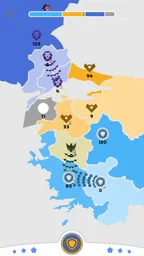
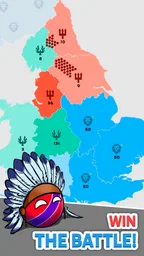
The visual language is built around territory and movement rather than a detailed battlefield. That choice helps the game stay legible: I can focus on which areas need attention instead of parsing elaborate scenery or a crowded interface. The map is not trying to tell a realistic war story. It gives the conflict a simple, almost abstract setting, so the important question remains where to act next.
That simplicity is a genuine strength on a phone. Strategy games can become frustrating when small screens make it difficult to distinguish the information that matters, but State.io’s uncluttered presentation supports quick scanning. I can look at the map, form a plan, and revise it without feeling that decorative detail is competing with the decision. The trade-off is that players looking for distinctive factions, rich environmental storytelling, or a strong sense of place may find the world visually spare.
The restrained art direction also affects how I interpret mistakes. Losing ground feels like a consequence of a poor choice or delayed response, rather than a dramatic event staged through elaborate animation. That keeps the mood light and approachable. It also means the game’s personality comes chiefly from the changing map and the pace of the contest, not from characters or a narrative that asks me to become invested in a particular side.
For a practical tip, I find it helpful to treat the map as a flow of attention rather than a checklist of places to own. When several fronts demand action, the most tempting move is not always the most useful one. Pausing to identify which area could change the balance of the contest makes the simplified visuals work in my favor: they show the shape of the problem without burying it in detail.
A soundscape that supports quick decisions
State.io’s mood is centered on brisk competition, and the pacing does more to establish that feeling than any elaborate presentation. The game encourages me to stay alert, notice a shift, and respond. That creates a compact loop: examine the territory, decide where to concentrate, and see whether the move improves my position. It is a satisfying rhythm when I have a few minutes and want something that still asks me to think.
I would not choose it primarily for audio or atmosphere in the cinematic sense. The appeal is the focused tempo of a map-based strategy challenge, rather than a sweeping soundtrack or a story-driven sound design. That distinction matters if you are choosing between this and a more immersive strategy game. State.io is better approached as a quick tactical diversion; a slower title is a better choice when you want to settle into a world, study a campaign, or let audio carry much of the experience.
The quick rhythm is not always a benefit. If I am interrupted often, I may have to return to a situation whose momentum has changed, and the game’s emphasis on response can make an unfocused session feel less satisfying. I would play when I can give it a little attention, even if the session itself is brief. It is not the kind of strategy experience I would pick when I want to leave a game running in the background and check in casually.
Strategy shaped for the phone
As a strategy game, State.io favors immediate decisions over layers of long-term management. Its central challenge is to react quickly while trying to conquer territory, rather than spending a long time preparing a detailed plan before a conflict begins. That makes it approachable for people who enjoy tactical choices but do not want to learn a dense rulebook first. The game is rated for Everyone, which fits its accessible, abstract presentation.
Compared with the usual alternatives in the genre, it sits on the fast and straightforward end of the spectrum. A grand strategy game is a better match if you want diplomacy, extensive resource planning, or a persistent empire to develop. A turn-based tactics game is preferable if you want time to weigh every action without a brisk contest pressing you forward. State.io occupies a useful middle ground for players who want strategic thinking in a format that is easier to pick up than those deeper formats.
One useful way to approach a session is to resist treating every newly available move as an urgent command. First identify the front that seems most likely to affect your overall position; then commit attention there rather than scattering decisions everywhere. This is not a hidden mechanic, but a way of making the game’s fast pace more manageable. It helps turn quick reactions into purposeful choices instead of a stream of clicks made simply because the map is moving.
Another trade-off is that quick strategic games can reward familiarity with their rhythm as much as careful planning. If you enjoy learning how to read a changing board, that gives repeated sessions a clear purpose. If you expect deep variation from each match or a long arc of character and world development, the compact setup may feel thin. I recommend treating it as a repeatable challenge, not as a substitute for a full-scale strategy campaign.
Who will enjoy the pace—and who may not
I can see State.io working well during a short break when I want more engagement than a passive time-killer but do not have room for a long session. It asks me to make choices, yet its basic premise is easy to grasp. That combination makes it approachable for someone new to strategy games, while the need to keep reassessing territory gives experienced players a reason to stay attentive.
It is less suitable if you dislike time pressure, prefer thoughtful turn-by-turn play, or want a detailed historical setting. The same simplicity that helps me read the map may leave you wanting more visual character. And if your favorite strategy games are built around slow development, complex alliances, or deep campaign systems, this one is likely to feel deliberately streamlined rather than satisfyingly expansive.
For an everyday scenario, I would open it while waiting for a friend or taking a short break, play with my attention on the map, and stop when I need to return to something else. I would not start it in the middle of a task that needs constant concentration, because its appeal depends on noticing the state of the conflict and responding rather than tapping through without thinking. That small distinction makes the experience more enjoyable and keeps its quick format from feeling like empty busywork.
Value, version, and a sensible expectation
The game is free to download, with in-app purchases priced from $0.49 to $24.99 per item. That means it is easy to try without paying upfront, but anyone who prefers to avoid optional spending should keep that range in mind. I would start by deciding whether the core territorial strategy is enjoyable on its own, rather than assuming that a purchase is needed to make the game worthwhile.
Version 4.5.1 is the current release, and the minimum operating-system requirement is 7.1. The game first appeared on November 27, 2020, so it is not a brand-new experiment; it has had time to build a sizeable audience. If you are considering installing it, check that your device meets the requirement and approach it as a lightweight strategy game, not as a large simulation with a long learning curve.
With around 20,000 reviews and its broad install base, State.io clearly reaches far beyond a niche audience. I would still use the game’s style as the deciding factor: popularity does not make a fast, simplified strategy loop right for everyone. Its rating of 4.1 gives a helpful snapshot of player sentiment, but your preference for quick map decisions versus slower, more detailed planning matters more.
A focused mood rather than a grand war story
What stays with me is how consistently the game’s presentation serves its central activity. The uncluttered map makes territory the star, the quick rhythm keeps decisions moving, and the abstract setting avoids pretending to offer a detailed account of warfare. The result is a coherent, playable mood: alert, competitive, and easy to return to when I want a brief strategy challenge.
State.io is at its best when you want clear territory-focused choices without the weight of a complex campaign. I would recommend it to someone curious about strategy games who values fast sessions and readable maps. I would steer a player seeking deep simulation, rich storytelling, or unhurried tactical planning toward a different kind of game. For me, its strongest quality is that it knows what sort of experience it wants to deliver—and keeps the focus on the next decision.
CASUAL AZUR GAMES has made a game that is easy to understand but still asks for attention. If that balance sounds appealing, the free download makes it straightforward to see whether its pace suits you; just remember that optional purchases are part of the package. I would keep it on my device as a quick strategic diversion, not as my choice for a long, immersive campaign.
What we like
- Quick matches make it easy to play in short sessions.
- Simple controls are easy for new players to learn.
- Territory expansion creates engaging tactical decisions.
- Offline play is available for campaign levels.
- Bright visuals make the map easy to read.
What could be better
- Later levels can feel substantially more difficult.
- Ads may interrupt the flow between matches.
- Progress can rely on repeated upgrades.
- Strategic options are simpler than in complex strategy games.
- Online features may require a stable connection.







