







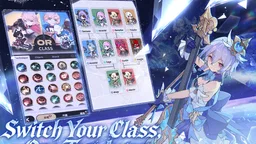
Sword x Staff review
 Analysis by Appsdrops
I went into Sword x Staff expecting a familiar role-playing adventure, but the title’s pairing of sword and staff gives it a clear identity before the journey even begins. Its setting is Kanstein, and the premise leaves room for players to shape their own adventure rather than promising a narrowly defined route. That makes it appealing if you like discovering a world at your own pace, though it also means the game’s real draw will depend on how much you enjoy exploring its particular take on fantasy RPGs.
A fantasy RPG with a deliberately open-ended pitch
At its core, this is a free role-playing game from BOLTRAY GAMES. The sword-and-staff contrast is an evocative hook: it suggests two different kinds of fantasy action, but I would treat it as a theme rather than assume particular combat rules or character roles. The most useful question for a prospective player is whether Kanstein and its adventure hold your attention, not whether the title alone guarantees a deep combat system.
The game is currently at version 1.0.0, released on May 13, 2026. That is a helpful point of reference for anyone deciding whether to join now: you are looking at the initial numbered release, not a long-running version with a documented trail of updates. I wouldn’t mistake that for proof that the experience is unfinished, but it does make it sensible to approach the game with measured expectations about how much content and refinement are already in place.
Its audience is broad within the usual RPG crowd. If you enjoy fantasy settings and want a game whose framing leaves the shape of the adventure open, it is worth a look. If you need a specific promise—such as a particular battle format, a lengthy story campaign, or a certain multiplayer mode—don’t infer that from the title or the short premise. Those expectations can make an otherwise interesting game feel like the wrong purchase, even when it costs nothing to start.
What the sword-and-staff identity does—and doesn’t—tell you
The title gives the game a memorable image, but I find it more useful as a mood-setting choice than as a complete explanation of play. A sword and a staff naturally evoke different fantasy approaches, and that contrast can help the game stand out among role-playing releases. Still, a player should wait to see how those ideas are actually expressed in play rather than deciding in advance that one weapon represents a particular class or strategy.
This distinction matters when comparing it with more conventional RPG alternatives. Some games lead with a detailed description of their combat loop, character builds, or party systems; Sword x Staff leads with a concise fantasy identity and a setting. That can be refreshing if you prefer to discover the shape of a game yourself. It is less reassuring if you choose RPGs mainly by checking a list of mechanical features before installing.
For a first session, I’d pay attention to the early minutes rather than trying to judge the whole game from its theme. Notice whether the presentation makes Kanstein easy to understand, whether the opening gives you a clear reason to continue, and whether the sword-and-staff idea becomes meaningful in the actual experience. Those are practical signals of fit, and they are more useful than assuming the game will match another RPG just because both use familiar fantasy imagery.
Where it sits among role-playing games
Role-playing games cover everything from tightly directed stories to sprawling systems that reward careful planning. Sword x Staff’s short pitch places emphasis on the player’s adventure in Kanstein, which may suit someone who wants the feeling of setting out into a fantasy world without first committing to a highly specific premise. Compared with a game that advertises a precise story structure or a complex tactical ruleset, its appeal is more about the invitation than a checklist of mechanics.
That makes it a potentially comfortable choice for short, exploratory sessions. If I had a little downtime and wanted to sample a fantasy setting, a free starting point is easier to justify than paying upfront for a game whose style I haven’t tested. On the other hand, if I wanted a deeply explained system to master or a clearly defined narrative goal from the first screen, I would compare it with RPGs that make those priorities explicit.
One practical tip is to decide what you want from the game before starting: atmosphere, a new world to explore, or a specific kind of challenge. Then judge the opening against that goal. This avoids the common trap of expecting every RPG to provide the same mix of story, action, and progression. Sword x Staff’s identity is distinctive enough to be intriguing, but the player’s own preference still matters more than the genre label.
What the launch version means for players
Because version 1.0.0 is the current release, existing players have a simple baseline for discussing their experience: they are playing the game’s first numbered version. There is no established sequence of changes to compare against, so I wouldn’t claim that a certain system has improved or that a past problem has been fixed. For someone arriving later, that also means advice from players should be checked against the version they actually have installed, rather than treated as timeless guidance.
The release date is May 13, 2026, and the game has already attracted over a million installs, with an average rating of 4.6 from around 139,000 ratings. Those figures suggest substantial interest and a broadly positive response, but they don’t tell me whether the game will suit an individual player. I’d use them as a reason to consider trying it, not as proof that its pacing, fantasy style, or systems will match your tastes.
The rating also needs a little context. A high average can coexist with genuine differences in what players value: some may be drawn to the setting and overall presentation, while others may care most about specific RPG mechanics. I’d treat player feedback as a way to spot recurring impressions, especially around the aspects you personally care about, rather than relying on the score alone. The game has about 4,900 written reviews, enough to give a prospective player material to browse without turning any single comment into a guarantee.
Cost, age guidance, and a sensible way to try it
The game is free to install, with optional in-app purchases priced from $0.49 to $99.99 per item. That range is wide, so I’d recommend opening the purchase details before spending and deciding on a personal limit in advance. A free entry price lowers the barrier to trying Kanstein, but it doesn’t mean every later option is free. If you’re sharing a device with a younger player, it’s worth checking purchase controls as well as the game’s age guidance.
Its content rating is Teen, which makes it more appropriate to consider for older children and teenagers than a game intended for very young players. Families should still make their own call based on the player and their comfort with the game’s content. On the technical side, the minimum operating system is Android 7.0, so checking the device’s software before installing is a straightforward way to avoid an unnecessary failed download.
A useful everyday approach is to try it during a short break, then stop and ask whether the world itself makes you want to return. That is a better test than continuing simply because you have already installed a free game. If it catches your interest, you can spend more time learning its rhythm. If it doesn’t, you have learned that its particular fantasy direction is not for you without having to make a large upfront commitment.
Who is likely to enjoy it, and who may prefer something else?
I’d point Sword x Staff toward players who like fantasy RPGs, enjoy meeting a new setting without needing every detail spelled out immediately, and are comfortable judging a game through play rather than a long feature list. The “make your own adventure” framing is especially appealing to someone who wants to explore at their own pace and is open to seeing what Kanstein offers.
I’d be more cautious if you want a specific kind of RPG experience and choose games based on confirmed mechanics. The same applies if you strongly prefer a well-established release with a long record of version changes, or if optional purchases would make a free-to-start game uncomfortable for you. In those cases, an alternative that clearly documents its systems and purchase structure may be a better fit, even if Sword x Staff’s premise sounds appealing.
It is also not automatically the best pick for a player who only has time for a very focused, short-form game. Role-playing adventures can ask for attention and investment, and the open-ended framing may appeal more to someone who enjoys settling into a world than someone who wants every session to have a sharply bounded objective. I’d choose it for curiosity about Kanstein, not just because I happened to be looking for any game in the RPG category.
What I’d watch as the game develops
For current players, the clearest thing to watch is how future versions shape the experience around the identity already established by the sword-and-staff name and Kanstein setting. Version 1.0.0 is the present reference point; anything beyond that should be treated as a possibility until an update actually appears. I would look for changes that make the game’s central appeal clearer or improve the parts that players find most important, rather than assuming that a particular feature is already planned.
For newcomers, the question is more immediate: does the opening experience give you enough reason to continue? Try the game, pay attention to whether its world and presentation land for you, and keep an eye on spending if you explore the in-app purchases. The developer is BOLTRAY GAMES, and the title is available as a free-to-play role-playing game for Android devices meeting its minimum OS requirement.
My overall view is cautiously positive. Sword x Staff has a clear fantasy identity, a setting that invites personal discovery, and a free starting point that makes sampling it straightforward. Its current version is an early reference rather than a long history of visible evolution, so I would avoid expecting a fully established feature set based only on the premise. If you want to explore a fresh fantasy RPG and are happy to decide for yourself whether its style clicks, it is worth trying. If you need a particular, clearly spelled-out system, compare it with alternatives before investing your time or money.
What we like
- Quick battles make it easy to play in short sessions.
- Distinct weapon styles add variety to combat.
- The fantasy setting gives the game a clear identity.
- Progression provides goals beyond individual battles.
- Touch controls are suited to mobile play.
What could be better
- Combat may feel repetitive after extended play.
- Progress can slow as upgrade costs increase.
- Small screens can make busy fights harder to follow.
- Some players may find the difficulty uneven.
- Long-term replay value may depend on updates.







