
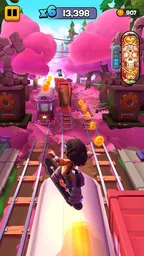
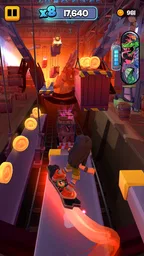
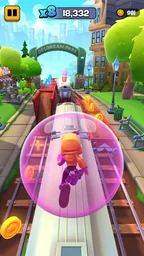
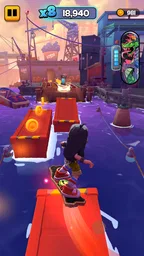
Subway Surfers City review
 Analysis by Appsdrops
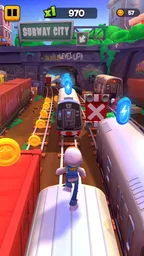
I would approach Subway Surfers City as a quick-action game for spare moments: start a run, react to what is in front of you, and see how far your timing carries you. Its premise is easy to understand, but the fun comes from staying alert as the route asks you to run, jump, dodge and make use of a hoverboard. If you have played endless runners before, you will recognize the basic appeal; if you have not, the controls and goals are approachable enough to make a first attempt feel manageable.
What a first run feels like
This is an action game from SYBO Games, built around movement rather than a long story or complicated preparation. The city setting gives the familiar runner format its own identity, while the changing obstacles make each stretch a small test of attention. I like this kind of design when I want an activity that begins immediately and does not require me to remember a long sequence of instructions.
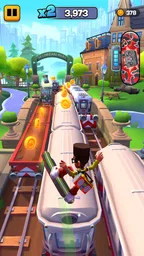
The main adjustment for a newcomer is learning to look a little ahead instead of reacting only to the obstacle directly in front of the character. A jump or dodge that feels obvious at the last second may come too late, so I would treat the opening runs as practice in reading the path. The first useful success is not necessarily a record run: it is getting through a section cleanly because you spotted the next hazard early and chose a response deliberately.
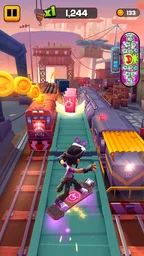
The hoverboard is part of the game’s central identity, but I would not assume that it removes the need for careful play. Think of it as something to use thoughtfully, not a substitute for watching the route. When a run gets busy, it is tempting to make several quick corrections at once. A calmer approach—identify the immediate threat, choose one move, then reset your attention—usually makes the action easier to follow.
As a first-time player, I would begin with short sessions and focus on one habit: anticipate. That makes the experience less frustrating than trying to master every movement immediately. It also gives you a practical way to tell whether the game suits you. If reacting to a lively route feels satisfying, the runner loop can be an easy fit. If you prefer slow exploration or uninterrupted narrative, the repeated focus on movement may feel too narrow.
Getting from install to a comfortable start
The game is free to download, and it is rated Everyone 10+. It supports Android 8.0 and later. I would check that your device meets that minimum before installing, then set aside a moment for a first run when you are not rushing. The opening experience is more useful when you can pay attention to the patterns of movement rather than trying to play between other tasks.
You do not need to arrive with a plan to spend money. In-app purchases are available, with listed prices ranging from $0.99 to $99.99 per item, so I would treat them as optional and decide on a personal spending limit before browsing any purchase options. For a new player, the sensible first step is to learn whether the basic running and dodging feel good. Paying before you know that would be putting the cart ahead of the board.
On a phone, I would also give myself enough screen space to see the route clearly and avoid playing while distracted. That is a practical tip rather than a special setting: glance at the path, make a move, and resist checking notifications during a run. The game’s quick-response nature makes interruptions matter more than they would in a slower puzzle game.
One useful way to make early progress feel concrete is to choose a single goal for each attempt. On the first, concentrate on recognizing hazards. On the next, try to make cleaner jumps or dodges. After that, pay attention to how the hoverboard fits into your decisions. This keeps a short session from becoming a string of vague attempts and makes it easier to notice what you are learning.
Your first meaningful success
For me, a good first milestone is finishing a run with a clear sense of why it went better: perhaps you anticipated an obstacle, avoided a panicked late move, or stayed focused through a denser stretch. That kind of progress is more encouraging than treating every run as a pass-or-fail test. The format naturally invites repeated attempts, but a small improvement in judgement can make the next one feel more controlled.
A realistic everyday use is a short break while waiting for a ride or taking a pause between chores. I would start one run rather than promise myself a long session, then stop when I have reached a satisfying attempt. Because the action is immediate, this works better than a game that needs a lengthy setup. The trade-off is that it is not ideal when you have only a few seconds or need to keep your attention elsewhere; a sudden interruption can leave you reacting at the wrong moment.
Another practical tip is to notice which mistakes repeat. If you often collide after making a last-second correction, try looking further ahead and choosing earlier. If you lose focus when several obstacles appear close together, slow your decision-making mentally: handle the next clear problem rather than trying to predict every move at once. These are small habits, but they turn the runner’s reflex challenge into something you can improve at instead of pure luck.
The game’s broader appeal is supported by its established audience: it has more than 10 million installs, around 339,000 ratings and a 4.6 average rating, alongside roughly 7,800 written reviews. Those figures suggest plenty of players have tried it, but they do not tell me whether its particular pace will suit you. I would use your first few runs as the real test: the key question is whether the movement feels satisfying enough to make another attempt appealing.
Where new players can get confused
The first common misunderstanding is expecting a runner to reward speed alone. Moving quickly is only part of the challenge; choosing the right response matters just as much. If a run ends, it is worth asking whether you reacted too late or made a move without checking what came next. That quick reflection is more useful than immediately repeating the same pattern.
Another source of friction is the urge to treat every obstacle as an emergency. In a game built around running, jumping and dodging, rapid inputs feel natural, but unnecessary corrections can make the route harder to read. I recommend keeping your attention on the next decision and avoiding a flurry of moves. The goal is not to press more; it is to respond with better timing.
New players may also wonder whether they need to buy anything to enjoy the game. Since it is free to start and offers optional in-app purchases, I would first spend time with the basic experience. Purchases can be a consideration for anyone who is easily tempted by optional spending, so setting a boundary beforehand is a sensible safeguard. If you want a game with no purchase prompts or no optional spending at all, this may not be your preferred choice.
The release date is February 25, 2026, so this is a relatively new entry for anyone deciding whether to try it. It is also worth remembering that familiarity with other endless runners helps with the general rhythm but does not guarantee that every move will feel automatic here. Give yourself time to adjust to this game’s own routes and pacing instead of judging it by muscle memory from another title.
How it compares and who should choose it
Compared with a slower action game, Subway Surfers City is better for short, focused bursts than for careful exploration. Compared with other endless runners, its recognizable city-running setup and hoverboard emphasis offer a familiar starting point, while the main draw remains the repeated challenge of reading a route and reacting cleanly. I would choose it over a more complex action game when I want to get into motion quickly; I would choose a story-led or strategy-focused alternative when I want decisions that unfold at a slower pace.
It is a good match for players who enjoy reflex challenges, replaying a short run to improve, and games that can fit into a break. It can also work for someone new to the genre, provided they are comfortable learning through attempts rather than expecting a detailed tutorial to do all the work. The Everyone 10+ age rating gives families a useful starting point when considering suitability, though adults should still decide whether the action and purchase options fit their household preferences.
I would skip it if repeated runs quickly feel monotonous to you, if you strongly prefer games with a clear narrative destination, or if you dislike optional in-app purchases even when the game itself is free. It is also not my first pick for a commute where I need to watch my surroundings constantly. A compact puzzle game is safer for that sort of divided attention, while this one is most enjoyable when your eyes and reactions can stay with the route.
What to try after the first run
Once the basic controls feel natural, make your next step a focused practice session rather than a spending decision. Pick one improvement—earlier hazard recognition, steadier dodging, or more considered use of the hoverboard—and see whether it changes the run. This gives you a personal measure of progress and helps you decide whether the game has enough depth for your taste.
SYBO Games has made a straightforward action game whose strongest quality is the ease of getting into a run. I find its appeal clearest when I want a lively, low-commitment challenge and can give it my attention for a few minutes. Its limitations are equally plain: the core loop depends on repeated play, and optional purchases may be unwelcome to some people. Still, if you enjoy learning a route through quick decisions, Subway Surfers City is worth trying free and judging by how satisfying that first clean run feels.
What we like
- Quick runs make the game easy to enjoy in short sessions.
- Distinct districts add variety to the familiar endless-runner format.
- New obstacles keep familiar routes from feeling entirely predictable.
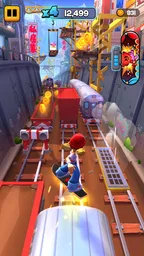
- Bright visuals make hazards and collectibles easy to spot.
- Simple swipe controls are accessible for new players.
What could be better
- Frequent visual effects may feel busy on smaller screens.
- Some missions require repeated runs to complete.
- Progress can feel slow without regular play.
- Limited-run events may pressure players to return often.
- The familiar runner formula may offer little novelty for veterans.







