


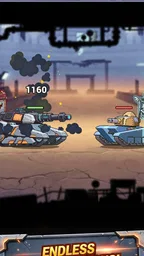

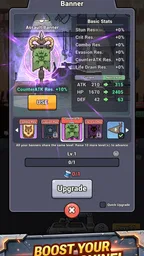
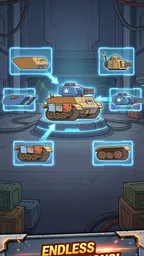
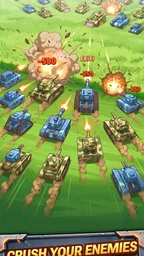
Steelborn: Tank Idle RPG review
 Analysis by Appsdrops
I’d approach Steelborn: Tank Idle RPG as a compact, competitive role-playing game rather than a sprawling fantasy adventure. Its appeal is the idea of shaping a warrior tank and taking that build into PvP fights: you make a character, improve it, then find out whether your choices hold up against another player. That gives a first-time player a clear goal, even if the finer details of progression take time to learn.
Developed by SayGames Ltd, this free game is rated Everyone and sits in the role-playing category. It has a 3.8 average from around 5,600 ratings, with more than 500,000 installs. Those figures suggest a sizeable audience, but they don’t tell you whether its particular mix of tank-building and arena battles will suit you. I’d recommend it most to players who enjoy gradually strengthening a focused character and then testing that progress, rather than people looking for a story-first RPG or a broad roster of heroes.
What the tank-building idea asks of you
The central choice is not simply whether to win a fight; it is how to build a warrior that can take one. That distinction matters. In a conventional RPG, I might spend most of my attention on quests, exploration, or a party of characters. Here, the tank is the project. PvP gives that project a practical test, so improvements feel more meaningful when they change how confidently you can enter a battle.
The word “idle” in the game’s name may lead some players to expect that nearly everything happens without input. I wouldn’t rely on that assumption. The game’s stated focus is arena combat and building a warrior, so it is sensible to think of idle progression as part of the experience rather than a promise that every session is hands-off. If you want a game that plays itself while you ignore it, check how the actual loop feels before deciding it fits.
For a newcomer, a useful first goal is modest: understand what makes your tank stronger, then take it into a PvP match once you feel ready. You do not need to plan an elaborate long-term build before starting. Treat early play as a chance to learn the connection between upgrades and results, not as a test you must ace immediately.
Getting started without overthinking the build
On your first session, I’d resist the urge to spend every available resource as soon as it appears. Look at the choices the game presents and note which ones seem to improve the tank directly. Make one or two changes, then use the arena as a checkpoint. This creates a simple comparison: did the adjustment make your next fight feel more manageable, or did it fail to address the problem?
That small experiment is more useful than changing several things at once. If you upgrade multiple parts of a build together, a win or loss tells you very little about which decision mattered. Making a single change between attempts gives you a better feel for the game’s cause and effect, even if the match outcome is not perfectly predictable.
I’d also set a spending boundary early. The game is free to download, but it offers in-app purchases ranging from $0.99 to $299.99 per item. That is a wide range, so I would treat purchases as optional rather than assume they are needed to understand the game. If you are trying it casually, begin without spending and decide later whether a paid option genuinely solves a problem you have encountered.
Your first useful win is a learning tool
A first victory is satisfying, but the more valuable success is learning why your tank performed well enough to win. After a match, take a moment to connect the result with your recent choices. Did your changes make the character feel more dependable? Was the match close, or did it expose a weakness you can address? Even a loss can be productive if it gives you a clear next experiment.
This approach is especially handy when you only have a short break to play. Rather than entering several battles without a plan, use one attempt to test a particular adjustment. If the result is inconclusive, you can stop and return later with a more focused question. That makes the game easier to enjoy in small sessions and reduces the temptation to spend just to force an immediate win.
For example, imagine opening the game during a commute or while waiting for an appointment. You have time for a brief check-in, not a long RPG session. I’d use that moment to inspect the tank, make one deliberate change if needed, and try an arena fight only if I can give it attention. The benefit is a clear stopping point: the session has either confirmed a choice or shown what to reconsider next time.
Where new players can get confused
The main potential friction is the gap between “build a tank” and knowing which build decisions are worthwhile. A game can make upgrades easy to tap while still leaving a beginner unsure what to prioritize. If you find yourself making changes without understanding their purpose, slow down. Keep track mentally of what you changed and judge it by how the next fight feels instead of assuming that every available upgrade is equally urgent.
Another possible mismatch is the competitive focus. PvP means your opponent is part of the experience, so progress may not translate into a smooth chain of easy victories. If you lose, it does not automatically mean your tank is badly built or that you must pay to continue. It may simply be a sign to pause, reconsider your last choices, and try again when you have a clearer idea of what you want to improve.
Players should also distinguish between wanting a tank-building game and wanting a traditional role-playing campaign. If your favorite RPGs are driven by a large cast, long dialogue scenes, exploration, or a carefully unfolding narrative, this may not deliver the kind of variety you want. Steelborn’s strongest identity is the relationship between a warrior build and arena competition. That narrower focus can be refreshing, but it is also a real limit.
How it compares with other RPG choices
Compared with story-led mobile RPGs, this game appears better suited to someone who wants a direct loop: develop one warrior, then use PvP to see how that development holds up. You trade the broad narrative and exploration many RPGs offer for a more concentrated character-building objective. That is a good exchange if you like tuning a single combatant; it is a poor one if you want the feeling of travelling through a large world.
Compared with purely idle games, the arena angle gives your progress a competitive destination. You are not only watching a number rise; the stated draw is fighting other players. But if you prefer a calm collection game with no pressure to compare your performance, the PvP element may be less appealing than the idle label suggests. Think about whether competition motivates you or makes a relaxing session feel like work.
The game’s version is 1.3.1, and it requires Android 8.0 or later. That is useful to check before installing on an older device. The rating and age guidance make it broadly accessible to families, but I would still keep the purchase range in mind if a younger player will use the device. A free download does not mean every optional purchase is inexpensive.
Who should give it a chance
I’d point this toward players who like a focused progression goal, enjoy learning from head-to-head matches, and don’t mind repeating a central loop while refining a character. It can also suit someone who wants an RPG-flavored game that does not ask them to commit to a long narrative session every time they open it. Starting with a no-spend trial and a small, testable build plan is a sensible way to find out whether the arena keeps you interested.
I’d steer story seekers toward a more narrative-heavy RPG, and players who dislike competitive outcomes toward a quieter solo game. It may also not be the best match for anyone who expects an idle title to remove all active decision-making. The useful question is not whether the game is universally good; it is whether you enjoy improving one warrior and letting PvP expose the strengths and gaps in that work.
A sensible next step after your first matches
Once you have a feel for the basic loop, avoid treating every defeat as an emergency. Pick one weakness to address, make a measured adjustment, and compare the next attempt with your previous experience. If you are winning and still enjoying the process, continue building gradually. If you are no longer curious about what a change will do, that is a fair sign the game’s central loop may not have enough variety for you.
Overall, I see Steelborn: Tank Idle RPG as a focused choice for players who want their character-building to lead straight into PvP testing. Its clearest strength is that the tank is both your project and your way into the arena; its clearest trade-off is that this narrow focus may not satisfy people seeking a full-scale RPG adventure. I’d install it for a low-pressure trial, learn through a few deliberate build choices, and spend only if the core competition has already earned your interest.
What we like
- Tank upgrades provide a clear sense of progression.
- Idle rewards make progress possible between play sessions.
- Short encounters suit quick gaming breaks.
- The tank-focused theme offers a change from fantasy RPGs.
- New stages provide goals to work toward.
What could be better
- Progress can slow when upgrade costs rise.
- Idle rewards may require frequent collection.
- Combat relies heavily on automated actions.
- Repeated encounters can feel similar over time.
- Some upgrades may take substantial grinding.







