


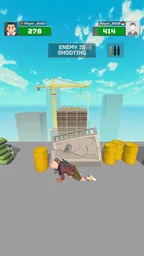




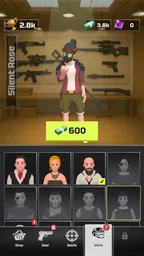
Shoot & Hide review
 Analysis by Appsdrops
I see Shoot & Hide as a quick action game best suited to short bursts of attention, not a long, relaxed session. Its premise asks you to balance two instincts: act quickly when there is an opening, then get out of sight before trouble catches up. That makes it easy to understand, but the fun depends on timing rather than simply tapping as fast as possible. In a shared household, that gives it an appealing pick-up-and-play quality, as long as players are comfortable taking turns rather than expecting a shared campaign or coordinated team mode.
How it fits into a shared-device routine
The most natural household use is informal: one person plays a round while someone else waits, then hands the device over. Because the central idea is immediately legible, a new player does not need a long explanation before trying it. I would introduce it with a simple rule of thumb: look for a safe moment to shoot, but treat hiding as part of the action, not an afterthought. That helps a beginner understand why rushing every opportunity can backfire.
It is an action game from CrazyLabs LTD, and its focus is much narrower than that of a large campaign shooter. I find that useful when someone wants a compact distraction between chores, during a short break, or while waiting for another household member to finish using the phone. It is less suited to a living-room session built around detailed planning or long-term cooperative play. The appeal is in the quick decisions, not in managing a complicated group activity.
When sharing one device, I would keep turns short and agree on who is playing before opening the game. That may sound obvious, but action games can invite “one more try” loops, and a clear handoff avoids arguments over whose turn it is. If several people want to compare how they approach the same challenge, let each person play in sequence and talk through the choice to shoot or hide. That makes the game a small social activity without assuming it has built-in multiplayer or shared progress.
Make the handoff deliberate
On a phone used by more than one person, the practical question is not only who gets the next turn; it is also whether the device is already open to the right person’s account and settings. Before handing it over, I would check that the intended player is using the appropriate profile on the device and that any purchase protections are handled at the device level. Those are sensible shared-device habits, rather than features I would expect this particular game to provide.
It is also worth treating a handoff as a clean pause. Let the current player finish what they are doing rather than grabbing the device during a tense moment, and make sure the next person knows whether they are continuing the same session or starting fresh. That small bit of coordination matters more here than a lengthy tutorial: the game’s fast-action premise means a distracted player can lose the thread quickly.
Keep accounts and spending separate
The game is free to download, with in-app purchases ranging from $0.99 to $99.99 per item. That broad range is a reason to make purchasing expectations clear before a child or guest uses a shared device. I would use the phone or tablet’s own purchase safeguards and keep the device owner’s account protected; I would not assume that the game itself has household profiles, spending limits, or parental controls.
For adults sharing a phone, it is still useful to agree that purchases are not part of a casual turn unless everyone has discussed them. If a younger player is using the device, the account owner should check the payment settings before handing it over. This is less about suspecting a problem and more about avoiding an accidental tap becoming a household disagreement. Free access makes it easy to try, but it does not mean every optional purchase is irrelevant to a family budget.
I would also avoid treating a shared device as a shared identity. If different people use the same phone, they may have different comfort levels around progress, purchases, or screen time. Decide who is responsible for the device and who may play before starting. The game can be a convenient common activity, but the boundaries come from the people and device settings around it, not from any family-management feature I can promise.
Who is likely to enjoy the play style?
The key trade-off is pace. A player who enjoys reacting under pressure and switching between aggression and caution may find the shoot-and-hide rhythm satisfying. Someone who wants a slow tactical game, a rich narrative, or a deep set of character systems should look elsewhere. Compared with many action games that emphasize constant firing, this one’s premise gives retreat and concealment equal importance. That can make each decision feel sharper, but it also means a player who dislikes stop-start tension may find the rhythm frustrating.
A useful way to approach a difficult moment is to resist firing as soon as a target or opening appears. First take a brief look at what is happening, then choose whether a shot is worth the exposure. If the situation feels unsafe, hiding is not wasted time; it is the other half of the game’s central loop. This is a practical adjustment for impatient players, and it gives younger or newer players a simple decision-making habit instead of encouraging frantic tapping.
Another small but helpful household tip is to keep the first few turns observational. Ask a new player to notice what seems to signal danger and when it feels safe to act, rather than telling them to copy someone else’s reflexes. That makes the game easier to learn without pretending there is a hidden tutorial or a special training mode. It also reveals quickly whether a person enjoys this kind of pressure or would rather play something calmer.
Age, trust, and expectations
Shoot & Hide has a Teen content rating, so I would not treat it as an automatic choice for every child simply because it is free and easy to start. A parent should consider the intended player’s maturity and comfort with action-game content, then make the decision using the family’s own standards. For a teen who already enjoys fast action games, its straightforward premise may be an accessible option. For a younger child, I would review the experience first and supervise the initial use rather than relying on the app’s broad appeal.
The game has an average rating of 4.5 from around 65 thousand ratings, with about 577 written reviews, and it has passed over five million installs. Those figures suggest that it has reached a sizable audience, but popularity is not a substitute for checking whether its pace and age context suit the person holding the device. I would use audience response as background, not as a guarantee that every household will enjoy it.
It was released on June 17, 2025, and the current version is 1.11.1. The minimum operating-system requirement is version 8.0, which gives owners of older compatible devices a clear starting point when deciding whether installation is possible. If the game is intended for a shared family tablet, check the device’s operating-system version and available space before planning a group turn; there is little value in promising a game night around a device that cannot run it comfortably.
What to expect from the free download
Since the download costs nothing, trying it is a relatively low-commitment way to see whether the basic action suits you. Still, I would separate “free to try” from “free of spending decisions.” The listed purchase range is wide, and a person who wants a completely purchase-free household experience should set that boundary before anyone plays. If you are choosing for yourself, you can simply decide whether the core action is enjoyable before considering any optional spending.
For a shared device, the better workflow is to install and test the game yourself first, then decide who else should have access. That gives you a chance to judge the pace, the content, and whether its purchase options fit your household expectations. It also avoids asking a child to make those decisions in the moment. I would not build a family routine around assumed account separation or parental tools; plan around the device’s existing controls and the rules you set together.
The biggest limitation for group use is that the game’s appeal is individual: one person reacts and chooses when to fire or hide. That makes it easy to pass around, but it does not automatically create cooperation. If your household wants people to play together at the same time, a multiplayer action game designed around shared objectives is a better fit. If you want a quick game that can be enjoyed one turn at a time, this format is more appropriate.
My household verdict
I would recommend Shoot & Hide to someone who likes compact action games and is happy to alternate between taking a shot and finding a safer moment. It is especially convenient for a short break or a casual hand-to-hand turn on one device, and the core idea is simple enough to explain without a long setup. Its free download makes trying it easy, while its in-app purchase range means the device owner should decide how spending is handled before sharing it.
I would skip it for a household seeking a calm game for very young children, a deep story-driven experience, or built-in teamwork between players. The Teen rating deserves attention, the fast pace will not suit everyone, and shared-device boundaries have to be managed by the people using the device. For the right player, though, the balance between quick action and timely retreat gives it a more thoughtful feel than a game built around nonstop shooting alone.
Overall, I see it as a good candidate for a teen or adult who wants a brief burst of action and does not mind learning through trial and error. Try it first on the device that will actually be shared, agree on turns and purchases, and let each person decide whether the pressure is fun or simply too frantic. That is the fairest way to find out whether its particular mix of shooting and hiding belongs in your household’s rotation.
What we like
- Quick rounds make it easy to play in short sessions.
- Simple controls are approachable for new players.
- Stealth adds a tactical twist to the shooting gameplay.
- Matches reward timing and careful positioning.
- The hide-and-seek theme gives the game a distinctive feel.
What could be better
- Gameplay may feel repetitive after extended play.
- Matches can be frustrating when opponents have more experience.
- The shooting may lack depth for players seeking complex combat.
- Progression may take time for players who prefer quick unlocks.
- A small player population could make matchmaking slower at times.







