





Rollance : Adventure Balls review
 Analysis by Appsdrops
I like quick action games best when their challenge is clear from the first move, and Rollance: Adventure Balls gets to its point without asking for much setup: keep a ball moving across a precarious route and try not to send it tumbling away. That simple premise makes it easy to pick up for a short break. It also puts the entire experience on a narrow track: the pleasure comes from steering carefully, noticing danger early, and deciding whether another attempt is worth it.
One small move starts the challenge
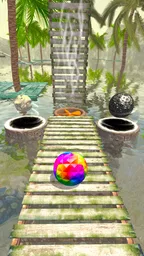
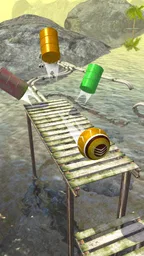
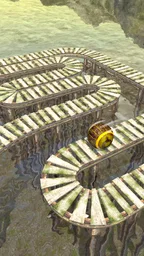
As an action game from CASUAL AZUR GAMES, Rollance is built around a rolling ball and paths suspended high above the ground as well as routes on solid terrain. The contrast gives the central task a little variety: a mistake on a lofty stretch feels more consequential, while grounded sections change the visual setting without changing the basic need for control. The appeal is not a complicated story or a large set of systems. It is the immediate question of whether I can keep the ball on course.
That makes the first few moments easy to understand, but not necessarily effortless. A rolling object carries momentum, so simply pointing toward the next safe spot is not the whole job. I have to think about how much correction a bend needs and whether an adjustment is likely to help or send the ball too far the other way. The useful habit is to make small, early corrections rather than wait until the ball is already close to an edge. It is a modest difference in approach, but one that makes the challenge feel more deliberate.
The game suits players who enjoy direct, physical-feeling tasks: guide something through a risky space, respond to what is in front of you, and learn from a fall. It is also a natural fit for short bursts on a phone. I can imagine opening it while waiting for a drink or taking a brief pause between errands, making an attempt, and putting it aside without needing to remember a complicated plot. That convenience is part of its identity, not a substitute for depth.
Players looking for a long campaign, elaborate character progression, or a broad collection of tactical choices should set their expectations accordingly. Rollance puts its attention on the rolling challenge. If I want a game where each session is about planning a build or developing a story, a different action game is likely to be more satisfying. If I want a small test of attention and control, the focused premise is a strength.
Why control is more about timing than speed
The most useful way to approach a difficult stretch is to look ahead rather than fixate on the ball itself. I try to notice where the route begins to curve, then make a measured adjustment before the turn becomes urgent. This is especially helpful on narrow elevated paths, where reacting at the last instant can turn a recoverable wobble into a fall. The game’s simple objective makes this kind of self-coaching easy: after a mistake, I can usually identify the moment when my correction was late or too strong.
That feedback is a practical form of learning rather than a guarantee that every failure feels fair. When a ball is already moving quickly, a correction can feel less precise than I want, and an overreaction may be hard to undo. I find that treating each attempt as a chance to judge the route, not merely to rush farther, is more rewarding. The trade-off is clear: players who enjoy refining their timing may find the challenge absorbing, while anyone who expects perfectly forgiving steering may find it frustrating.
The rhythm of action, mistake, and response
Rollance’s core rhythm is easy to describe: move, read the path, adjust, and deal with the result. Safe progress gives a small sense of control; an unstable approach prompts a quick correction; a fall breaks the run and invites a fresh try. That compact sequence is why another session can begin so easily. There is no need to reconstruct a complicated plan after a mistake. I can simply take the lesson from the previous attempt and test a different timing choice.
The same rhythm can also expose the game’s limits. Repeating a section is motivating when I can see what I want to do differently, but less so if a run ends and I feel I have learned nothing. The game is at its best when I treat failure as information: perhaps I started steering too late, perhaps I pushed too far, or perhaps I was watching the ball instead of the path ahead. That mindset makes the reset feel purposeful rather than merely repetitive.
For a realistic everyday use, I would play it in a short, interruption-friendly window rather than plan a long evening around it. A few attempts during a commute break or while waiting for an appointment can give me a complete little challenge without demanding sustained concentration for hours. If I get interrupted, the basic objective is easy to return to. On the other hand, someone who prefers a calm game to unwind may not appreciate a task where a moment of inattention can end progress.
What counts as a reward here
The main reward is the satisfaction of keeping control through a stretch that initially looked awkward. It is a small, immediate payoff: I made a better adjustment, stayed on the route, and reached farther than before. That kind of progress works well in a game whose central action is so easy to grasp. It does not need a complicated explanation to make a careful run feel like an achievement.
There is a useful trade-off in that simplicity. A player motivated by mastering movement can enjoy the sense of improvement even when the reward is mainly the successful run itself. A player who needs a deep progression system, a strong narrative payoff, or a steady stream of new strategic decisions may find that the core pleasure runs thin. I would choose Rollance for an immediate control challenge, not as a replacement for a larger adventure game.
It also helps to separate the game’s challenge from the temptation to rush. Moving quickly can feel like a way to get past a difficult section, but a careful approach gives me more time to read the route and correct my line. When a run goes wrong, I try changing just one thing on the next attempt—such as starting the turn earlier—instead of making several different adjustments at once. That makes it easier to tell whether my choice helped.
How it compares with other action games
Compared with action games built around combat, aiming, or elaborate combinations of moves, Rollance is much more focused on steering and balance. That makes it approachable in a different way: I do not need to learn a roster of abilities before understanding what I am trying to do. Compared with endless runners, its ball-and-route premise gives the challenge a more hands-on feel, although the experience still depends heavily on reacting to hazards and keeping forward progress under control.
This focus is a good reason to try it, but also a clear reason to skip it. If I want busy screens, lots of attacks, or several independent systems to manage, a conventional action game will offer more variety. If I enjoy a simple physical challenge where a small steering decision matters, Rollance gives that idea room to breathe. It is best judged against other quick arcade-style action games, not against large games that promise hours of story or layered progression.
Practical expectations before playing
The game is free to download, with in-app purchases listed at $1.99 per item. I would approach those purchases as optional spending rather than assume they are needed to enjoy the basic idea. The important decision is whether the rolling challenge itself appeals to me; if it does, I can start without treating a purchase as part of the entry price. If I prefer to avoid optional spending entirely, it is worth keeping that preference in mind before using any in-game purchase options.
Rollance has an average rating of 4.2 from around 91,000 ratings, with about 1,300 written reviews, and it has passed 100 million installs. Those figures suggest that the simple premise has found a large audience, though popularity alone cannot tell me whether its steering style will suit me. It is rated for Everyone, so its broad, straightforward presentation is easier to share across ages than a game built around mature themes.
Released on August 15, 2022, Rollance is a focused choice for a quick action break rather than a game I would recommend to someone seeking an expansive new world. Its strongest quality is the clean link between action and consequence: I make a correction, see whether it worked, and decide whether to try again. Its biggest limitation is the same narrow focus; if repeated steering challenges stop being fun, there is not a broader mode of play to change the mood.
Who should give it a try
I would recommend Rollance to someone who likes short, skill-based challenges and does not mind learning through occasional falls. The most helpful tip is to make corrections early and lightly, then use each reset to test a specific change. That turns the game from a string of hurried attempts into a small exercise in timing and attention.
I would point a player elsewhere if they want a substantial campaign, a peaceful experience, or an action game with many different ways to play. For everyone else, the decision is simple: do you enjoy guiding a rolling ball along a route where a small mistake matters? If yes, the loop has a clear reason to start again: the next run offers another chance to make a cleaner move. If that repeated test sounds more tiring than satisfying, its simplicity will probably feel restrictive rather than refreshing.
What we like
- Simple controls make the game easy to pick up.
- Short levels suit quick play sessions.
- Ball movement gives familiar platforming a fresh feel.
- Collectibles add goals beyond reaching the finish.
- The colorful visuals make obstacles easy to spot.
What could be better
- Precise jumps can take repeated attempts.
- Later stages may feel challenging for casual players.
- Frequent retries can become frustrating.
- The rolling physics may take time to master.
- Some levels offer limited variety in their obstacles.







