




Police Chief review
 Analysis by Appsdrops
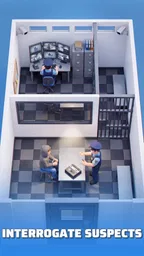
I like strategy games that give me decisions to weigh rather than a string of battles to tap through, so a police-station management premise caught my attention. Police Chief puts the appeal in the role: you are responsible for a station and its development, not simply watching a police story unfold. That makes it an easy game to consider for a short break, though the real test is whether its management decisions stay interesting once the novelty wears off.
It is a free strategy game from VoyagerOne IE, with optional in-app purchases listed from $0.99 to $99.99 per item. The game is rated Teen, and its store version is 0.1.158. It has an average rating of 4.8 from around 216,000 ratings, with over 5 million installs. Those figures suggest broad interest, but they do not tell me whether spending is necessary or whether progress is balanced for every player; I would treat them as context, not proof of a particular experience.
What managing a station asks of you
The central attraction is the fantasy of turning a local police operation into a respected organization. That is a more appealing hook to me than a strategy game built only around collecting units or winning fights, because it gives each decision a clear theme. You are thinking like a chief: how to run the station, what deserves attention, and how to build toward a bigger reputation.
That framing also sets expectations. This is best approached as a management game with strategy elements, rather than as a detailed police simulator. Players looking for realistic casework, procedural investigation, or a story-driven detective adventure may find the premise points in a different direction from what they want. I would try it for the broader sense of overseeing a police operation, not for a promise of authentic law-enforcement procedures.
In a typical session, I would expect the satisfaction to come from checking the station’s situation, deciding what to prioritize, and seeing whether those choices move the organization forward. The useful habit is to make each visit purposeful: choose one improvement or goal, carry it through, and then decide what matters next. That gives a management game a rhythm instead of turning each session into aimless tapping.
One practical tip is to resist treating every available upgrade or task as equally urgent. In station-management games, spreading attention too thin can make progress feel slow even when several small improvements are underway. I would first identify the bottleneck that most clearly holds back the next step, then focus resources there before switching to another target. It is a simple way to keep the strategy legible and to notice which decisions actually help.
Progress feels better with a plan
The “world-renowned chief” ambition gives progression a natural long-term direction, but it can also make the early stretch feel like setup. I enjoy that sort of gradual build when each new milestone changes how I think about the station. If progression instead becomes a checklist of repetitive actions, the theme alone will not keep me engaged indefinitely. For that reason, I would judge the game by whether its management choices continue to create trade-offs, not just by how quickly the organization grows.
A realistic use case is a brief break between errands or during a quiet part of the day. I would open the game, review what is currently holding progress back, make a focused decision, and leave rather than trying to force a long session. That approach suits a management premise because it makes planning part of the fun. It is less suitable if you want a game that delivers a complete, intense challenge in one sitting or lets you finish a meaningful story quickly.
Another useful way to play is to keep a mental note of what you changed and what result followed. Even without a spreadsheet, comparing one priority at a time helps separate a genuinely effective decision from a purchase or upgrade that merely looks attractive. This matters particularly in a free game with paid items: deliberate choices make it easier to tell whether you enjoy the underlying management loop or are relying on spending to smooth over frustration.
Spending and fairness need a careful read
The listed purchase range runs from $0.99 to $99.99 per item, so the potential cost of optional purchases varies substantially. That is enough reason for me to set a personal spending limit before playing, especially if I tend to make impulse purchases when progress slows. The existence of paid items does not, by itself, establish that payment is required, that purchases provide a competitive edge, or that free progress is unfair. I would not assume any of those things without seeing them in play.
For a fair test, I would begin without buying anything and pay attention to how the game feels across several sessions. Does progress remain satisfying when I make patient choices? Do I understand what each decision changes? Is a delay a meaningful strategy trade-off, or does it simply make me want to pay to move on? Those are better questions than judging the game by the largest price shown. If the free loop feels enjoyable, optional purchases can remain optional; if it does not, spending more is unlikely to fix a mismatch in taste.
The game’s popularity—over 5 million installs and an average rating of 4.8—can make it seem like a safe recommendation, but ratings cannot answer a personal fairness question. A player who enjoys gradual management may be comfortable with a slower pace, while someone who expects rapid progress may read the same experience very differently. I would use the ratings as a reason to consider trying it, not as a guarantee that it suits my budget or preferred pace.
Where it fits among strategy games
Compared with a conventional combat-focused strategy game, Police Chief has a more administrative identity: the hook is building and managing a station rather than commanding an army. That makes it a better candidate for players who like prioritization and gradual organizational progress. If your favorite part of strategy games is tactical combat, direct competition, or finely controlled battles, a more battle-centered alternative will probably offer a clearer match.
It also differs from a full simulation in what the premise promises. The police setting supplies the identity, but I would not choose it expecting an exhaustive model of dispatch, investigations, or real-world police policy. Someone who wants a grounded simulation may be happier with a game that explicitly centers those systems. Police Chief makes more sense if you want the broad managerial fantasy and are content to let the theme support the strategy rather than serve as a documentary-style simulation.
That distinction is useful before installing: ask yourself whether you want to manage an organization, solve cases, or compete in tactical encounters. The first is the closest fit to this game’s stated premise. The others call for different alternatives, even if they share a police or strategy label. Knowing that can prevent the common disappointment of downloading a game for its setting and discovering that you actually wanted a different kind of play.
Small habits that make the experience clearer
I would keep sessions focused on one question: what is the most important obstacle to the next step? That avoids changing several things at once and then having no idea which choice helped. I would also avoid spending simply because a prompt appears at a moment of impatience. Waiting until I understand the value of an item—and whether the game remains enjoyable without it—is a more reliable way to protect both my budget and my opinion of the game.
For players who like checking in regularly, a second habit is to stop when the next decision is clear rather than continuing until the game feels like a chore. Management games can be satisfying in small doses because each visit becomes a chance to reassess. If the game only feels worthwhile when played for a long stretch, that is a sign it may not fit a busy routine. If short, intentional visits are rewarding, the station-building premise has a practical advantage over games that demand uninterrupted attention.
Who should try it—and who should pass
I would recommend giving it a look if you enjoy strategy games built around oversight, steady development, and choosing what deserves attention first. The station theme gives the management premise a specific identity, and the free entry point makes it possible to decide whether that identity appeals before spending. Its Teen rating is also worth checking against your own preferences or the needs of anyone you are choosing a game for.
I would skip it if you mainly want an intricate detective narrative, a realistic law-enforcement simulator, or a strategy game centered on immediate tactical combat. I would also be cautious if optional purchases tend to turn a relaxing game into a source of pressure for you. The wide range of listed item prices makes a spending boundary sensible; it does not tell me which items matter, so I would not budget around a purchase before seeing whether the free experience is enough.
A measured recommendation
My verdict is cautiously positive. Police Chief has a clear, appealing management premise, and its scale makes it easy to imagine as a game I would check during ordinary downtime. The strongest reason to try it is the chance to shape a police station through strategic choices, rather than merely consume a police-themed story. Its broad audience and strong average rating are encouraging, but the best evidence for a personal recommendation will be whether the progress loop remains satisfying without turning patience into pressure.
Because the game was released on May 6, 2026, I would also keep in mind that it is a relatively new release. It is currently at version 0.1.158, so a player’s experience may change as the game develops. I would not read that as a promise about future additions or fixes; I would simply approach it as a game whose current version is the one to judge today.
Overall, I would try it for free, play deliberately, and decide after a few focused sessions whether managing this station is genuinely enjoyable. If you find yourself weighing priorities and looking forward to the next step, it may be a good fit. If you are mostly waiting for the game to hurry up—or hoping it will become a detective or combat game—it is probably better to choose something built for that instead. Police Chief is most appealing when you want to think like a chief, keep spending on your own terms, and enjoy gradual strategy without expecting the premise to be something it is not.
What we like
- Offers a clear command role for players who enjoy management games.
- Short missions make it easy to play in brief sessions.
- Progression gives players new goals as their department develops.
- The police theme provides a distinct setting for strategy gameplay.
- Suitable for players who prefer planning over fast reflexes.
What could be better
- Management systems may feel familiar to experienced strategy players.
- Progress can slow down as upgrades become more demanding.
- Some missions may lack variety after extended play.
- Players seeking action may find the pace too restrained.
- Frequent reminders or prompts can interrupt the experience.







