



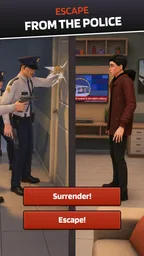


Pawn to Don Mafia Crime Story review
 Analysis by Appsdrops
The first thing I look for in a crime-story game is whether its choices feel like part of the drama or just buttons between scenes. Pawn to Don Mafia Crime Story sets out to make the decisions central: it is a role-playing game built around an interactive crime thriller, with a rise through a dangerous world suggested by its title. That premise gives it a clear hook, but it also sets a high bar. For me, the appeal depends on whether I want to steer a story and live with its turns, rather than spend my time mastering a complex combat or strategy system.
A crime story shaped by the player
Made by Funcell Games Pvt Ltd, Pawn to Don Mafia Crime Story is free to download and aimed at players aged 10 and up. Its role-playing label is useful context, though I would approach it first as a narrative game: the defining promise is that choices influence where the story goes. That makes it a natural pick for a short session when I want a bit of suspense and a decision to think about, rather than a long stretch of tactical play.
The game has an average rating of 4.6 from around 27,000 ratings, and has passed one million installs. Those figures suggest that its crime-story premise has found an audience, but they do not tell me whether its particular style will suit every player. If you enjoy stories about ambition, loyalty, and risk, the setup is easy to understand. If you mainly want a deep role-playing system with lots of character builds or hands-on combat, the story-first approach may feel limited.
First impressions: a focused premise, not an open-ended sandbox
The title points toward a climb from a low position toward power, and that gives the story an immediate direction. I find that more inviting than a crime setting with no clear personal stakes: a character’s changing status can make each decision feel connected to the larger arc. The trade-off is that a strong central trajectory is not the same as a freely explorable criminal underworld. I would choose this for narrative momentum, not on the assumption that it offers a sprawling simulation.
That distinction helps set expectations before playing. In a conventional action game, the pleasure often comes from movement, aiming, or timing. In this kind of interactive thriller, the more important question is what a choice says about the character and what consequences it might bring. I recommend paying attention to the wording and context of decisions instead of clicking through quickly. Even when a choice looks like a simple response, slowing down can make the story easier to follow and the decision more satisfying.
For an everyday use case, it fits a quiet break between other tasks: I can settle into a scene, make a choice, and leave the game when I reach a natural pause. It is less suited to a moment when I have only a few distracted seconds and cannot keep track of who wants what. Crime plots rely on relationships and shifting stakes, so playing while constantly switching attention can make the drama feel flatter than it should.
World language: crime drama rather than a guide to real life
The setting works best as a dramatic frame. The mafia theme supplies familiar tensions—status, trust, danger, and the cost of getting ahead—without needing the player to treat the game as a realistic account of organized crime. I would read its world through the character’s choices and the consequences they imply, not as a source of practical knowledge. That keeps the focus where it belongs: on the fictional conflict and the role the player takes within it.
Art direction matters especially in a story-led game because every scene has to establish mood quickly. A tense exchange should feel distinct from a moment of relief or an encounter where a character’s motives are uncertain. Rather than judging the visuals only by technical spectacle, I pay attention to whether they help me read the emotional temperature of a scene. The strongest use of a crime setting is not simply to make everything look dark; it is to make power and vulnerability feel present in the way characters meet and respond.
One practical way to get more from the narrative is to treat choices as clues to the game’s priorities. Before deciding, consider whether the response sounds cautious, confrontational, or loyal, and ask what kind of character that would make yours. This is not a promise that every decision has equal weight; it is a useful way to stay engaged with the role-playing side instead of treating scenes as a sequence of prompts. It also helps if you are playing casually and want to remember the character you are trying to shape.
There is a limitation to this form of storytelling: players who want complete control over a character’s personality may find a written choice menu narrower than free-form role-play. A story can offer meaningful direction without letting me express every possible motive. If that is a deal-breaker, a tabletop role-playing game or a more open-ended role-playing title may be a better fit. If you are happy to choose among authored paths, the more focused structure can make it easier to follow the drama.
Sound and rhythm: let the scenes breathe
Sound in a crime thriller has a quiet job: it helps create tension and gives scenes a sense of pace without taking attention away from the writing. I would approach the game with that in mind, giving dialogue and scene transitions room to work rather than rushing through them. If you usually play mobile games with the sound off, you can still follow the central appeal, but you may lose some of the mood that audio is meant to support. A quieter place and a comfortable volume are a sensible way to give the story a fair chance.
Its rhythm is likely to feel different from a match-based game. Rather than expecting constant action, I would look for a cadence of setup, decision, and consequence. That slower pattern can be a strength when I want to settle into a plot, but it can feel stop-start if I am looking for quick bursts of mechanical challenge. A useful habit is to pause after a consequential choice and take in the next scene before tapping onward. It keeps the story’s emotional beats from blurring together.
That pacing also affects when I would play. A commute with frequent interruptions may be fine for a self-contained scene, but a longer stretch is better when the plot is building toward a turning point. I would avoid beginning a story-heavy session when I know I will need to stop almost immediately. This is not a demanding strategy recommendation; it is simply the difference between remembering a character’s dilemma and returning later with no sense of why the decision mattered.
Compared with the usual alternatives in mobile role-playing games, this is a more narrative-first proposition. Many role-playing titles ask for attention to equipment, battles, or repeated progression loops. Here, the central draw is the crime-thriller framing and the chance to influence the character’s path. That focus is welcome if you want story without making every session about optimizing a build. It is a weaker match if you expect a steady stream of combat or systems to tinker with.
Mechanical fit: choices first, spending second
The core interaction is appealing because it gives the player a clear job: decide how to respond as the story develops. The challenge is not necessarily about finding a universally correct move; it is about choosing the response that fits the character you want to play and accepting the uncertainty that comes with it. I find that approach more engaging when I resist the urge to search for a perfect answer. A crime drama loses some of its tension if every decision is treated like a puzzle with an obvious solution.
There is also a practical question about cost. The game is free, with in-app purchases ranging from $0.69 to $59.99 per item. I would start without spending and see whether the story and its pacing hold my attention first. If a purchase prompt appears during play, it is worth pausing to decide whether the item would genuinely improve your experience or whether you are reacting to a moment of impatience. The wide range makes it especially sensible to set a personal spending limit before beginning.
That advice is useful for younger players as well. The age rating is Everyone 10+, but a rating does not replace a parent’s judgment about whether a crime-themed story is appropriate for a particular child. Since purchases are available, families may also want to review their device’s purchase controls together. This is a straightforward precaution, not a reason to assume that spending is necessary to enjoy the game.
The current version is 2.9.1, and the minimum operating-system requirement is 7.1. If you are deciding whether to install it, check that your device meets that requirement and leave enough attention for reading and following scenes. This is not the kind of game I would recommend to someone who wants a purely passive background experience. Its central mechanic asks for decisions, and those decisions work best when I am actually paying attention.
One trade-off worth considering is replay value. Choice-led stories invite players to wonder how a different response might change events, but that does not automatically mean every branch will feel equally substantial. If you enjoy revisiting scenes to explore another attitude or outcome, the premise gives you a reason to do that. If you prefer a game that constantly introduces new mechanical challenges, repeating story moments may feel less rewarding than trying a different genre.
Who will enjoy it—and who should look elsewhere
I would recommend it to players who like fictional crime dramas, character decisions, and a steady narrative pace. It is especially suitable for someone who wants a mobile game that can occupy a focused break without asking them to learn a large set of controls. The role-playing element makes it more personal than simply watching a story unfold: I can think about what kind of rise to power I want the character to pursue, even if the game’s available choices define the boundaries.
I would steer away from it if your priority is realistic crime-world detail, fast action, extensive character customization, or a sandbox where you can ignore the main plot. Those expectations point toward other kinds of games. Likewise, if you dislike pausing to read and weigh responses, the basic appeal may not land. A puzzle game would be better for compact problem-solving, while an action-focused role-playing game would suit someone who wants combat to carry most of the excitement.
Players who are unsure can make the first session a test of pacing rather than a commitment to finish the story. Notice whether you care about the people and stakes enough to consider each response, and whether the scenes hold your attention without constant mechanical rewards. That is a more useful measure than judging the game by its crime theme alone. If the decisions make you curious about what follows, it is doing the job this kind of experience needs to do.
Atmosphere is the reason to stay
My overall view is that this game is best approached as an interactive crime drama with role-playing choices, not as a broad or mechanically dense RPG. Its strongest potential lies in the connection between the mafia setting and the player’s decisions: the theme gives those choices a sense of consequence, while the focused story structure can make it easy to settle into a session. I would take my time with the scenes, play somewhere I can pay attention, and hold off on purchases until I know the experience suits me.
With an average rating of 4.6 and a community of roughly 27,000 raters, it has clearly drawn interest, but the right question is still whether its particular balance of story and interaction fits your habits. I would try it if you want a tense, choice-led break and are comfortable with an authored narrative. I would skip it in favor of a combat-heavy or open-world alternative if you want mechanics to take the lead. For me, that clear distinction is the most useful way to decide: come for the atmosphere and the decisions, and do not expect the game to be something it is not.
What we like
- The crime-story setting gives chess matches a distinctive theme.
- Turn-based play lets you take time to consider each move.
- The mafia premise may appeal to fans of crime fiction.
- Chess rules are familiar to many strategy game players.
- Matches can offer a focused alternative to action-heavy games.
What could be better
- The chess gameplay may feel familiar to experienced players.
- The mafia theme may not suit younger audiences.
- Players seeking fast-paced action may find the turns slow.
- The story may offer limited appeal to those who dislike crime themes.
- Chess knowledge can be a barrier for newcomers.







