




Helicopter Escape 3D review
 Analysis by Appsdrops
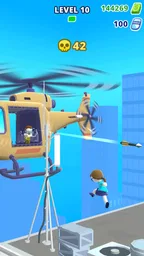
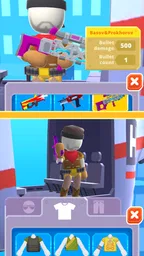
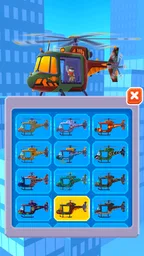
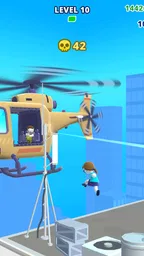
At a glance, Helicopter Escape 3D has a clear, pulpy premise: I’m above the action in a helicopter, trying to get a hostage out while using the aircraft’s weapons against enemies below. That setup gives each level an immediate purpose, and the game is easy to understand before I’ve had time to settle in. It’s a free action game from SayGames Ltd, and its appeal is less about a complicated battlefield than about turning a rescue into a brisk, visually direct challenge.
My first impression is that the game wants to keep me moving. The helicopter provides a strong viewpoint and a sense of urgency, while the rescue objective gives the shooting a reason beyond simply clearing targets. That combination makes it a natural fit for short sessions: a few levels can fill a break without asking me to learn a large set of controls or remember a sprawling story. The trade-off is that anyone looking for a deep campaign or a demanding tactical simulation may find the basic premise too light.
A rescue mission with a readable visual language
The setting is built around the contrast between a vulnerable person in danger and the firepower of the aircraft overhead. That contrast is the game’s most useful piece of visual storytelling. I can grasp what matters quickly: keep the rescue in view, identify the threats, and make the helicopter’s presence count. Rather than relying on a dense narrative, Helicopter Escape 3D uses a straightforward action-movie mood that supports its central task.
The 3D presentation helps make the action feel like an aerial operation rather than a conventional run-and-gun game. The viewpoint changes what I pay attention to: I’m not navigating a character through every space on foot, but responding to threats from above while the hostage remains the reason for the mission. That perspective is a specific strength, especially for players who enjoy seeing a scene unfold and reacting to it rather than exploring a large map.
The visual clarity also shapes how I approach a level. When a target appears, I want to judge whether engaging it helps the rescue or merely distracts me from the objective. The best way to enjoy the game is to treat every shot as part of the escape, not as an invitation to fire at everything on screen. That small change in mindset gives the missions more purpose, even when the underlying action stays simple.
The game’s tone is deliberately heightened. Helicopters, armed enemies, and a rescue under pressure belong to familiar action fiction, and the presentation makes that premise easy to read without demanding that I take the setting too seriously. It is suitable for a broad audience, with an Everyone 10+ age rating. Parents should still consider whether cartoonish shooting and hostage-rescue themes are comfortable for their child, rather than relying on the age label alone.
Sound and the pace of a quick session
Sound matters in a helicopter game because the aircraft should feel like more than a floating camera. The audio helps reinforce the sense of an active rescue and gives the action a more immediate, cinematic character. I find that this kind of presentation works best when I’m focused on a short burst of play: the mission starts, danger is apparent, and the pace carries me toward the next decision.
That brisk rhythm is convenient, but it can also make the experience feel repetitive if I play for a long stretch. The core fantasy remains consistent—oversee the situation from the helicopter and use its weapons to deal with enemies—so players who want frequent changes in setting, mood, or mechanics may tire of the loop sooner than casual players. I’d approach it as a game for spare moments, not as something that needs to occupy an entire evening.
A practical tip is to play when you can give the screen your attention, even if the session is short. The rescue framing makes it tempting to regard the game as background entertainment, but action that depends on spotting threats is more satisfying when I’m actually watching. A quick turn between other tasks suits it better than trying to play while distracted. If you want a quiet, story-led experience to unwind with, this is probably not the right mood; its appeal comes from urgency and impact.
Where the helicopter mechanics fit
Helicopter Escape 3D belongs to the accessible end of the action game spectrum. Compared with a traditional shooter that asks me to move through corridors, manage cover, and handle a larger set of combat decisions, this game puts the aerial viewpoint and rescue objective first. That makes it easier to pick up, but it also means the pleasure is in a focused action loop rather than in mastering a broad combat system.
For a better result, I’d keep the hostage’s safety in mind when deciding what deserves attention. The obvious target is not always the most important one if another threat is closer to the person being rescued. This is a useful way to add a little judgement to an otherwise direct experience: look at the relationship between the threat and the objective before committing to an attack. It makes the rescue feel more like a job to complete and less like a shooting gallery.
The aerial perspective is also a trade-off. It gives the game a distinct identity and lets the action read as a coordinated rescue, but it may not satisfy players who want precise movement through a level or the tactile feel of controlling a character on foot. If you usually prefer platformers, tactical shooters, or action games built around exploration, those alternatives will offer more control over positioning and more varied ways to approach a challenge.
Because the action is so immediately understandable, it can work well for a casual player who wants to open a game and get into a mission without a long tutorial. It is also a reasonable choice for someone who likes rescue scenarios and arcade-style combat but does not want a realistic military simulation. On the other hand, players sensitive to repeated combat or who want a substantial narrative arc should look elsewhere; the game’s central hook is the helicopter rescue itself.
What to expect from access and spending
The game is free to download, with in-app purchases listed from $2.99 to $99.99 per item. That range is worth noticing before installing, particularly if a child will be playing. I’d check purchase settings on the device and decide in advance whether spending is allowed. The presence of optional purchases does not change the basic appeal of trying a short action game, but it does make a little household planning sensible.
There is a broad audience for the format: the game has a 4.5 average from around 177,000 ratings, and it has passed 50 million installs. Those figures suggest that its easy-to-grasp rescue premise has reached many players, though popularity alone does not tell me whether its pace or repetition will suit you. I’d use them as context, then decide based on whether a compact, helicopter-centered action loop sounds appealing.
On the practical side, the current version is 1.18.32 and the game requires Android 8.0 or later. It was released on April 14, 2021. If you are choosing a game for a particular device, checking that operating-system requirement first is a simple way to avoid a frustrating install attempt. I’d also keep expectations focused on the experience described by the game: an action rescue built around a helicopter, rather than a broad simulation or a story-heavy adventure.
Who will enjoy it, and who may want something else
I’d recommend Helicopter Escape 3D to someone who likes compact action, dramatic rescue setups, and games that communicate their objective quickly. It is especially suited to short breaks when I want a clear task and an energetic presentation without having to keep track of a complicated plot. The hostage gives the combat a recognizable goal, while the helicopter view makes the game feel different from a standard character-based shooter.
It is less convincing for someone who wants a long-term progression project, a realistic flight experience, or finely controlled movement. The same simple premise that makes the game approachable can limit its variety for players who want each level to demand a completely different strategy. If that describes you, a deeper shooter or a flight game with more emphasis on piloting will likely be a better fit.
For an everyday example, I can imagine opening it during a short wait, playing a mission or two, and putting the phone away without needing to recall a complex objective later. That is where its format makes sense. If I have a longer stretch of free time, I would choose a game with more varied activities or a stronger story, because the helicopter rescue loop is most effective when enjoyed in concise bursts.
A focused action mood, with clear limits
What stays with me is the consistency between the game’s setup and its pace. The helicopter is not just scenery: it establishes the viewpoint, gives the combat its character, and makes the rescue feel like an urgent operation. The sound and action support that mood, while the straightforward objective keeps the experience accessible. I don’t need a complicated backstory to understand why the mission matters.
My reservation is that a strong central idea cannot by itself guarantee variety. If the rescue-and-shooting pattern is exactly what you want, the focused design is a plus. If you need a wider range of mechanics or a more involved world, it may feel thin after the novelty wears off. I’d keep that distinction in mind rather than expecting it to become a full-scale action adventure.
Overall, I see Helicopter Escape 3D as a convenient, energetic pick for players who want an aerial rescue fantasy in an approachable form. Its strongest feature is how quickly the helicopter viewpoint, hostage objective, and enemy threats come together into a readable scene. Its limitation is the narrowness of that same loop. If a short, cinematic-feeling action game sounds good to you, it is worth trying; if you want depth, exploration, or a more realistic challenge, I’d choose another kind of game.
What we like
- Simple controls make aiming and flying easy to learn.
- Short levels suit quick play sessions.
- Rescuing hostages gives each stage a clear objective.
- Bright 3D visuals make targets easy to spot.
- The action offers a satisfying casual challenge.
What could be better
- Gameplay can feel repetitive after several stages.
- Ads may interrupt the flow between levels.
- Aiming may feel imprecise during hectic encounters.
- Progression offers limited depth for long-term play.
- Performance may vary on older devices.







