

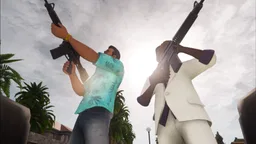





GTA: Vice City - Definitive review
 Analysis by Appsdrops
I think GTA: Vice City – Definitive is easiest to judge as a return to a particular kind of action game: a sprawling city, a story to follow at your own pace, and plenty of room to wander off-task. Its appeal is not a new mobile design built around quick rounds. It is the chance to revisit Vice City on a phone or tablet, with the freedom—and occasional friction—that comes with carrying a large, older-style open-world game around.
What you are paying for, and what the game asks of you
Rockstar Games developed this action game, which is free to download and rated Mature 17+. That free entry point is worth separating from the full spending picture: in-app purchases are listed at $19.99 per item. I would check the purchase details in the app store before committing, particularly if you are deciding whether the free download gives you enough access for your needs. The available purchase information does not establish what each item contains, so I would not assume that a particular payment is necessary to enjoy the game—or that every part of the experience is included at no cost.
The game was released on December 8, 2023, and its current version is 1.90.0. It requires iOS 11 or later, so an older device may rule it out before the question of gameplay even comes up. Its audience is substantial: it has over five million installs, with an average rating of 3.8 from around 22,000 ratings. Those figures suggest that many people have tried it, while the less-than-unanimous average is a useful reminder that a famous title and a familiar setting do not guarantee a perfect fit on every device.
I would approach the download as a chance to see whether this particular mobile release suits you, not as proof that the entire game will be free. Before spending, check the purchase screen and the app-store description for the exact terms shown to you. If you are downloading for a younger player, the Mature 17+ rating should be a deciding consideration rather than a detail to brush aside.
A city built for detours, not just missions
Vice City’s strongest draw is its sense of place. The game’s structure gives you reasons to move through the city and follow its action, but the setting is also what makes an unplanned session worthwhile. You can begin with a clear objective and still find yourself paying more attention to the streets, the atmosphere, or the simple pleasure of moving around than to finishing the next task. That blend is a better fit for open-ended play than for someone who wants a tightly guided sequence with no distractions.
That freedom has a trade-off. If you only have a few minutes and want a clean, self-contained match, a conventional mobile action game is likely more convenient. Vice City makes more sense when you can settle in, remember where you left off, and let a longer session develop. I would not pick it as my first choice for a quick queue between appointments; I would consider it for a quiet evening, a long break, or a commute where I have enough uninterrupted time to engage with its larger world.
Progress works best when you set your own pace
The game is more enjoyable when I treat progress as a loose plan rather than a checklist. A practical approach is to start a session with one main goal, then allow a little room for exploring before stopping. That keeps the city from feeling like a collection of chores while still giving the playtime direction. It also makes it easier to return later: instead of trying to remember every unfinished possibility, I can focus on the next thing I actually want to do.
There is a useful distinction between being drawn into the world and feeling pressured by it. I do not see the listed purchase price as evidence of a competitive advantage or a required shortcut, and I would not infer a pay-to-win structure from the existence of in-app purchases alone. The confirmed purchase detail is simply that items are available at $19.99 each. What those items do, whether they affect progress, and whether they change the experience are not established here, so I would avoid spending on the assumption that a purchase will solve a particular frustration.
For a player who likes to explore, the open format can make progress feel personal. For someone who wants constant guidance, clear short-term rewards, or a tightly controlled difficulty curve, it may feel less accommodating. That is not a flaw unique to the mobile release; it is a consequence of choosing a large, free-roaming action game over a mission-by-mission alternative. I would recommend it to a friend who enjoys setting their own agenda, but not to one who finds open-world wandering more tiring than relaxing.
Mobile play rewards a little preparation
One non-obvious tip is to decide what counts as a satisfying stopping point before you start. A mission or a deliberate pause after exploring is easier to remember than quitting in the middle of an aimless wander. That simple habit helps when a phone session gets interrupted, and it prevents the next launch from beginning with the vague question of what you were doing. The game’s scale is part of the appeal, but on a mobile device it can also make a session feel directionless if you do not give yourself a small objective.
Another useful trade-off is where you play. A portable device makes it easy to fit the game into spare time, but a large open-world experience benefits from enough attention to follow what is happening. If you are frequently distracted, trying to play while juggling messages or other tasks may make the story and city less engaging. I would save it for a stretch when I can focus, rather than expecting it to work like a quick-action title that remains satisfying with constant interruptions.
Compatibility is also a practical first check: the minimum requirement is iOS 11. If your device meets that requirement, it still makes sense to consider how you personally like to play action games on a touchscreen and how much time you want to give this kind of world. Those are preference questions, not claims about performance. I would rather be honest about them than promise that the game will feel effortless on every device or to every player.
How it compares with more conventional action games
Compared with mobile action games built around short matches, Vice City offers a different kind of value: continuity and a place to return to, rather than a series of compact rounds. That makes it more appealing when I want a longer escape and less appealing when I want instant action with a simple start-and-stop rhythm. It also differs from linear action games, which usually make the next objective more obvious. Here, the open setting is part of the entertainment, but it asks the player to bring some curiosity and patience.
I would choose a focused mission-based game instead if I wanted to know exactly what I would be doing in each short session. I would choose a free-roaming game like this when the setting itself is a reason to play. The distinction matters more than the broad label “action”: two games can share that category while serving very different moods. Vice City’s particular strength is not that it removes friction, but that its world can make the time spent in it feel worthwhile.
There are trade-offs in the other direction, too. A player who dislikes mature-rated content should skip it, and someone looking for a casual game for a child should choose a more suitable option. Someone who expects every part of a free download to be available without payment should also pause and inspect the in-app purchase details first. Those are clear reasons to choose something else, even if the game’s setting and reputation sound appealing.
What I would verify before spending
The purchase details call for a careful, ordinary check rather than a guess. The listed in-app purchases cost $19.99 per item, but that fact alone does not tell me what is being sold, whether there are several kinds of items, or how a purchase relates to access and progress. I would read the current purchase screen before confirming anything and make sure the amount and item are clear. If the purchase does not solve a specific need I can name, I would wait.
That restraint is especially sensible when the game’s main appeal is the world and the freedom to explore it. A payment may or may not be useful to a particular player, but I would not treat spending as a requirement simply because the option exists. Nor would I promise that avoiding purchases unlocks every part of the experience; the details needed to make that claim are not established. For a fair decision, keep the confirmed price in mind and let the actual in-app explanation answer the rest before you buy.
For parents or anyone managing a shared device, I would also treat the age rating and purchase prompts as separate checks. Mature 17+ concerns who the game is intended for; the listed $19.99 per-item purchases concern spending. Neither point replaces the other. Reviewing both before handing over the device is more useful than relying on the game’s free download label by itself.
My trust verdict
I find GTA: Vice City – Definitive most appealing for adults who want a substantial open-world action game on a mobile device and are happy to explore at their own pace. Rockstar Games has a well-known name attached to it, but I would still make the decision based on the things that affect daily use: the Mature 17+ rating, the iOS 11 minimum, the free download versus paid in-app items, and whether a sprawling city suits the way you like to play.
The rating of 3.8 from around 22,000 ratings gives a useful snapshot of a game that has attracted many players without satisfying everyone. I would read that as a reason to be measured, not as a verdict that tells me exactly how it will perform or feel for you. The game’s appeal is specific: a memorable setting and open-ended action. If those are what you want, the mobile format can make it easier to return to the world. If you mainly want bite-sized sessions, a simple purchase model, or a game for a younger audience, I would look elsewhere.
My recommendation is conditional but positive: try it if you are drawn to Vice City’s free-roaming style, meet the operating-system requirement, and are comfortable checking purchase terms before spending. Give it a focused session rather than judging it by a rushed few minutes. If the world pulls you in, its freedom is the point; if you find yourself wishing for shorter, more guided play, that is a good sign that another action game will suit you better.
What we like
- The open world lets you explore Vice City at your own pace.
- The story offers memorable characters and plenty of missions.
- A wide range of vehicles makes getting around fun.
- The soundtrack captures the atmosphere of the 1980s.
- Touch controls can be customized to suit your preferences.
What could be better
- The mobile version requires a compatible device and substantial storage.
- Touchscreen aiming can feel imprecise during combat.
- Some missions can be frustrating when objectives are unclear.
- The remastered visuals may not appeal to fans of the original look.
- The game is a paid download rather than a free-to-play experience.







