
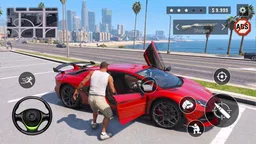




Gangster Miami RP: Grand City review
 Analysis by Appsdrops
I think Gangster Miami RP: Grand City is easiest to judge as a game for people who want to drop into an urban role-playing setting for a short while, rather than follow a tightly directed story. Its premise suggests room to explore and make your own kind of session, but the appeal depends on whether you enjoy shaping your own goals. I would treat it as a casual shared-device option only when everyone using the device understands that progress and purchases belong to the person playing, not automatically to the household.
Playing around one shared device
On a phone passed between friends or relatives, an open-world role-playing game can work well in small turns: one person explores, another tries a different approach, and each can hand the device back when their session ends. That makes this style more flexible than a game built around long, sequential levels. It also brings a practical catch: a shared screen does not necessarily mean shared progress. Before taking turns, agree whose play session is active and avoid changing anything that another person expects to keep.
For an ordinary evening, I can imagine one player using a spare few minutes to roam around the city, then letting someone else have a turn after dinner. The useful habit is to make each handoff deliberate: finish the current activity, return to a familiar point if possible, and let the next player know what they changed. That advice is especially helpful when several people are curious about the same game but have different ideas of what counts as a successful session.
The game is a role-playing title from Universe Game Labs, and its urban setting gives the experience a different flavor from fantasy adventures built around magic, monsters, and party management. The open-world framing can suit players who like choosing their own direction. If you prefer a clear chain of objectives, frequent story guidance, or a fixed pace, the same freedom may feel less satisfying. I would not choose it as a substitute for a focused, chapter-by-chapter RPG.
Agree on boundaries before handing over the phone
For shared use, the most useful setup is a conversation, not a complicated routine. Decide whether the device is for one person’s ongoing save or for casual turns, and ask before starting a new run or altering anything another player has left behind. If the game presents a purchase prompt, the person holding the phone should pause and get the owner’s approval rather than treating a tap as harmless experimentation.
That caution matters because the game is free to install but offers in-app purchases at $8.99 per item. I would make the household rule simple: no purchase is made without the account owner’s permission. A free download can still lead to spending, so it is worth explaining this before a younger player starts exploring menus. This is not a reason to avoid the game; it is a sensible boundary for any shared device with payment details attached.
There is another small but valuable habit: keep play sessions distinct in conversation, even if everyone is using the same screen. A quick “I’m done; I changed this” avoids confusion later. If a family member expects to continue from a particular point, ask them before taking over. I would not assume that a game will provide separate profiles or household controls unless those options are visible in the installed version.
Coordination matters more than playing at the same time
The role-playing premise can give two players plenty to talk about even when they are not playing together. One might prefer exploring, while another is more interested in experimenting with the setting. A useful way to coordinate is to agree on a shared goal for the next turn—such as checking out a new area—without prescribing every action. That keeps the handoff friendly while leaving room for each person to play in their own way.
I would be cautious about treating this as a dependable group activity that requires everyone to be online at once. The confirmed appeal is its open-world action and role-playing format, not a promise of a particular multiplayer arrangement. If your main reason for downloading is to play cooperatively with friends, check what the current version actually offers before planning around it. For a group that wants guaranteed shared sessions, a game built explicitly around cooperative play is the safer choice.
For solo use, a simple session plan helps make an open world feel less aimless. I would pick one thing to explore, play until I lose interest, and stop there rather than expecting every session to advance a major plot. This approach suits short mobile breaks and also makes it easier to hand the device to someone else. The trade-off is that players who need strong direction may find they are doing the work of setting their own objectives.
Age, trust, and the person holding the account
The listed content rating is Everyone, which makes the game broadly approachable by age classification. That label is useful context, but I would still make the first session a shared decision for a child: look at the game together, see how its action and role-play feel in practice, and talk about any purchase prompts. Age labels do not replace a parent’s judgment about a particular child’s preferences or comfort.
The rating and audience figures offer a little context without answering every personal question. It has a 4.7 average from around 6,400 ratings and has passed 5 million installs. I see that as evidence that many players have tried it, not a guarantee that a child will enjoy its style or that every session will suit every household. The more useful test is whether the player likes open-ended city play and can follow the family’s rules around the device.
Account boundaries are worth spelling out when a phone belongs to an adult but is used by several people. The adult should remain the decision-maker for purchases, while anyone borrowing the device should know not to approve a payment or alter another person’s progress without asking. I would also avoid sharing account credentials as a workaround for convenience. A clear owner-and-player arrangement is easier to manage than trying to untangle unexpected changes afterward.
What to expect from the game and its alternatives
Compared with a conventional role-playing game that sends you through a tightly ordered campaign, this one is better approached as a place to spend time and make your own choices. Compared with a pure action game, its role-playing identity implies a more exploratory mood rather than only chasing a quick reflex challenge. Those are differences in the kind of experience it invites, not a reason to assume specific missions or systems that may not be present.
That freedom can be a strength when I want to play without committing to a long narrative. It can also be a weakness: if I open the game and have no idea what I want to do, a more structured RPG may give me a better use of my time. Players who want a calm, non-violent setting should also compare alternatives instead of choosing on the basis of the general role-playing label alone; the game’s gangster-themed urban framing may not be their preferred tone.
The current version is 1.1.7, and the minimum operating-system requirement is 7.1. I would check that a device meets the requirement before asking someone else to install it, especially on an older phone used by multiple people. The game is free, so trying it does not require an upfront purchase, but that does not remove the need to agree on in-app spending. These practical checks are more useful than assuming every device or household will have the same experience.
Who I would recommend it to
I would recommend giving it a look if you enjoy open-world role-playing, like inventing your own short-term goals, and are comfortable with a game that may not guide every step. It is also a reasonable candidate for a shared device when the owner sets clear boundaries and everyone treats the game as one person’s session at a time. Universe Game Labs has made a free-to-install option with a broad age classification, and the rating and install totals suggest it has reached a substantial audience.
I would steer a different player elsewhere if they want a compact story with a definite ending, a guaranteed cooperative experience, or a game with no purchase prompts. I would also skip it for a child if the household cannot supervise spending or agree on who controls the account. Those are not flaws unique to this title; they are the situations where its open-ended format and shared-device context make another kind of game a better fit.
A household verdict grounded in expectations
My view is that Gangster Miami RP: Grand City is most appealing when everyone treats it as a flexible city role-playing game, not as a structured campaign or a ready-made family activity. Its open-world angle gives players room to choose how they spend a session, while that same looseness asks them to bring their own goals. A shared phone can make trying it convenient, but considerate handoffs and clear purchase boundaries matter more than any assumption that progress or settings will be separated automatically.
If you are deciding whether to install it, start with three practical questions: does the device meet the minimum system requirement, is the player happy with an open-ended role-playing experience, and has the account owner set a rule for purchases? If the answers are yes, the free download makes it straightforward to try. If you need a guided story or reliable group play, choose a title that makes those features its central promise instead.
What we like
- Open-world city gives players room to explore at their own pace.
- Role-play activities let players create different criminal or civilian stories.
- Vehicle options add variety to getting around the city.
- Character progression gives players goals beyond basic exploration.
- The urban setting suits fans of crime-themed mobile games.
What could be better
- Online role-play can depend on finding active players.
- The city environment may feel repetitive during long sessions.
- Progression may require considerable time and repeated play.
- Touchscreen controls can take practice to master.
- Crime-themed content may not suit younger players.







