





Forest Cabin: Survive review
 Analysis by Appsdrops
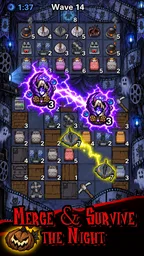
Forest Cabin: Survive is a strategy game built around one appealing idea: combining towers to hold off danger around a cabin, while Roguelike skills add variation to each run. I like that this gives the central decision a clear shape. Rather than simply placing more defenses wherever there is room, I have to consider how merging towers changes my setup and whether a skill is worth building around. That makes the game’s hook easy to understand, but leaves room for choices that matter.
Why merging towers changes the decision
In many tower-defense games, the main puzzle is where to place defenses and how to upgrade them. Here, merging is part of that puzzle. A tower is not only a fixed piece of coverage: it can become part of a stronger combined defense. The practical effect is that every merge asks me to weigh immediate coverage against the value of consolidating what I have. That tension between holding the line now and preparing a better defense later is the game’s defining appeal.
I find this more interesting than a system where upgrading is always an obvious improvement. If I combine towers too quickly, I may give up useful coverage in the process; if I keep everything separate, I may miss the benefit of strengthening my defenses. The challenge is therefore less about following one ideal recipe and more about reading the position in front of me. It rewards attention without requiring me to approach every run as a complicated strategy exercise.
The Roguelike skills add a second layer to that core decision. They can change what seems valuable as a run develops, so a tower choice is not necessarily good in isolation. A skill that complements the direction I am already taking can make a focused setup feel worthwhile, while a different option may encourage me to adjust. I enjoy that element because it gives the merging system a reason to be reconsidered rather than treated as a routine upgrade.
There is a useful distinction here between variety and control. Roguelike choices can make runs feel less predictable, but they also mean that I cannot assume every attempt will support the same plan. Players who like adapting to the options in front of them are likely to appreciate this. Anyone who would rather build a carefully rehearsed defense in exactly the same way each time may find the changing emphasis less satisfying.
Making decisions during a run
The most useful way to approach a run is to pause mentally before merging and ask what the current defense needs. Is the priority keeping enough separate towers in play, or does the position call for a stronger combined option? That question is more helpful than merging simply because the opportunity appears. I would also treat each skill choice as a nudge, not an order: it can inform a plan, but a plan still has to fit the cabin’s immediate defense.
This is one of the game’s less obvious strengths. The merge mechanic makes small decisions feel connected. A choice that looks locally efficient may narrow the shape of the defense, while holding back can preserve flexibility at the cost of delaying consolidation. That trade-off gives me something to think about even when I am not chasing a perfect run. It is a compact strategy loop, not a promise of deep, long-term simulation.
For a practical routine, I would first look at the immediate threat and the coverage already available, then consider whether a merge leaves the defense better positioned rather than merely more impressive. After that, I would choose a skill with the setup in mind. This is not a guaranteed winning formula; it is a way to avoid making upgrades on autopilot. The game is most engaging when I respond to the state of a run instead of trying to force the same sequence every time.
That approach also helps when a run turns out differently than expected. A skill choice may make one direction tempting, but it is sensible to stay flexible if the available defenses do not support it. I would rather make a modest adjustment that protects the cabin than keep pursuing an attractive combination at the expense of the immediate situation. The game’s appeal lies in balancing those scales, not in assuming every option can be made equally effective.
A good fit for short, focused play
A realistic use case is a quick break when I want to make a few meaningful choices without committing to a sprawling campaign. Forest Cabin: Survive’s central loop is easy to explain to a friend: defend the cabin, consider which towers to combine, and adapt to Roguelike skills. That clarity makes it approachable for someone who enjoys strategy but does not want to learn a large collection of interconnected systems before playing.
It also suits players who like runs to feel a little different. If I have only a short window to play, I can focus on the current defense rather than needing a lengthy planning session beforehand. The game’s theme gives the strategy a specific point of reference: the cabin is what I am trying to protect, so my choices have a clear purpose. That helps the central loop feel more grounded than a set of abstract upgrade decisions.
At the same time, I would not recommend it as a substitute for a deep strategy game built around extensive long-term planning. Its distinctive pitch is the combination of tower merging and Roguelike skills; a player looking for a broad campaign, elaborate base management, or precise control over every variable should choose a game that makes those elements its focus. This is better approached as a focused defense game with run-to-run variation than as a full-scale strategy sandbox.
Compared with familiar tower-defense alternatives, the merge mechanic shifts attention away from simply adding another defense and toward deciding how to consolidate. The Roguelike element then makes the best route less fixed. That combination is a meaningful difference, but it also defines the audience: people who enjoy adapting and weighing upgrades are more likely to stay interested than players who want a stable layout and a predictable progression path.
Where the trade-offs show
Merging creates a real strategic question, but it can also make a decision feel awkward if I am not sure whether I need present coverage or future strength more. That uncertainty is part of the point, yet it may frustrate someone who expects each upgrade to be a clear, immediate improvement. I would not treat every successful-looking merge as automatically correct; the important measure is whether the resulting defense still answers the situation in front of me.
Roguelike skills have a similar trade-off. They promise variation, but variation is not the same thing as complete control. Players who enjoy improvising can see a new skill as a chance to rethink their approach. Players who prefer to plan a particular build and execute it reliably may instead feel that the available direction is not always the one they wanted. The game’s best moments come from adapting, so that expectation matters before installing it.
There is also a spending consideration. The game is free to download, while in-app purchases range from $0.99 to $99.99 per item. That is a broad span, so I would check the purchase details in the app store before spending and set a personal limit if optional purchases are a concern. The free entry point makes it easy to try the core idea, but anyone who dislikes in-app purchase menus should factor that into the decision.
The Teen content rating is another useful point for households choosing games together. I would still have a parent or guardian review the game and its purchase options for a younger player rather than treating the age label as a substitute for their own judgment. That is especially sensible when a free game includes paid items, since the distinction between starting at no cost and choosing to spend can matter to families.
Who is likely to enjoy it
Forest Cabin: Survive is developed by Harvest Star Game and sits squarely in the strategy space. It has a 4.6 average from around 15,000 ratings, and it has passed one million installs. Those figures suggest that the central premise has found an audience, but what matters more to me is whether that premise matches how you like to play: this is for someone who enjoys making quick defensive decisions and revising a plan as skills change.
The game is free, runs on Android 8.0 or later, and its current version is 2.13.001. The version number is useful when checking compatibility, especially if you are installing it on an older device. I would not choose it solely because it is easy to access, though. The stronger reason is the specific merge-and-adapt loop, which gives short sessions a clear strategic focus.
I would recommend it to a friend who likes tower defense but is ready for a twist on the familiar upgrade routine. It is also a reasonable pick for someone new to strategy games who wants a premise they can grasp quickly. I would point a perfectionist toward a more controllable alternative if they dislike adapting to changing skill options, and I would steer anyone seeking a large, methodical campaign toward a game with that kind of structure instead.
My take after weighing the premise
The best way to enjoy Forest Cabin: Survive is to treat each run as a sequence of small trade-offs rather than a hunt for one perfect tower arrangement. Keep the cabin’s immediate defense in view, merge with a reason, and let the Roguelike skills influence your direction without locking you into it. That mindset makes the central mechanic more rewarding and keeps an unexpected option from feeling like a dead end.
I like the game’s focus because the merging decision is easy to grasp but not entirely automatic. Its main limitation is also clear: if you want complete control, long-form progression, or a fixed strategy to master, this may not be the right tower-defense game for you. But if adapting a defense around tower combinations and changing skills sounds appealing, it is worth trying. For me, the strongest reason to play is the moment-to-moment choice of whether to preserve coverage or consolidate power.
Overall, Forest Cabin: Survive is a focused recommendation rather than a universal one. I would install it for a compact strategy break, keep an eye on the purchase options, and judge it by whether its shifting decisions stay enjoyable over several runs. If they do, the simple goal of protecting a cabin has enough strategic texture to hold attention; if you prefer a fixed plan, a more traditional tower-defense game will probably suit you better.
What we like
- A compact setting keeps exploration focused and easy to follow.
- Survival tasks give each play session a clear purpose.
- The cabin setting creates a distinct atmosphere.
- Resource gathering adds useful choices to exploration.
- It can appeal to players who enjoy survival challenges.
What could be better
- Survival mechanics may feel familiar to genre fans.
- Limited scenery may make exploration feel repetitive.
- Progress can depend on collecting resources over time.
- The challenge may frustrate players seeking a relaxed game.
- Players may want more variety in activities and locations.







