
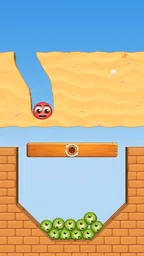
Draw to Dig - EPO Eats All review
 Analysis by Appsdrops
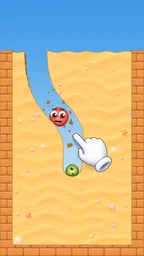
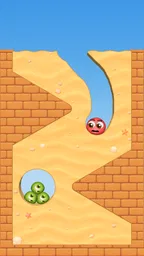
Draw to Dig - EPO Eats All has a simple premise that puts drawing at the center of its strategy: sketch a path, dig through sand, and help hungry EPO reach bacteria and germs. That idea is easy to understand, but a game built around drawing can feel quite different from one player to another. I find its appeal lies in the quick connection between deciding on a route and seeing the result, while its accessibility depends on how comfortable each player is with reading the screen, making gestures, and playing in their surroundings.
A drawing puzzle with a clear goal
As a strategy game, Draw to Dig - EPO Eats All focuses attention on a practical question: how can I make a path that gets EPO to its food? The store description presents the essential loop plainly—draw to dig, then guide the hungry character toward bacteria and germs. That direct framing gives new players a useful starting point without requiring them to learn a complicated premise before they begin.
The game is listed as free, with in-app purchases priced at $4.99 per item. Its age rating is Everyone 10+, a useful point for families considering whether the title suits their household. These details establish the broad setting around the game, but they do not change the core appeal: the player is asked to think spatially and express that plan by drawing.
Readable ideas, familiar actions
Drawing a route is an action many players already understand from using a touchscreen. That familiarity can make the central idea feel approachable, especially for someone who prefers learning by trying rather than studying a long set of instructions. The goal is also concrete: EPO is hungry, and bacteria and germs are what it needs to eat. I like that the premise can be explained in a sentence, because a clear objective helps players focus on solving the puzzle rather than decoding the basic concept.
Still, a simple premise does not automatically make every screen easy to interpret. Readability depends on how clearly the game presents the character, the sand, the route, and the target at any given moment. Players with low vision, limited contrast sensitivity, or difficulty distinguishing small visual elements may need more time to identify what matters. The drawing itself could also become harder to follow if a route blends into the surrounding scene. Those are practical considerations for any visually guided drawing game, rather than claims about a particular display option.
Navigation is similarly tied to what appears on screen and how the game communicates the next action. The basic instruction, “Draw to Dig,” is memorable and action-oriented. That short phrase is a good foundation for a casual puzzle, though players who benefit from more explicit prompts may find a concise instruction less helpful if they are unsure what their drawing should accomplish. I would approach the first play session patiently, giving the game room to show how its central action works before judging whether the interaction feels intuitive.
How drawing shapes the experience
The defining interaction is also the main motor consideration. Drawing calls for a controlled touch gesture, and the amount of precision a player can comfortably manage varies widely. Someone who can make smooth finger movements may find the action natural; someone with tremors, restricted range of motion, fatigue, or difficulty using a touchscreen may find it less predictable. A stylus can be more comfortable for some people, while others may prefer a finger. Neither approach is universally easier, so the best fit depends on the player and device.
Strategy adds a second layer to that movement. A player may want to pause and think about where a route should go before making a gesture. That can be satisfying when the drawing feels like a direct expression of the plan. It can be frustrating if the player has difficulty placing a line precisely or repeating a gesture after an unintended result. For players who need a slower pace, the most comfortable experience will depend in part on whether they can take their time without feeling rushed by the game.
It is also worth considering the physical context of play. Holding a phone in one hand while drawing with the other can be awkward for some people; resting the device on a table may be more comfortable. A larger screen could make visual elements easier for certain players to inspect, though it may also require reaching farther across the display. These are ordinary differences between devices and play positions, not guaranteed advantages. I recommend choosing a setup that lets the player see the screen clearly and make a relaxed gesture.
Sensory comfort and attention
Because the game’s premise is visual and touch-driven, players who process information best through sight and direct interaction may find its central concept straightforward. Other players may need more support to understand what has happened after a drawing or why a route did not lead to the intended result. Clear visual feedback is particularly helpful in a puzzle game: it allows a player to connect an action with its outcome and adjust their next decision.
Sound can matter in mobile games, but I would not treat it as essential to understanding this title’s premise based on its short description. Players who are sensitive to sound may want to explore the available device and game settings before settling into a longer session. Likewise, anyone who relies on audio cues should consider whether the visual presentation alone is comfortable to follow. These are sensible checks for a drawing-based game, without assuming that particular sound controls or accessibility settings are available.
Attention and cognitive load matter too. The main objective is easy to summarize, which is a welcome quality for players who prefer a focused task. At the same time, strategy puzzles require planning, and the player has to connect a drawn path with a desired outcome. Some people enjoy that small problem-solving challenge; others may prefer clearer guidance or more time to consider their choices. The title’s straightforward premise offers an inviting entry point, while individual comfort will depend on how its puzzles communicate cause and effect during play.
Playing in different situations
Draw to Dig - EPO Eats All is a mobile game, so its natural setting is a handheld screen. That makes it easy to imagine playing during a quiet break or at home, but not every setting is equally suitable for a drawing action. On a moving bus, in a crowded room, or while standing, it may be harder to hold the device steady and make a deliberate gesture. A calm place with a stable seating position can make the interaction more comfortable for players who need precision or extra time.
Short, clearly framed objectives often suit casual play because a player can focus on one decision at a time. The game’s central task has that kind of immediate clarity: draw a route and help EPO reach food. Even so, players who are easily interrupted may prefer to start when they can give the puzzle their attention. If someone is sharing a device or playing around other people, screen visibility and physical space may also affect how comfortably they can interact.
Device compatibility is another practical part of access. The listed minimum operating system is Android 7.0, so players should check that their device meets that requirement before attempting to install the game. The title is available on Android, and people browsing an app store can check the compatibility information shown for their own device. A compatible operating system does not guarantee that every screen size or input setup will feel equally comfortable, but it is a useful first check.
What may still get in the way
The same design choice that makes the game easy to describe may also define its biggest barrier: drawing is not equally comfortable for everyone. Players who cannot reliably perform touch gestures, who have limited dexterity, or who experience pain from repeated hand movements may find the central interaction demanding. A game centered on drawing gives that action a prominent role, so it is important to consider personal comfort rather than assuming that a simple gesture is effortless for all players.
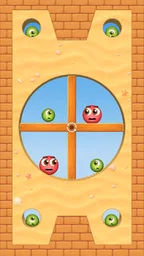
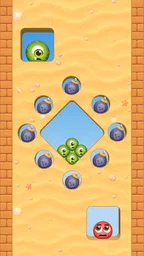
Visual interpretation can pose another challenge. To plan a route, a player needs to understand the relationship between the drawing, the sand, EPO, and the food. If any of those elements are difficult to distinguish, the strategy may become harder than intended. Players with low vision or color-vision differences may want to look closely at the opening screens and assess whether the important objects are clear on their display. I would also avoid playing in glare or dim conditions if those make the screen harder to read.
For some players, the mental task may be the more significant hurdle. Planning a route requires a little experimentation and an understanding of how the drawn path affects the outcome. People who prefer step-by-step instruction may want a moment to become familiar with the game’s visual language. Families introducing the title to younger players can make the first session more welcoming by sitting together and talking through the goal, while still letting the player experiment at their own pace.
These considerations do not mean the game is unsuitable for a particular group. They simply show why an inclusive review should distinguish an easy-to-grasp idea from an experience that is automatically easy for everyone. A clear premise is a good start; comfortable access also depends on the player’s vision, movement, attention, device, and surroundings.
A welcoming concept with individual limits
The game has attracted over one million installs and holds an average rating of 4.4 from around 8,800 ratings. Those figures suggest broad interest, although they cannot tell me whether the drawing interaction will suit a particular player. The developer is GOOD TO SEE YOU, and the current version is 0.2.3. It was released on August 4, 2026, so players considering it can check the app store for the latest version and compatibility information.
For me, the strongest point is the clarity of the core idea. Draw to Dig - EPO Eats All gives players a direct objective and makes drawing the way to pursue it, which is an appealing fit for a touch-screen strategy game. Its free entry point makes it easy to consider, while the in-app purchases are a separate part of the overall experience for anyone deciding whether to spend.
My inclusive verdict is cautiously positive: this looks like a straightforward drawing puzzle that may be enjoyable for players who can comfortably see the screen, plan a route, and make touch gestures. The simple goal can help newcomers understand what they are trying to do, but the central drawing action may create a real obstacle for people with motor or visual access needs. I would recommend trying it in a comfortable setting and paying attention to whether both the screen and gestures feel manageable. Clear goals are a strength, but comfort with drawing is what will determine whether the game works for you.
What we like
- Simple drawing controls are easy to learn.
- Short levels make it convenient for quick play sessions.
- Physics-based puzzles reward creative solutions.
- The playful premise gives the game a lighthearted feel.
- Different ways to draw can encourage experimentation.
What could be better
- Some puzzles may feel repetitive after extended play.
- Physics outcomes can be unpredictable at times.
- Later levels may require trial and error.
- Ads may interrupt the flow of play.
- The game offers limited depth for players seeking a long challenge.







