
Bungee Beat review
 Analysis by Appsdrops
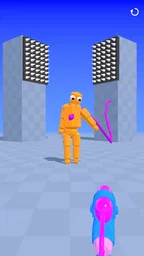
I find the idea behind Bungee Beat easy to grasp and fun to picture: connect enemies and objects with elastic gum, then use that strange little setup to drive the action. It gives the game a clear hook from the start. Rather than relying on a complicated premise, it invites you to experiment with connections and see how the physics respond. If you’re looking for an action game with a playful, hands-on concept, Bungee Beat has a distinctive starting point.
Making the first move
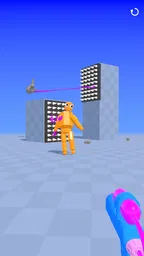
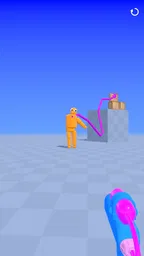
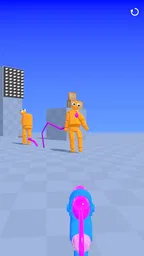
At the heart of Bungee Beat is a simple interaction with room for creative thinking. Enemies and objects become part of the same elastic playground, and your job is to connect them with gum. That immediately makes the action feel different from a game built around a more conventional attack button: the connection itself is the interesting choice, while the physics give that choice its character.
I like how naturally the concept encourages a quick question before each move: what might happen if these two things were linked? The answer depends on the objects and enemies involved, so the appeal comes from trying an idea and watching the resulting motion. It’s a satisfying foundation for a physics action game because the player is not only reacting to what’s on screen; they are also shaping the situation that unfolds.
The premise is easy to explain, which helps it feel approachable even if you don’t usually seek out physics-based games. You don’t need an elaborate story setup to understand the central attraction. Elastic gum connects things, connected things can move in surprising ways, and those interactions create the action. That clarity makes the game’s identity stand out quickly.
For me, the first action in a game like this is less about mastering a long list of commands and more about discovering the feel of the central mechanic. A connection can be a small experiment, but it also creates anticipation: once the gum is in play, the physical response is the payoff. That pairing of a direct action and an observable result is what gives the idea its immediate charm.
Why the elastic-gum idea works
Elasticity is a strong fit for a game where enemies and objects share the same space. Gum suggests stretch, tension, and movement without needing a complicated explanation, and it gives the physics a playful identity. The result is a premise that sounds lighthearted while still being rooted in action. I find that contrast appealing: the interactions can feel lively, but the basic goal of connecting things keeps the concept grounded.
It also gives experimentation a natural role. When you connect two elements, you are setting up a relationship between them rather than simply choosing an isolated move. That makes each attempt feel like a little cause-and-effect puzzle wrapped inside an action game. Even a straightforward interaction can be entertaining when the physical response is the part you want to see.
Following the feedback rhythm
A physics game depends on feedback. You make a move, the world responds, and the response tells you whether the idea worked the way you expected. Bungee Beat’s elastic-gum concept puts that rhythm front and center: the action is the connection, and the fun comes from seeing how enemies and objects react once they are linked.
That rhythm can make a short play session feel active without demanding that every moment be planned far in advance. You can approach a situation with an idea, test it, and take in the result. If the outcome surprises you, that surprise becomes useful feedback for the next attempt. If it goes the way you hoped, there is the simple pleasure of having made the physics work in your favor.
I’m especially drawn to games where the rules are easy to understand but the outcomes still invite curiosity. The gum provides a clear rule: connections matter. The physical interactions provide variation within that rule. This combination gives the player a reason to keep paying attention, because the next connection may produce a different kind of response than the last one.
There is a pleasing immediacy to that loop. You don’t have to wait for a lengthy explanation before the central idea becomes relevant. The game’s core mechanic is also its main source of feedback, so action and response belong together. That makes the experience easy to return to when you want something playful and focused rather than a game that asks for a long commitment every time you open it.
Learning through reactions
When physics is part of the appeal, a reaction can be as informative as a success. A connection that behaves unexpectedly shows you something about the relationship between the objects and enemies involved. That gives trial and error a meaningful place in the experience. Instead of treating every imperfect attempt as wasted effort, you can use it to shape your next choice.
This is one reason the concept has potential for repeated play. The player’s understanding grows through observation: make a connection, watch the result, and adjust your approach. That kind of learning feels informal and hands-on. It suits a game whose selling point is not a complicated ruleset, but the fun of interacting with a physics-driven setup.
The feedback rhythm also helps the action remain legible in principle. The game’s premise tells you what to focus on: enemies, objects, and the elastic links between them. That focus gives each attempt a clear center. You are not just watching motion for its own sake; you are seeing the consequences of a choice you made moments earlier.
The small reward that keeps it moving
The reward in Bungee Beat is closely tied to the moment a connection produces an entertaining or useful result. That is a compact kind of payoff, but it can be a compelling one. You set up an interaction, the physics bring it to life, and you get an immediate reason to feel that your action mattered. For me, that direct connection between effort and response is more appealing than a reward that feels detached from what I just did.
There is also a quieter reward in getting a better feel for the mechanic. Each attempt can make the next one more deliberate. You begin with curiosity, then start forming expectations about what a connection might do. When the game responds in a way that matches your plan, the satisfaction comes from both the result and the sense that you read the situation well.
That kind of reward is well suited to a game you may pick up for a brief burst of action. A session can feel worthwhile simply because you tried a few ideas and saw the physics play out. The game’s premise does not need to promise a huge progression system to make its core interaction engaging. The moment-to-moment payoff is the important part of the pitch.
The playful tone of the gum mechanic helps, too. Elastic connections naturally suggest motion and surprise, so even an ordinary attempt can carry a little anticipation. I like that the hook is not just “do something to an enemy,” but “connect things and see how the situation changes.” That gives the reward a distinctive flavor and makes the central action easier to remember.
What makes another attempt tempting
A good repeatable action loop gives you a reason to try again without making the previous attempt feel pointless. Here, the reason is easy to understand: another connection might create a better reaction, or reveal a possibility you did not notice before. The player’s curiosity becomes part of the reward. You are not only chasing an outcome; you are also testing the range of a simple, expressive mechanic.
That is a useful quality for an action game, because repetition can feel flat if each move seems interchangeable. Bungee Beat’s physics-centered premise gives each setup the chance to become a small experiment. The satisfaction rests on the relationship between your choice and the resulting motion, so the game’s concept remains present throughout the action.
Resetting without losing the thread
In a repeatable action game, a reset matters because it gives you a clean chance to act on what you have learned. The most appealing version of that cycle is straightforward: you try a connection, watch its effect, and return ready to experiment with a new idea. That structure keeps the focus on the mechanic rather than on holding onto a single outcome forever.
I see the reset as part of the game’s natural rhythm. A surprising result can make you want to start again with a different plan, while a satisfying result can leave you curious about whether you can produce another one. Either way, the next session begins with a question. What else can the elastic gum link, and how might the physics respond this time?
That question is a strong reason to return, especially for players who enjoy learning by doing. The game’s central idea is compact enough to remember, but open-ended enough in spirit to encourage different experiments. You can come back without needing to rebuild a complicated understanding of the premise. The basic attraction remains clear: connect enemies and objects and see what happens.
A reset also gives the action room to stay light. When a game is built around quick physical reactions, the pleasure often lies in the next attempt rather than in turning every session into a major project. Bungee Beat’s concept fits that kind of return play. The same core action can keep its appeal because the player is still choosing how to use it and anticipating the response.
A loop for curious players
The game is likely to appeal most to people who enjoy playful experimentation, quick feedback, and mechanics that are easy to describe but interesting to test. If you prefer a highly structured action experience with a lot of narrative explanation, the gum-and-physics premise may feel more modest than that. But if your favorite moments come from trying something, seeing the result, and immediately thinking of another possibility, the core loop has a clear attraction.
It is worth approaching the game for what its central idea offers: a physics action setup built around elastic connections. That focus is a strength because it gives the experience a recognizable identity. The action, reaction, reward, and restart all point back to the same mechanic, so the game does not need a complicated pitch to explain why another attempt might be fun.
My take on the full loop
Bungee Beat has a neat action-game hook: use elastic gum to connect enemies and objects, then let physics turn those links into the main event. The loop is easy to picture and satisfying in concept. You make a choice, watch the response, learn from what happened, and have a reason to try again. That is the kind of clear, repeatable structure I appreciate when I want a game that gets to its point quickly.
The strongest part of the idea is how closely the central action is tied to the feedback. The gum is not just decoration for an unrelated combat system; it is the defining interaction described by the game’s premise. That gives the experience a playful, tactile identity and makes experimentation feel like a natural part of the action.
FourM Inc. is the developer behind the game, which is offered free and has an Everyone content rating. It was released on August 3, 2026, and its current version is 0.19. The game has reached over 500,000 installs, with an average rating of 4.5 from around 3,600 ratings. Those figures suggest that plenty of players have already taken a look at its unusual physics concept.
Overall, I’d recommend Bungee Beat to anyone curious about a lighthearted action game where the fun comes from connecting things and watching the physical consequences. Its appeal is not a complicated setup; it is the promise of one more experiment. If that action-feedback-reward-reset rhythm sounds like your kind of play, this is an easy game to consider for your next short session.
What we like
- Rhythm-based controls make each run feel lively.
- Short levels suit quick play sessions.
- Colorful visuals make obstacles easy to spot.
- Unlockable content adds goals beyond finishing levels.
- The simple premise is easy for newcomers to understand.
What could be better
- Precise timing can make some sections frustrating.
- Repeated attempts may feel monotonous over time.
- Fast obstacles can be difficult to read on small screens.
- Progress may depend heavily on memorizing level patterns.
- The rhythm gameplay may not appeal to every player.







