

AI Dungeon Master & RPG Fablia review
 Analysis by Appsdrops
I find AI Dungeon Master & RPG Fablia most interesting as a role-playing game you can approach through imagination rather than a large collection of maps, menus, and character animations. Its central idea is a fantasy adventure guided by AI, with a hero you create and dice rolls shaping the journey. That setup can make the game feel welcoming to someone curious about tabletop-style role-play, but it also means the experience depends heavily on reading, making choices, and being comfortable with an unpredictable narrator.
It is a free role-playing game from Applogy Studio, rated for Everyone, and its audience response is encouraging: it holds a 4.5 average from around 6,500 ratings, with over 100,000 installs. I’d describe it as a flexible story game rather than a conventional RPG built around reflexes or elaborate visuals. That distinction matters if you are deciding whether it fits your attention, reading preferences, and the situations in which you like to play.
How the story format affects readability and navigation
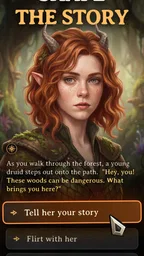
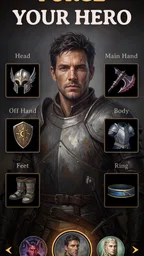
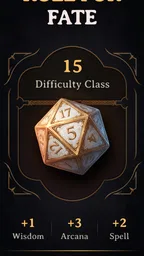
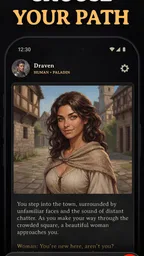
The promise of an AI-led adventure changes what I look for in an RPG. Instead of expecting a fixed sequence of quests and scenes, I approach each exchange as a piece of a story that I help steer. Creating a hero gives the adventure a personal starting point, while dice add a familiar role-playing element: not every outcome has to follow the player’s plan. For me, that combination is appealing when I want to explore possibilities rather than work through a checklist.
The format can also make reading the main activity. If you enjoy following narrative text and imagining a scene from a few words, that is a strength: the game can leave space for your own interpretation rather than requiring you to inspect a busy screen. If you prefer an RPG that communicates mostly through visible action, movement, or voiced dialogue, a text-led adventure may feel like work. I would treat that preference as a real deciding factor, not a small detail.
With AI-directed storytelling, clarity is not only about legible text. It is also about whether a player can understand what the current situation is and what kinds of responses make sense. I recommend making deliberate, specific choices instead of trying to cover every possibility in one long prompt. A concise action gives the narrator a clearer direction and makes it easier for me to judge whether the story has followed my intent.
One useful habit is to keep a simple mental note of the immediate goal, the people involved, and any detail that seems important. In a branching story, it is easy to lose track of a minor promise or an earlier choice when the adventure moves on. That is not unique to this game, but the open-ended AI format makes it especially worthwhile to pause between turns and restate the detail that should guide the next scene.
I would not choose this as my first recommendation for someone who wants carefully authored prose with a guaranteed tone. An AI narrator can offer variety, but open-ended generation also makes consistency a judgment call. If a scene starts drifting, a practical response is to steer back toward the character’s goal in plain language rather than adding more unrelated details. Players who enjoy shaping a story may find that interaction satisfying; players who want a tightly edited campaign may prefer a fixed narrative RPG.
Making choices without turning play into a writing task
A common concern with this kind of game is whether every turn requires elaborate writing. I would not approach it as a writing contest. A short action, a question, or a clear intention is a sensible way to participate; the value is in making the choice yours, not in producing polished prose. That makes the game easier to fit into a brief break, though a longer session is better when you want to remember the story’s context and follow its consequences.
Another helpful approach is to separate what your hero does from what you hope will happen. For instance, describing an attempt to persuade a guard is clearer than demanding that the guard immediately agree. The first gives the story room to respond and leaves the dice-led uncertainty intact. This is a small but meaningful trade-off: players who like unpredictable outcomes may enjoy it, while anyone looking for precise control over every plot beat could find it frustrating.
Motor, sensory, and everyday access
Because the core appeal is narrative choice rather than fast combat, the concept may suit players who do not want a game centered on rapid reactions. That is a useful distinction when comparing it with action-heavy RPGs. Still, a text-focused format is not automatically accessible to everyone: reading, entering responses, and staying oriented in a conversation can each create friction. I would not assume that the game removes those demands simply because it is story-driven.
For someone who finds long writing sessions tiring, I’d suggest keeping responses brief and playing one scene at a time. That reduces the effort of composing each turn and makes it easier to return after a pause. It is also a practical way to test whether the interaction suits you before committing to a longer campaign. If reading on a small screen is uncomfortable, the best choice may be to try a short session in a setting where you can comfortably focus, rather than pushing through a long stretch.
Sensory context matters too. A quiet moment with enough attention for reading is a better fit than a noisy commute where you can only glance at a screen. The game’s imaginative format may be enjoyable without demanding a particular visual style of play, but the words still need your attention. I would avoid starting a complicated scene when you expect frequent interruptions; if you must stop, note your hero’s immediate aim so it is easier to resume the thread later.
That gives the game a useful everyday role: a short wind-down session when you have a little time and want to make a story choice, rather than a game that needs a full group to be present. For example, after dinner, I might start a fresh fantasy premise, make a hero, and play through a small encounter before putting the phone away. The format makes that kind of solo, imaginative break plausible. It is less suitable when I want a quick burst of visual action without reading or composing anything.
For players who enjoy tabletop role-playing but struggle to coordinate a group’s schedule, an AI-led adventure can offer a different kind of convenience: the story is there to engage with when they have time. That should not be mistaken for a replacement for the social energy of playing with friends. A human game master can read the room, share jokes, and negotiate a group’s preferences in ways an AI story cannot reliably replicate. I’d choose Fablia for solo experimentation, not as a substitute for a group campaign if conversation is the main thing I’m seeking.
Where the format can still create barriers
The biggest potential barrier is the need to stay engaged with text and make decisions. Someone who prefers speech, images, or straightforward tap-based progression may not find this style comfortable. The open-ended nature can also ask for patience: if a response is not what you intended, you may need to clarify the direction and continue. That extra steering is part of the appeal for some players, but it can become tiring for anyone who wants the game to infer exactly what they mean.
There is a second trade-off in story control. A conventional RPG often makes its boundaries visible through defined quests and progression, while an AI-guided adventure invites experimentation. That freedom is attractive if you like trying unusual actions, but it may leave you uncertain about what the game expects next. When that happens, I’d ask a direct in-story question or state a clear immediate objective instead of guessing at a hidden route. It is a more practical way to explore than repeatedly issuing vague commands.
Cost is worth considering before a long-term commitment. The game is free to start, with in-app purchases ranging from $0.99 to $299.99 per item. That wide spread is a reason to check each purchase carefully and decide in advance whether you want to spend at all; a free entry point does not mean every optional purchase will suit every budget. I would first see whether the basic story loop is enjoyable before considering anything extra.
The game is currently version 5.2.0 and supports Android 7.0 or later. Those details are useful when checking whether an older device is compatible, but compatibility alone does not tell you how comfortable the experience will be on a particular screen or for a particular person. I’d treat a short trial as the best way to judge readability, response entry, and the amount of attention the narrative asks for.
Who I’d recommend it to
I’d recommend AI Dungeon Master & RPG Fablia to players who like fantasy role-play, enjoy making choices in text, and are happy to help guide an evolving story. Its free starting point makes it approachable to test, while its 4.5 average and roughly 370 written reviews suggest that it has drawn a meaningful group of players. Those figures are context, not a promise that every player will enjoy the same kind of open-ended experience.
I’d be more cautious recommending it to someone who wants a visually led campaign, a predictable plot, or a game that can be played with almost no reading. It is also not my pick for a player who dislikes correcting a narrator or prefers a fixed set of outcomes. If you want tactical combat, polished cinematic scenes, or the social give-and-take of a human-led tabletop session, a more conventional RPG or a real group game is likely to be a better match.
Overall, I see Fablia as a potentially inviting way to try solo fantasy role-play, especially for someone who wants to shape a hero and see where a dice-influenced story goes. Its accessibility depends less on a single feature than on whether its text, pacing, and open-ended interaction suit the player and the moment. My advice is to begin with a simple character and a clear, manageable goal, then judge whether the storytelling feels engaging or burdensome. If you enjoy that back-and-forth, it has a distinctive niche; if you need a more predictable or low-reading experience, another kind of RPG will serve you better.
What we like
- AI helps generate fresh story ideas during play
- Flexible prompts support a wide range of fantasy scenarios
- Can suit both solo play and group adventures
- Useful for players who want help building a campaign
- Offers room to explore creative character choices
What could be better
- AI-generated details may sometimes conflict with earlier events
- Good results can depend on writing clear prompts
- Generated stories may lack the consistency of a human game master
- Some features may require an internet connection
- AI responses may not always match the intended tone







