






Pogo: Earn Cash & Rewards review
 Analysis by Appsdrops
I see Pogo as a casual rewards app, not a serious way to earn money. Its appeal is the mix of small activities—such as playing games, answering surveys, and submitting receipts—rather than a single demanding routine. If you already enjoy those tasks and are comfortable with rewards accumulating gradually, it may be a pleasant extra on your phone. If you want dependable income or dislike sharing purchase information, I would look elsewhere.
Small rewards work best when they fit your routine
Pogo: Earn Cash & Rewards is a free shopping app from Pogo Technologies Inc. The idea is to connect everyday activities with rewards: you can explore games and surveys, and submit receipts instead of relying only on shopping through a particular retailer. That gives it a broader feel than a standard coupon app, though it also means the experience depends on which activities suit you and are available to you.
In practice, I would treat it as a lightweight habit rather than a task list to complete. A survey while waiting for an appointment or a receipt submission after grocery shopping can feel like a small bonus. Setting aside a long session solely to chase rewards is a different proposition: the time and attention involved may not feel worthwhile if the return is modest.
The app’s scale is notable: it has more than a million installs, and its average rating is 4.6 from around 134,000 ratings. Those figures suggest that many people find the basic proposition appealing, but they do not tell you how much an individual user will earn or whether every activity will be a good fit. I would judge it by whether its available tasks naturally fit your day, not by expecting a particular payout.
Why the mix of activities is useful
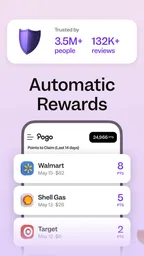
Receipt rewards are the most practical part of the concept for someone who already keeps track of purchases. Rather than changing where you shop just to use a rewards program, you can make receipt submission a small step after an ordinary errand. My tip would be to build it into the moment you unpack groceries: decide then whether the receipt is worth submitting, rather than letting a pile of paper build up and trying to sort it out later.
That workflow has a trade-off. Receipt-based rewards can feel less disruptive than chasing store-specific deals, but they still ask you to share purchase information and complete a manual step. If you prefer not to document what you buy, or you routinely discard receipts immediately, this part of Pogo may feel like friction rather than a benefit. It makes sense to use it only for purchases you are comfortable recording.
Games and surveys give the app options for moments when you do not have a receipt to submit. They also ask for different kinds of attention. A game can be a more relaxed way to pass a few spare minutes; a survey requires reading questions and deciding whether you want to provide answers. I would choose deliberately rather than opening every offer automatically. A task is only worthwhile if its time commitment and information requests feel acceptable to you.
One useful approach is to check the app when you already have a natural pause, then pick one activity and stop when it no longer feels convenient. That keeps rewards in the background instead of letting the app dictate your free time. It is a small distinction, but it helps prevent a casual rewards tool from turning into another chore.
Where it sits among shopping rewards apps
Compared with the usual alternatives, Pogo’s strength is variety. A retailer loyalty app is often most useful when you repeatedly shop at that retailer; a coupon app is centered on finding eligible deals before buying; and a receipt-focused service makes scanning the main event. Pogo brings receipt submissions together with surveys and games, so there are more than one kinds of activity to try.
That breadth is not automatically better. A focused cash-back service may suit you more if you want a clear path from shopping to rewards and do not care about games or surveys. A store’s own loyalty program may be simpler if you mainly shop in one place and want benefits tied directly to that routine. Pogo is a better match when you are open to several low-effort activities and do not mind switching between them.
I also would not use it as a reason to buy something you did not plan to purchase. Rewards should be a by-product of an ordinary shopping trip, not the justification for spending. For a careful budget, the most sensible use is to submit eligible receipts from purchases already made and ignore anything that would encourage extra spending or take too much time.
What to expect before you install it
The rating is strong, but a high average does not mean the app will feel equally useful to everyone. Rewards apps are personal: the value depends on which activities appeal to you, how often you remember to use them, and how you feel about the effort involved. Pogo has around 14,000 written reviews, which gives prospective users plenty of public feedback to consider alongside the overall score; I would read recent comments for clues about the experience that matters most to me.
The app is currently at version 4.59 and requires Android 10 or later. It is rated Mature 17+, so it is not an app I would recommend casually installing on a younger user’s device. Those practical details matter as much as the reward idea: check that your phone meets the requirement, and consider the age rating before deciding who should use it.
It is also worth being realistic about how the word “cash” influences expectations. I would not assume that every activity produces an immediate or substantial return. The safer mindset is that Pogo may provide occasional rewards for tasks you were willing to do anyway. If you need predictable earnings, are short on time, or want a rewards program with a simple and consistent calculation, a more focused alternative is likely a better fit.
A routine that keeps the effort in check
For a realistic everyday example, imagine finishing a grocery run, putting the food away, and checking the receipt while it is still easy to find. You could submit it if the process and purchase details feel comfortable, then leave the app until another convenient moment. On a commute or during a quiet break, you might browse a survey or game instead. The point is not to do everything; it is to use whichever activity fits the time you already have.
I would also keep a simple personal rule: do not spend more time on a task than you feel its reward is worth. That rule is especially helpful with surveys, where reading questions and deciding whether to continue can take more attention than expected. If you find yourself repeatedly abandoning tasks or checking for new ones out of habit, step back. A rewards app should remain optional entertainment or a modest perk, not a source of pressure.
Another small but useful practice is to review your own usage after a few days. Ask whether you actually submitted receipts, enjoyed the games, or found surveys worthwhile. If one activity consistently feels tedious, ignore it and keep only the parts that suit you. Pogo’s variety makes that selective approach possible in principle, and it is more sensible than treating every available option as an obligation.
Who will enjoy Pogo—and who should skip it
I would recommend Pogo to adults who like casual games, do not mind occasional surveys, and are willing to submit receipts from everyday shopping. It is particularly appealing if you want a few different ways to earn small rewards without making a separate shopping trip or committing to one retailer’s program. The free price makes it easy to try, provided the age rating and receipt-sharing aspect work for you.
I would skip it if you want a reliable side income, dislike surveys, prefer not to share purchase details, or find reward tracking distracting. It is also not the best choice if you want a single, highly focused shopping tool. In those cases, a retailer’s loyalty app, a straightforward coupon service, or simply doing nothing may be more useful than adding another app to your routine.
My verdict: Pogo is most convincing as a low-pressure assortment of small reward opportunities, not as a money-making plan. Its mix of receipts, games, and surveys gives it more flexibility than a narrowly focused shopping app, while the need to spend time and share information keeps it from being a universal recommendation. If those activities already fit your habits, I think it is worth trying; if they do not, its rewards are unlikely to change that.
The app has been available since November 23, 2020, and its current version is 4.59. That history and its broad user base make it an established option in the shopping-rewards space, but the best reason to keep it is still personal: it should make an ordinary routine a little more rewarding without asking you to spend or disclose more than you are comfortable with.
Pogo: Earn Cash & Rewards earns my recommendation for patient users who enjoy choosing between small tasks and can keep expectations modest. I would try it with a clear boundary—use it when convenient, skip activities that feel intrusive, and never treat potential rewards as guaranteed income. That is the version of Pogo most likely to feel useful rather than like another obligation.
What we like
- Offers several ways to earn rewards through games and activities.
- The app is free to download and use.
- Rewards can be redeemed for cash or gift cards.
- Progress toward rewards is easy to track in the app.
- A broad selection of activities can suit different interests.
What could be better
- Earnings may be modest and take time to accumulate.
- Some activities may not be available to every user.
- Reward eligibility can depend on location and account details.
- Some offers may require purchases or personal information.
- Cash-out options may have minimum redemption thresholds.





