




Meta Horizon review
 Analysis by Appsdrops
I’d think of Meta Horizon less as one self-contained adventure and more as a social place where games are the reason to drop in. It is a free multiplayer game from Meta Platforms Inc, aimed at Teen players, and its appeal depends on whether you want to spend time with other people rather than simply work through a fixed story alone. That distinction matters: if you are looking for a traditional adventure with a clear campaign and a defined ending, this may not scratch the same itch.
In my view, its strongest case is a casual one: you and a friend have a little time, want to meet inside a game, and would rather browse for something to do than agree on a single long title. The social angle can make a short session feel worthwhile, but it also means the experience is shaped by who is online and what you choose to play. I’d approach it as a flexible meeting place, not as a guaranteed, tightly directed adventure.
What you are paying for—and what you are not
The basic app is free, which makes trying it a low-commitment decision. There are in-app purchases ranging from five cents to $99.99 per item, so the free entry point should not be confused with a promise that every optional purchase is small. That is the key spending fact I would keep in mind before letting a younger player explore the app or approving purchases on a shared device.
I would not treat the upper end of that range as proof that a particular purchase is necessary, or that it buys an advantage. The purchase range alone does not tell me what each item does, whether it affects play, or how often a player will encounter prompts. Those details matter to a family’s spending decision, so I would check the item and its purpose in the app store before approving anything. Free to start is not the same as spending-free in every situation.
At the time of writing, Meta Horizon is on version 397.0.0.17.186, and it requires Android 8.0 or later. It has a 4.5 average from roughly 155,000 ratings, with about 21,000 written reviews and more than 10 million installs. Those figures suggest that it has reached a substantial audience, but popularity is not a substitute for checking whether its social format fits your household or your own expectations.
A social game, not a solo adventure campaign
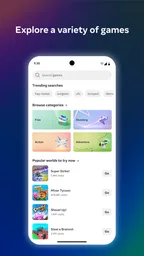
The store categorizes it as an adventure game, but I would set expectations around its multiplayer, social character. You are not simply installing a conventional adventure and following a single author-led path from beginning to end. The experience is better understood as a way to connect with friends and take part in games together. That makes it potentially more replayable as a shared activity, while also making it less appealing if you want a story you can enjoy entirely on your own.
This difference changes how I would plan a first session. Rather than opening it expecting an immediate, polished campaign, I would go in with a friend and agree to explore together. That small adjustment can prevent the common disappointment of arriving in a social game with no one to meet and no particular activity in mind. If your friends are not interested or available, the central reason to choose this over a solo adventure is weaker.
The app’s description emphasizes connecting with friends and unlocking rewards. I would see rewards as an extra reason to return, not as a guarantee that every session will feel meaningful. A reward loop can help give a short visit a purpose, but it should not be the only reason you play. If you find yourself logging in mainly to avoid missing a reward, step back and ask whether the social games themselves are enjoyable.
Keeping progress enjoyable instead of turning it into pressure
For a relaxed routine, I would treat Meta Horizon as an occasional destination rather than a daily obligation. For example, if a friend messages after school or work and you both have half an hour, you can use the app as a shared starting point. Agree on a loose time limit before opening it, then stop when you have had your fill. That makes rewards feel like a bonus rather than a schedule you have to obey.
One useful habit is to decide what would make a session successful before you enter: catching up with a friend, trying an activity together, or simply having a laugh. This is a practical safeguard against aimless browsing. In a broad social environment, the choice of what to do can itself take time; a little coordination makes it more likely that the session feels like play rather than waiting for the group to settle.
I would also separate social progress from spending decisions. If a purchase appears, pause and consider whether it is something you genuinely want or just an impulse in the moment. Because purchases vary widely in price, it is sensible to make a personal spending rule before browsing, particularly for a teen using a family account. I would not assume that buying an item speeds progression or improves competitive standing; the available purchase facts do not establish that.
For parents, the Teen content rating is a useful starting point, not a replacement for a conversation about who a young player will meet and what they may choose to buy. I would talk through spending expectations in advance and check the device’s purchase controls. This is more practical than relying on the word “free” to settle every concern, because the app includes paid items even though its initial download costs nothing.
Fair play and the limits of what purchase facts tell us
Fairness in a multiplayer game depends on what affects the match, and I would not infer that from a list of purchase prices. The fact that optional items can cost money does not, by itself, show whether they are cosmetic, progression-related, competitive, or something else. I would avoid assuming either that spending is required to compete or that all players have precisely the same options. The responsible conclusion is narrower: there are paid items, and their effect should be judged item by item.
If you are deciding whether to spend, look for a clear explanation of what the particular item provides before confirming. Ask yourself whether you would still want it if it did not change your position against another player. That question is especially helpful for a social game, where the fun may come from being together rather than from owning everything available. It also keeps a small purchase from becoming a habit simply because the app is already open.
I would be cautious about comparing Meta Horizon with competitive games that publish explicit ranked rules or tightly defined progression systems. The verified picture here supports a social multiplayer experience with games and rewards, not a promise of a particular competitive structure. If your main priority is a transparent, skill-first ladder where you can evaluate how purchases interact with competitive balance, choose a game that spells out those rules clearly.
Choosing it over familiar alternatives
Compared with a standalone adventure game, Meta Horizon trades a fixed route and predictable solo pacing for the possibility of shared play. A conventional story game is the better choice when you want to relax without coordinating with anyone, pause whenever you like, or know exactly what kind of narrative you will get. This app is more attractive when the social appointment is part of the point and you enjoy deciding together what to do.
Compared with a one-purpose multiplayer game, it has a broader social framing: the idea is to connect with friends and play games in a shared environment. That breadth can be a strength if your group wants variety, but it can be a weakness if everyone already has one favorite competitive game and wants to get directly into it. In that case, the focused alternative may waste less of your group’s time and make its rules easier to understand.
I would also distinguish it from simply chatting with friends. A call or message is more direct when conversation is all you want; Meta Horizon makes sense when you want the conversation to happen alongside play. The trade-off is that a game-based gathering asks everyone to install and engage with the same app. If your friends are unwilling to do that, the social promise is difficult to realize, no matter how appealing the concept sounds.
Practical checks before you settle in
Before downloading, I would check that your Android device runs version 8.0 or newer. If you are on iOS, confirm availability and compatibility in the app store for your device rather than assuming the Android requirement applies there. Then think about the people you would actually play with. This app is much easier to recommend when you already have a friend or group who is interested; without that, the first question is whether you enjoy exploring social multiplayer spaces on your own.
For a first visit, I would keep the goal modest. Invite one friend, agree on a short window, and explore the experience together instead of trying to evaluate every game or reward at once. If you encounter a purchase, read its description and price before deciding. That workflow helps you judge the part that matters most—whether the shared play feels enjoyable—without mixing that judgement up with a spending decision.
There are limits to what a buyer can conclude from the purchase range alone. It does not reveal the full set of paid items, the way any item works, or its impact on a particular activity. I would not fill those gaps with guesses. When fairness or value is central to your decision, inspect the specific item and the game context before paying, and skip it if the benefit is not clear to you.
Who I would recommend it to
I would recommend Meta Horizon to someone who wants a free way to meet friends through multiplayer games and is comfortable with a social experience whose appeal depends partly on the group. It is especially promising for casual sessions where the shared time matters as much as the activity. Its Teen rating and large audience may make it easier to consider for older teens and adults, though I would still set sensible expectations around spending and online interaction.
I would skip it if you want an entirely solo adventure, a tightly scripted story, or a clearly documented competitive progression system. I would also hesitate if you do not want optional purchases in your games at all, or if you would rather not manage spending settings for a younger player. A free download is a convenient way to try the social format, but it does not remove those practical considerations.
My overall view is positive but conditional. Meta Horizon is a plausible choice when you already have someone to play with and want a flexible shared activity, rather than a replacement for a focused adventure or a dedicated competitive title. Its free entry makes a trial reasonable, while the presence of paid items means I would keep purchase decisions deliberate. Choose it for the company and the play you can share, not because a reward or purchase is supposed to make the experience worthwhile.
What we like
- Explore immersive worlds and social spaces in VR.
- Create a personalized avatar to represent yourself.
- Join live events and games with friends.
- Discover a broad range of user-created experiences.
- Connect with people across supported Meta devices.
What could be better
- A compatible Meta VR headset is needed for most experiences.
- Some content may require extra purchases.
- Experience quality can vary between user-created worlds.
- Social features may expose users to unwanted interactions.
- Availability and features can vary by region and device.







