

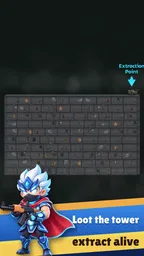



Last Extract review
 Analysis by Appsdrops
I like survival adventures best when every detour has a cost. Last Extract sets up that kind of tension: you head out to gather useful resources, deal with a growing threat, and try to get away alive. Its premise is easy to grasp, but the appeal depends on making small decisions under pressure rather than simply charging forward. I would describe it as a focused, repeatable adventure for players who enjoy weighing one more pickup against the risk of losing their chance to escape.
Learning a reliable run
My first practical recommendation is to treat each attempt as a route with a clear purpose, not a race to collect everything in reach. Resources matter, but the horde makes lingering costly. A sensible run starts with a quick scan of what is nearby, followed by a decision about what you actually need. That habit helps prevent a common survival-game mistake: spending time on a tempting detour and then having no margin left to get out.
The central rhythm is straightforward: explore for loot, respond to enemies, and make extraction the priority when the situation turns. That simplicity is a strength on a phone. I can understand the goal quickly and get into a session without learning a complicated backstory first. It also gives each choice a useful edge. A resource is not automatically worth taking; its value depends on how much danger and time it adds to the trip.
For a normal short play session, I would set one objective before starting: gather a particular kind of useful material, learn a route, or practise leaving before things become chaotic. This keeps the run from turning into aimless scavenging. It is especially helpful when I only have a few minutes, because a clear goal makes even an unsuccessful attempt feel informative. I can notice where I hesitated, what distracted me, and whether I should have turned back earlier.
That approach also suits players who like improving through repetition. Rather than judging a run only by how much loot it produced, I look at whether I made a better decision about when to leave. In an extraction-focused game, escaping with a modest haul can be a smarter result than carrying more and failing to get out. Knowing when to stop looting is part of the challenge, not a retreat from it.
Make the controls and options work for you
Before settling into a routine, I would check the available settings and control options on the device you plan to use. I would not assume that a particular layout or sensitivity suits every player, especially in a game where reacting to enemies and moving toward an exit can compete for attention. If an option lets you adjust the feel of control, test it in a low-pressure run rather than changing several things at once. That makes it easier to tell whether a change actually helps.
It is also worth checking how the game presents its objectives and any on-screen prompts. When a run becomes hectic, a clear view of what you are trying to do matters more than a theoretically perfect setup. I would keep the screen readable and avoid letting optional distractions take attention away from movement and danger. These are ordinary setup habits, not secret tricks, but they can make a repeated run feel much less frantic.
Because the game is free to download, trying it does not require an upfront purchase. It does offer in-app purchases, with listed item prices ranging from $0.99 to $109.99, so I recommend checking the purchase prompts carefully and using device-level purchase controls if you share a phone or want to avoid accidental spending. I would first decide whether the core loop holds my interest before considering any paid items. A purchase should not be treated as a substitute for learning how to manage risk and extraction.
The current version is 0.0.37, and the minimum operating-system requirement is Android 8.0. If you are choosing a device for a younger player, note that the game is rated Teen. Those practical details are worth checking before installing, particularly on an older phone or a shared family device. The game is free, but that does not mean every optional purchase is free, so keeping those two ideas separate is useful.
Repeatable habits that save a run
One habit I find especially useful in this kind of game is to make the extraction decision before I feel forced into it. Decide what would count as a worthwhile haul, then leave when you reach it or when the route starts looking unsafe. Waiting until danger is already overwhelming makes the choice feel less like strategy and more like panic. The exact threshold will depend on the run, but having one in mind gives you a way to resist the urge to keep collecting.
A second useful pattern is to notice which detours repeatedly cost more than they return. If a tempting area pulls you away from a safer route or leaves you exposed to the horde, remember that trade-off on the next attempt. I would not try to memorise a perfect route immediately; instead, keep track of one lesson at a time. That is more realistic for a mobile game played in short bursts and avoids turning each session into homework.
When I have only a brief break, I would choose a low-pressure run aimed at practising movement and recognising when to leave, rather than expecting to make a major haul. When I have longer, I can be more deliberate about exploring and testing different choices. This makes the game easier to fit around everyday life: a quick attempt can still teach me something, while a longer session gives more room to experiment.
It also helps to treat a failed escape as feedback rather than proof that every future run needs to be more aggressive. Ask what changed first: did you spend too long collecting, lose track of the threat, or choose a detour without a clear reason? A small adjustment on the next attempt is more useful than trying to do everything differently. The game’s premise naturally rewards this kind of focused learning, because the same broad decision—whether to keep looting or head out—keeps returning.
Where its simplicity helps, and where it may not
Last Extract is an adventure game from VOODOO, and its appeal is its concentrated survival loop. Compared with a sprawling adventure built around a long campaign, character development, or a large world to explore at leisure, this is better suited to players who want a direct objective and immediate pressure. Compared with a purely action-focused game, the resource-and-escape premise gives looting a purpose beyond simply defeating whatever appears in front of you.
That focus is not for everyone. If you want a relaxed collecting game where you can explore without a looming threat, the horde-driven premise may feel stressful rather than exciting. If you prefer a deep narrative or a long sequence of carefully explained systems, the concise setup may feel too spare. I would choose a story-led adventure for atmosphere and sustained character arcs, or a calmer exploration game when I want to unwind without constantly judging risk.
Another limitation is that a simple core loop can become repetitive if the player does not enjoy refining decisions across attempts. The same basic tension—take more or leave—can be compelling when I am learning, but it may lose its pull for someone who wants a steady stream of new mechanics. I would give it a fair trial by focusing on whether each run makes me curious to try a different approach. If the pressure feels identical every time and the decision-making does not appeal, another adventure with more varied objectives is likely a better fit.
The game has an average rating of 4.4 from around 36,000 ratings, with about 1,300 written reviews and over one million installs. That level of reach suggests it has found an audience, though popularity alone cannot tell me whether its particular rhythm will suit you. I would use those figures as context, then make the decision based on the central loop: do you enjoy gathering under pressure and choosing a moment to escape, or do you want exploration without that constant calculation?
Who should give it a try
I would recommend Last Extract to players who like short survival challenges, clear goals, and the satisfaction of improving through better judgement. It is also a reasonable pick for someone who enjoys replaying a run with a slightly different plan, rather than needing a large amount of story to stay engaged. The Teen rating is a useful reminder for families to consider whether the game’s tone and threat-focused play suit the intended player.
I would be more cautious about recommending it to someone who dislikes time pressure, gets frustrated when a cautious run produces a small reward, or wants to play without monitoring danger. Likewise, if you are looking for an adventure that can be enjoyed as a long, leisurely exploration session, this is not the first option I would suggest. Its appeal comes from the tension between gathering and getting out, so that tension needs to be enjoyable rather than merely tolerable.
For a friend trying it, I would suggest starting with a simple personal rule: decide what you came for, avoid unrelated detours, and leave while you still have a choice. Check the control and display options before building a routine, and pay attention to any purchase prompts if you intend to keep the game free. These steps do not promise a successful escape, but they make it easier to understand why a run went well or badly.
My verdict on getting better at extraction
Last Extract works best when I play deliberately. Its resource gathering creates reasons to explore, while the horde turns each extra stop into a decision rather than a free bonus. That gives the game a clean identity and makes it easy to pick up, but it also means the experience relies heavily on whether I enjoy repeating that risk calculation. I appreciate that the premise asks me to think about the exit as much as the loot.
My strongest advice is to build a repeatable routine instead of chasing a perfect run: set a modest goal, observe which choices create trouble, and adjust one habit next time. Check the available settings on your device, keep paid options separate from the free download, and do not expect a calm, story-first adventure. If making a timely escape feels as satisfying as finding resources, this is a worthwhile adventure to try. If you would rather explore without pressure, I would point you toward a different kind of game.
What we like
- Compact rounds make it easy to play in short sessions.
- The extraction objective adds tension to each match.
- Combat rewards careful positioning and timely decisions.
- Unlockable gear gives players goals to pursue.
- The post-apocalyptic setting creates a distinct mood.
What could be better
- Repeated missions can make progression feel routine.
- New players may need time to learn the combat.
- Success can depend heavily on equipment upgrades.
- Match difficulty may feel uneven for some players.
- Limited variety can reduce long-term replay value.







