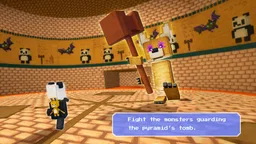
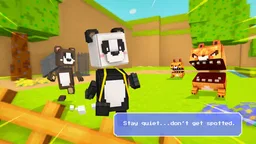
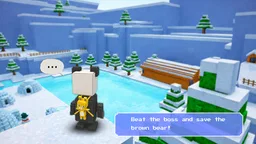

Blocky Quest: 3D Platformer review
 Analysis by Appsdrops
I like adventure games that give me something active to do within a few minutes, and Blocky Quest: 3D Platformer has an appealing premise: move through a three-dimensional world, jump across gaps, dash through danger, and fight along the way. Its blocky look suggests a straightforward, readable style rather than a realistic one. That can be a good fit for quick play, though the central question is whether its movement and challenges stay satisfying once the initial novelty wears off.
From my perspective, the game is most promising for players who enjoy action-led exploration and don’t need a long story to motivate every session. It is a free adventure game from Bibota, rated for Everyone, with a current version of 1.1.3. Its average rating is 4.1 from around 2.7 thousand ratings, and it has passed one million installs. Those figures point to a game with a meaningful audience, but they don’t tell you whether its particular mix of platforming and combat suits your tastes. The feel of that mix matters more.
Small goals make the first sessions easy to approach
The basic actions give the game an immediately understandable rhythm. A jump asks you to judge space; a dash implies a quicker way through a stretch or a threat; fighting adds a reason to pay attention to what is nearby. I find that combination more inviting than an adventure that opens with lots of explanation. You can focus on what is directly in front of you and learn through play.
That simplicity also puts pressure on the level design. When the actions are familiar, the satisfaction comes from how they are arranged: whether a jump feels carefully placed, whether a dash is useful at the right moment, and whether combat interrupts exploration in an interesting way rather than merely slowing it down. I would judge each new stretch by whether it asks me to use those actions thoughtfully, not by how much scenery it shows me.
A practical way to try it is to play in a short, attentive session instead of treating it as background entertainment. Pay attention to whether you can read a platforming situation before committing to a jump, and whether you understand why a fight became difficult. If a mistake feels like your timing or route choice, that can make retrying satisfying. If the cause feels unclear, repeated attempts are more likely to become frustrating.
For a realistic everyday use case, this is the sort of game I would open during a break when I want active input rather than a passive story or a puzzle that needs a long stretch of concentration. The broad action verbs make it easy to get oriented, while the three-dimensional setting offers more visual space than a simple side-on platformer. I would still avoid starting a demanding section when I have only a few seconds available: action and jumps reward attention, and interruptions can make precise movement less enjoyable.
What to watch for as the adventure opens up
The most useful early signal is whether the game teaches through its challenges. A good platforming sequence can introduce a movement idea, give you room to try it, and then ask for a more deliberate use. Likewise, a fight feels fairer when the player can connect the outcome to positioning or timing. I recommend noticing these patterns instead of rushing forward; they reveal whether the game is building skill or simply asking for repetition.
Another small but helpful habit is to pause mentally before a dash. A fast move can be tempting whenever a route looks awkward, but speed is only useful if it leaves you in a better position. In a voxel environment, judging depth and landing space may take more care than judging a flat platform. I would use the dash with a clear purpose—crossing a risky gap or changing position in a fight—rather than tapping it automatically. That is a way to make the advertised movement feel like a decision, not just an extra button.
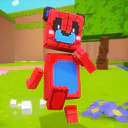
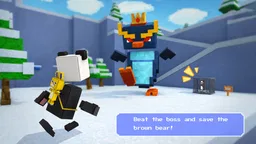
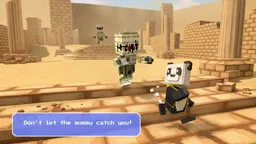
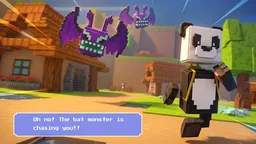
The block-based visual language is likely to appeal to players who prefer clear shapes and a playful presentation. It may be less compelling for someone who wants finely detailed environments or a strong cinematic mood. That is not a flaw by itself; it simply changes what the game needs to deliver. For me, readable routes and responsive movement would matter more than visual realism in this kind of adventure.
Progress feels best when challenge has a purpose
In platformers, progress is not only about reaching a later area. It is also the feeling that a tricky jump has become manageable because I understood the spacing, or that a fight went better because I chose a safer position. Those moments can keep a compact action game engaging even when its goals are simple. I would look for that kind of personal improvement here, rather than expecting the game to rely on a deep narrative or elaborate progression structure.
The store description establishes a large three-dimensional voxel world and the core actions of jumping, dashing, and fighting, but a short premise cannot tell you how consistently those actions are combined. My advice is to assess the variety of decisions, not just the number of places you pass through. A new-looking route is less meaningful if it asks for exactly the same timing and approach as the last one; a familiar setting can still feel fresh if it changes how you use movement and combat.
When an attempt goes wrong, try to identify one adjustable choice before repeating it: approach speed, the point where you jump, or whether you dash early or late. This is a useful test of the game’s challenge curve. If small changes make a difference, the difficulty can encourage learning. If you cannot tell what to change, or if the same obstacle demands many identical attempts, the pacing may feel more like a barrier than a lesson.
That distinction matters especially for younger players and families. The game’s Everyone age rating makes it broadly accessible in content terms, and its basic action premise is easy to explain. But an accessible rating does not guarantee that every sequence will feel easy. A child who enjoys experimenting with movement may take naturally to it; someone who dislikes repeating a difficult jump may prefer a gentler, less timing-focused adventure. I would consider temperament as much as age.
Challenge and pacing are personal trade-offs
Jumping, dashing, and fighting can create lively pacing, but they can also compete for attention. If a section asks for precise movement while adding combat pressure, it may feel exciting to a player who likes multitasking and hectic action. A player who wants calm exploration may find that combination tiring. I would not recommend choosing this game solely because its world sounds expansive; the more important fit is whether you enjoy responding quickly while navigating three-dimensional space.
Compared with a conventional side-scrolling platformer, a voxel world can make routes feel more spatial and give movement a different sense of depth. The trade-off is that judging distance may be less immediate, particularly when the camera perspective makes a landing point look closer or farther away than expected. Compared with a combat-heavy action adventure, this game’s stated emphasis sounds more focused on movement through the environment. If you want complex fighting as the main event, a deeper combat game may be a better match; if you enjoy platforming with fights along the way, the balance is more appealing.
I also recommend separating a fair challenge from a frustrating one. A fair obstacle makes its risk understandable and rewards a better attempt. Friction becomes harder to enjoy when a failure seems unrelated to a choice you made. During a first session, notice whether you feel curious after a mistake or simply annoyed. That reaction is a more useful personal guide than trying to infer the whole game’s difficulty from a single tough moment.
Free to start, but keep purchases in mind
Free to download does not mean every possible purchase is small. The game offers in-app purchases ranging from $0.99 to $399.99 per item. That wide span is worth knowing before handing a device to a child or enabling purchases. I would check purchase controls on the device and agree on a spending rule in advance, especially in a family setting. The existence of purchases does not by itself tell me how often the game prompts players or what each item provides, so I would avoid assuming that spending is necessary to enjoy the core adventure.
For adults, the sensible approach is to start without buying anything and decide whether the movement and challenge justify more commitment. The free entry point makes that trial straightforward, while the purchase range calls for a little care around accidental taps or impulse spending. If you prefer games with no optional spending at all, that may be a reason to choose another title, even if the price to begin is zero.
Version 1.1.3 is the current release, and the game is listed for a minimum OS of 7.1. Before installing, I would check that the device meets that requirement and leave enough attention for the first play session to judge controls and visibility. Since jumping depends on spatial judgment, a screen and control setup that feel comfortable can make a noticeable difference to enjoyment, even without changing the game itself.
Who is likely to stick with it
I would recommend giving it a try if you like compact action adventures, enjoy improving through repeated attempts, and find a mix of traversal and combat more appealing than either activity alone. It may also suit someone who wants a colorful, block-shaped alternative to realistic action games. The 4.1 average and million-plus installs suggest that many players have been willing to give it a chance, but personal fit still comes down to whether the movement feels clear and the challenge feels earned.
I would skip it if you mainly want a rich story, relaxed sightseeing, or combat with lots of tactical depth. I would also be cautious if repeated platforming attempts quickly sour a play session for you. A quieter exploration game is a better choice for unwinding without pressure, while a more combat-focused adventure makes more sense if fighting is the part you want to master. Blocky presentation alone should not be the deciding factor; the action loop is the real draw.
Overall, Blocky Quest: 3D Platformer has a clear reason to exist: it puts movement and action at the center of a voxel adventure, with jumping, dashing, and fighting shaping the experience. I like that straightforward focus, and I would approach it as a game to learn in short bursts rather than one to judge by its premise alone. Its strongest appeal is the possibility that each obstacle will make me more deliberate; its main risk is that challenge can feel repetitive if the game does not keep changing how those core actions matter. If you enjoy testing your timing and adapting your route, it is worth a try. If you want story-first or low-pressure play, I would look elsewhere.
What we like
- Bright block-based visuals make platforms easy to distinguish.
- Short stages suit quick play sessions.
- Collectibles add optional goals beyond reaching the exit.
- Simple controls are approachable for new platformer players.,3D levels offer a change from side-scrolling platform games.
What could be better
- Camera angles can make judging jumps difficult.
- Some hazards require repeated attempts to learn their timing.
- Precision jumps may feel challenging on a touchscreen.
- The blocky art style may not appeal to every player.
- Progress can feel repetitive when level mechanics recur.







