
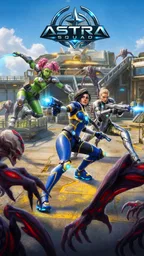





Astra Squad review
 Analysis by Appsdrops
I would approach Astra Squad as an adventure game for players drawn to a large-scale rebuilding premise, rather than as a known quantity with a long track record. Its short pitch suggests a journey from repairing a damaged world toward reaching the stars, but that idea alone doesn’t tell me whether its moment-to-moment play will suit me. My recommendation is therefore a measured one: it is worth considering if the setting appeals to you and you are comfortable trying a free game while judging its actual pace for yourself.
What to consider before you start
The first decision is what you want from an adventure game. If you mainly want a strong narrative, carefully directed exploration, or a tightly defined single-player journey, you should check whether Astra Squad’s opening gives you that feeling before you invest much time. If you are more interested in the broad idea of restoring a world and pursuing a cosmic goal, its premise has a clear point of appeal.
I also weigh how much a game asks of my attention. Some adventure games are best enjoyed in long, uninterrupted sessions; others work as small breaks. I would try Astra Squad during a relaxed first session and notice whether its objectives feel satisfying in short bursts or leave me wanting to keep playing. That matters more than the grand scale of its premise: a compelling destination only works if the steps toward it fit your routine.
The game is free to download, while optional in-app purchases range from $0.99 to $99.99 per item. That broad spread is a reason to decide on a personal spending limit before browsing any purchase screens, not a reason to assume that paying is necessary. I’d begin without spending, see how the ordinary play feels, and only consider a purchase if it clearly improves something I already enjoy.
Its Everyone age rating makes it suitable for a broad audience, though that label should not be mistaken for a promise that every player will find the game equally engaging. Younger players may respond to the space-facing adventure concept, while adults deciding whether to play should focus on the kind of challenge and pacing they enjoy. The best test is whether the game’s actual play keeps your interest, not simply whether its theme sounds inviting.
A promising premise, with a practical test
The idea of rebuilding before reaching the stars gives the adventure a natural sense of direction. It implies that the journey is about more than arriving somewhere: progress begins with putting something back together. That can be a satisfying frame for players who like stories or settings where a damaged world offers a reason to explore.
At the same time, I would not treat that premise as proof of particular mechanics. A description of a world to reclaim does not, by itself, establish how construction, exploration, combat, or progression work. My practical advice is to judge the actions the game actually puts in front of you. Are they easy to understand? Does each session give you a useful sense of progress? Those answers will tell you more than any imagined system attached to the theme.
For MEGAGIGA GAMES BILISIM A.S., Astra Squad is a relatively early versioned release, currently at version 1.0.5. I would approach that as a reason to keep expectations flexible, not as evidence that the game is unfinished or that a particular issue exists. If an interface or task feels unclear, give yourself a little time to learn its rhythm, but don’t feel obliged to push through friction that makes playing feel like work.
Where it may stand out
Astra Squad’s strongest distinction is its combination of restoration and a destination beyond the world itself. Many adventure games put the emphasis on discovery, danger, or a character’s journey. Here, the stated goal brings repair into the picture as well as reaching the stars. That pairing may appeal if you enjoy imagining how a place changes over the course of an adventure, rather than simply moving from one obstacle to the next.
One useful way to assess that appeal is to pay attention to what motivates you after the first play session. If you return because you want to see the next stage of the larger journey, the premise is doing its job for you. If you return only because you feel you ought to make progress, that is a warning sign: a game should earn your attention through play, not through an ambitious-sounding objective.
Another good test is to notice whether the game gives you a natural stopping point. On a busy day, I prefer an adventure I can put down without losing track of what I was doing. After your first session, take note of the last task or goal you reached. If you can pick up the thread easily the next time, that is a practical advantage for casual play; if you need to relearn the context every time, a more self-contained adventure may fit your routine better.
The audience numbers show that it has attracted interest: it has over 100,000 installs, with an average rating of 4.6 from around 22,000 ratings. I see that as useful context, not a guarantee that its style will suit you. Ratings can help answer whether a game has found an audience, but they cannot tell you whether you personally prefer its pacing, presentation, or approach to progression. I would use them as a reason to take a look, then make the decision based on your own first session.
How it compares with other adventure choices
Compared with a story-first adventure, Astra Squad may be a better fit if the idea of restoring a world and aiming beyond it is what draws you in. A more tightly authored alternative may be better if you want a clearly defined story and a dependable sense of how long each chapter will take. I would choose based on the kind of motivation I want: a broad world-level goal, or a more focused narrative path.
It may also be less suitable than a familiar exploration game if your main priority is wandering freely without a strong central objective. The rebuilding-and-stars premise points toward a purposeful journey, so players seeking an open-ended atmosphere should check whether the actual play leaves them room to explore at their own pace. A different adventure can be the better choice when freedom matters more than following a larger goal.
For players who usually pick action-heavy games, the question is whether Astra Squad’s adventure framing provides enough immediate excitement. For those who prefer calmer progress, the question is whether its tasks feel rewarding rather than repetitive. I would not select it just because it belongs to the adventure category; that category covers very different experiences. Think about whether you want to explore a setting, follow a goal, or simply fill a short break, then see which of those the game delivers for you.
Making the first sessions count
I’d use the opening sessions as a small, low-risk trial. Start without making purchases, learn the basic routine the game presents, and ask three practical questions: Do I understand what I’m working toward? Do I enjoy the actions needed to move forward? Do I want to return when I have a spare moment? If one of those answers is no, give the game another short try only if the premise still interests you.
This approach is especially useful for someone choosing between several free adventures. Instead of spending time comparing broad promises, play each option just long enough to see which one feels easiest to re-enter. Astra Squad may win for you if the act of rebuilding gives its larger journey a distinctive appeal. A more immediately gripping story or a more open exploration experience may win if those are what keep you engaged.
I would also make purchase decisions separately from enjoyment. A free start makes it easy to sample, but optional purchases can become a distraction if you start thinking about what to buy before you know whether you like playing. Set a limit in advance, avoid treating a purchase as a shortcut to fun, and keep playing only if the core experience is already working for you.
Who should choose it—and who should pass
I’d recommend giving Astra Squad a try if you like adventure games with a large-scale restoration theme, want a free starting point, and are willing to judge the experience through a few sessions rather than expecting the premise to answer every question. Its audience figures suggest it has attracted considerable attention, and its rating is encouraging context, but neither replaces your own sense of whether the game’s rhythm suits you.
I would steer you toward another option if you need a very specific kind of adventure: a clearly defined narrative, unrestricted wandering, or a particular style of action. Those preferences are best served by a game that makes them central. I would also pass if optional purchases make you uncomfortable or if you prefer not to try games whose appeal you have to discover for yourself.
On Android, the listed minimum operating-system requirement is 7.1, so check your device’s software before downloading. The game is free, carries an Everyone age rating, and has optional purchases; that makes it straightforward to sample, but still worth approaching with a sensible spending boundary.
My verdict is that Astra Squad is worth a cautious first look for players intrigued by its world-rebuilding, spaceward adventure. I like the clarity of that broad direction, but I would let the actual play—not the scale of the promise or the popularity figures—make the final call. Try it without spending, see whether its progress feels rewarding in your everyday routine, and keep it only if you genuinely want to continue.
What we like
- Runs in short missions that fit quick play sessions.
- Each pilot brings distinct abilities to squad battles.
- Upgrade choices give room to shape a preferred playstyle.
- Bright pixel art keeps combat easy to follow.
- Offline play makes it accessible without a connection.
What could be better
- Random upgrade offers can make some runs feel uneven.
- Early stages may feel repetitive before more content unlocks.
- Small combat effects can become hard to track on busy screens.
- Progression can require repeated runs to improve your squad.
- Touch controls may feel less precise during hectic fights.







