





Hilton Honors: Book Hotels review
 Analysis by Appsdrops
I’d keep Hilton Honors on my phone if I stayed at Hilton properties often enough to make its rewards and trip tools part of my routine. The first impression is practical rather than flashy: it brings hotel searching, offers, account rewards, and a Digital Key into one place. That combination can make a stay feel easier to manage, but it is most valuable when Hilton is already a realistic choice for your trip—not when you need a universal hotel finder.
What feels useful in the first week
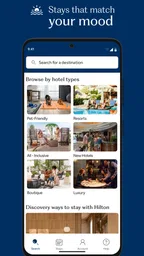
Hilton, the developer, has made an app for both planning and handling a stay. I like that distinction. A hotel app can be useful before booking, when I am weighing locations and offers, and after booking, when I need the details close at hand. Here, the appeal is having those parts connected to a Hilton Honors account instead of treating each stay as a separate transaction.
Finding an offer can be a useful starting point, but I would still compare the total cost and location with other places I am considering. A promotion is only worthwhile if the hotel fits the trip and the terms suit the way I travel. The app is therefore better viewed as a focused way to explore Hilton options than as an impartial comparison tool across every hotel brand.
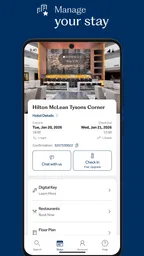
The Digital Key is the feature most likely to make the app feel immediately different from a basic booking tool. When it is available for a stay, having access on the phone can reduce the need to handle a separate key card. I would still keep the hotel’s check-in instructions handy and avoid treating a phone key as a guarantee that every part of arrival will be contactless. It is a convenience, not a reason to skip the normal arrival process.
For someone trying the app for the first time, the sensible workflow is simple: sign in, look for a property that genuinely suits the trip, review the offer and booking details carefully, then keep the app available for the stay. That is more useful than installing it solely to browse rewards. The app is free, and its Everyone age rating makes it suitable for a broad audience, but the value comes from actual Hilton travel rather than from having another icon on the home screen.
A realistic trip where it earns its place
Imagine I am arranging an overnight stay for a work trip. I can search Hilton options while planning, consider whether a displayed offer changes the value, and then return to the app when I reach the hotel. If a Digital Key is available, it may simplify getting into the room; meanwhile, the account keeps the trip connected to Hilton Honors. That is a modest but coherent chain of benefits: planning, staying, and earning rewards are not scattered across unrelated services.
The practical tip is to check the details before travel rather than waiting until I am in the lobby. Confirm the reservation in the app, make sure I can access my account, and keep an ordinary backup plan for arrival. This matters especially if I am travelling with a low phone battery or unreliable connectivity. The app can smooth out a routine stay, but it should not be the only place I rely on for essential trip information.
Why the value can last from one trip to the next
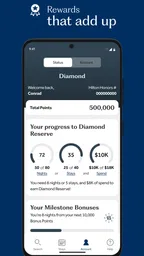
Rewards are a habit-based benefit. If I stay with Hilton repeatedly, the app has a reason to remain installed: I can return to the same account and use it as the starting point for the next hotel search. If my stays are occasional and spread across many brands, that recurring value gets weaker. In that case, a general travel app may be more useful for comparing a wider range of properties, while Hilton Honors can remain a secondary tool for checking Hilton specifically.
The app has an average rating of 4.4 from around 169,000 ratings, with roughly 59,000 written reviews. Those figures suggest that many travellers find a reason to use it, though ratings alone cannot tell me whether it will fit an individual trip. Its scale is also substantial: it has passed 10 million installs. I would read that as evidence of broad use, not as proof that every feature works equally well for every stay.
The long-term advantage is less about opening the app every day and more about having it ready at the moments when it matters. A hotel app does not need to become a daily habit to earn its place; it needs to be dependable when I am comparing a stay, reviewing an offer, or arriving at a property. For frequent Hilton guests, that occasional but repeated usefulness can be enough.
There is also a trade-off in loyalty. The more convenient it becomes to search within one hotel group, the easier it is to overlook a better-located or better-priced option elsewhere. I would use Hilton Honors to understand what Hilton can offer for a particular journey, then compare outside it when choice matters more than keeping everything within one rewards account. Loyalty is useful when it rewards trips I would take anyway; it is less convincing when it starts dictating where I stay.
Keeping it useful without extra effort
Maintenance is fairly light if I already travel with Hilton: keep the app updated, stay signed in, and check it when a Hilton booking is relevant. Hilton Honors is listed at version 2026.11.3, and the app has been available since May 12, 2014, so this is an established product rather than a newly launched experiment. Still, an updated app cannot remove the practical dependencies of a phone-based travel tool: I need access to my account and a charged device when I want to use its digital conveniences.
I would avoid turning notifications or reward checks into a constant chore. The useful routine is to open the app when planning or managing a stay, not to keep checking it just because rewards exist. This is a small but meaningful distinction: if I travel with Hilton regularly, the account can build value in the background; if I rarely stay there, repeated browsing is unlikely to make the app worthwhile.
For a multi-person trip, I would also think through who needs the booking information and who will be handling arrival. A phone-based key is most convenient for the person who has access to the relevant account and device. If several people are coordinating, it is worth agreeing on the arrival plan in advance rather than assuming everyone can use the same digital access. That little bit of preparation prevents a convenience feature from becoming a point of confusion at the front desk.
Where the routine can become tiring
The main limitation is its natural focus. Hilton Honors is not the app I would choose as my only travel tool if I want to search across independent hotels and competing chains in one broad sweep. It can help me make a Hilton decision, but that is not the same as showing me the whole market. For flexible travellers who prioritize the cheapest suitable room or the widest location choice, a general booking service may be a better first stop.
Rewards can also make the experience feel less compelling when travel is infrequent. If I only take a hotel trip now and then, I may not return often enough for account-based benefits to influence my choices. In that situation, it is reasonable to book wherever the trip works best and install Hilton Honors only when a specific Hilton stay makes its tools useful.
There is a smaller kind of fatigue too: expecting a digital feature to remove every bit of friction. A Digital Key can be convenient, but I would not plan a late arrival around it without checking the reservation and arrival details first. Likewise, an offer should not distract from comparing the room, location, and overall booking conditions. The app is strongest when it assists a sound decision, not when it replaces one.
Compared with using a hotel’s mobile site or relying on email confirmations, the app’s advantage is the connection between Hilton searches, the Honors account, and stay-related convenience. Compared with broad travel apps, its advantage is that Hilton-specific tools are gathered in one place; its disadvantage is that its scope is narrower. Choosing between them depends on whether I want a loyal-brand workflow or a wider market view.
My long-term verdict
I recommend Hilton Honors to people who book Hilton often enough to benefit from keeping their travel activity and rewards together. It is free, straightforward in purpose, and more useful than a one-off booking shortcut when I return to the same hotel group. The app’s strongest case is recurring convenience: find a Hilton stay, consider an offer, and have account-based tools close by when the trip arrives.
I would not recommend relying on it as a complete travel planner or as a reason to choose Hilton without comparison. Occasional hotel guests, brand-flexible travellers, and people who prefer to manage every trip through one broad booking service may get more value elsewhere. For them, this app may be worth installing only when a Hilton reservation is on the table.
After the novelty of a phone-based key wears off, what remains is the real test: does the app make repeat Hilton stays easier without demanding much attention? For regular guests, I think it can. I would keep it installed, use it when planning a Hilton trip, and still compare alternatives when the location or price matters more than loyalty. That balance gives the app lasting value without asking it to do a job it was not built for.
What we like
- Digital check-in lets you prepare for arrival before reaching the hotel.
- The app stores your digital room key at participating properties.
- Saved stays make it easier to revisit booking details and preferences.
- Points activity is accessible alongside your reservation information.
- Hotel listings include photos and property details before you book.
What could be better
- Digital keys are available only at participating hotels.
- Some app features depend on a reliable internet connection.
- Room preferences are requests and may not be guaranteed.
- Award availability can vary by hotel and travel dates.
- Managing reservations may require signing in to an Honors account.





