

Grab - Taxi & Food Delivery review
 Analysis by Appsdrops
When I need to arrange a ride and sort out a meal or groceries, I like the idea of having those everyday tasks in one place. Grab is an all-in-one delivery and taxi app built around exactly that convenience, bringing ride booking, food delivery, and grocery delivery together. Its broad scope makes it worth considering for people who want a single app for common local trips and doorstep orders, rather than juggling separate services.
One app for everyday local needs
Grab sits in the travel and local services space, but it reaches beyond transportation. I see its main appeal in the combination: you can use it to arrange a taxi ride, order food, or have groceries delivered. That mix gives the app a practical role in daily routines, whether you are heading somewhere or staying in and getting essentials brought to you.
The experience is easiest to understand as a central hub for local errands. Instead of treating rides and deliveries as unrelated activities, Grab groups them under one app name. That can make it simpler to remember where to start when plans change: open the same app to think about getting across town, choosing a meal, or arranging a grocery order.
That convenience is also the product’s clearest promise, not a guarantee that every service will suit every situation. People tend to judge a taxi app by how well it fits their journeys, and a delivery app by how easily it helps them place an order. Grab has to satisfy both kinds of expectations, which makes its range attractive but also means the overall experience can depend on which part of the app you use most.
What the app brings together
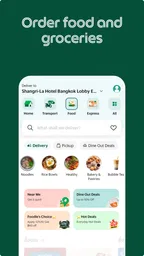
The core services are straightforward: taxi rides, food delivery, and grocery delivery. For a user, that breadth matters because local transportation and delivery needs often come up in the same week, sometimes on the same day. Having those options in one place can reduce the mental overhead of switching between apps and keeping track of different starting points.
Grab’s store description presents it as an all-in-one delivery and taxi app, and that is a useful way to frame its identity. It is not only a ride-booking tool, nor is it solely a food-ordering service. The draw is having several practical services under one roof, with the possibility of returning to the same app for different needs.
The app is free to download, which makes trying it a low-commitment way to see whether its available services fit your routine. It is rated for Everyone, and the stated minimum operating system requirement is version 7.0. Those details help set basic expectations for installation, while the actual usefulness will depend on the service options available to you and what you need from them.
How I’d think about the day-to-day experience
For rides, the central question is whether the app makes arranging a local trip feel convenient. For food and grocery delivery, it is whether ordering fits naturally into the way you plan meals and household errands. Grab’s strength on paper is that users can approach those separate jobs through one service. I would judge it less as a collection of unrelated buttons and more as a practical shortcut for common local tasks.
That does not mean the same person will use every part equally. Someone who mainly wants transport may treat delivery as an extra, while a frequent food-ordering user may open the app primarily for meals. The combined model gives users options, but its value comes from the services they actually need rather than from the number of categories an app can mention.
It is also helpful to approach an all-in-one app with realistic expectations. A broad service range can make an app feel more useful, but it does not automatically make each individual activity ideal for every user. My recommendation would be to focus on the task at hand: choose the ride option when you need transport, or the relevant delivery option when you want food or groceries, and decide whether the app’s overall convenience suits your habits.
A product with a long-running footprint
Grab was released on May 30, 2013, and its current version is 5.436.0. Those two facts offer a useful snapshot of a product that has been around for years and continues to have a current version. They do not, by themselves, tell me exactly which features changed between releases, so I would not treat the version number as a changelog. What they do show is that the app has an established history and an ongoing release identity.
For people who have used Grab before, a newer version is a reason to check the app’s current presentation and make sure their installed copy is up to date. But a version number alone cannot tell users what has changed in the interface or how a particular service works today. It is more accurate to say that Grab has continued to be maintained as a product than to claim a specific redesign or new feature without a confirmed release note.
What its history and reach suggest
The app has passed 100 million installs, with an average rating of 4.8 from around 17 million ratings and roughly 12,000 written reviews. That scale suggests it has attracted a very large audience and earned substantial engagement in app stores. Ratings can be a useful signal of broad user response, but they are not a personal guarantee; I would still judge the app against the services I need and the experience I get myself.
Its long history and wide adoption help explain why Grab is positioned as a familiar option for local transport and delivery. A service that combines rides, meals, and grocery orders can become more useful as people return to it for different reasons. At the same time, popularity should be treated as context, not proof that every service is available or equally convenient in every location.
That distinction matters for new users as well as returning ones. An established app can be a sensible place to begin when comparing local-service tools, but your own requirements should guide the decision. If you only need occasional rides, the transport experience will matter most. If you want a delivery app, the ordering side will carry more weight. If you expect to use several services, the all-in-one approach becomes more compelling.
What changes mean for existing users
For someone already using Grab, the steady presence of a current version is reassuring in a general sense: the app is not simply a frozen product from its launch era. Still, users should separate that broad observation from claims about particular improvements. Without a confirmed description of a specific update, it would be unfair to promise that a recent version has changed booking, ordering, layout, or performance in a particular way.
In practical terms, existing users can keep evaluating Grab through the parts they rely on. If they use it for rides, they can focus on whether it continues to meet their travel needs. If they use food or grocery delivery, they can consider how well those services fit their routine. The wider menu of options remains the product’s defining idea, while the value of any update is best judged through actual use and clearly described changes.
For someone considering a first download, the same principle applies in reverse. The app’s reputation and history may make it worth a try, but the most useful test is whether its local services match what you want. Because Grab is free, sampling its available options does not require paying for the download itself. I would begin with the feature I expect to use most, then decide whether having the other services close at hand adds real value.
Where expectations should stay grounded
The all-in-one pitch has a natural limit: an app can bring services together, but it cannot make every user’s needs identical. A person may want a ride without needing deliveries, or groceries without regular taxi bookings. That is not a flaw by itself; it simply means the app’s broad design will be most appealing to people who value having several local services in one place.
There is also a difference between knowing the headline services and knowing the details of how each one works. The broad description makes clear that Grab covers taxi rides, food, and groceries, but a careful review should not assume specific operating rules or features beyond that. I would look at the options shown in the app and consider how they fit the task rather than expecting every detail to be the same across all services.
For searchers comparing a taxi and food delivery app, Grab is easy to place: it combines transportation with two types of delivery and has a large, established user base. The question is not whether it covers those broad categories, but whether this combination is useful to you. If one app for rides, meals, and groceries sounds convenient, it belongs on your shortlist. If you prefer separate tools for each job, the all-in-one approach may matter less.
What I’d watch next
Going forward, I would pay attention to clearly stated release notes and product updates, rather than infer changes from version numbers alone. Specific explanations of what has improved would help existing users understand whether an update affects the services they depend on. For new users, clear descriptions of ride and delivery options can make it easier to decide whether Grab fits their needs before building it into a routine.
I would also keep an eye on how well the app continues to balance its different roles. Combining rides with food and grocery delivery is an appealing idea, but the experience has to remain understandable for people who come to the app with different goals. Updates that make the overall service easier to navigate would strengthen the central benefit, provided those improvements are described and users can see their effect for themselves.
Overall, Grab is a practical choice to consider if you want a single app for local rides and delivery. Its long-running presence, large install base, and combination of taxi, food, and grocery services give it a clear identity. I would not assume that every update brings a particular change, but the app’s broad purpose is easy to understand: it aims to help with common local trips and orders through one service.
My take is that Grab is most appealing to people who value convenience across several everyday tasks. It may be more than you need if you only want a narrowly focused tool, yet its range can be useful if rides and deliveries both feature in your routine. As a free app with a broad local-service focus, it is worth exploring and judging by the options that matter most to you.
For anyone searching for Grab as a taxi and food delivery app, the bottom line is simple: it brings transport, meals, and groceries together, with a well-established history behind it. Try the service that matches your immediate need, see how the app fits your habits, and let that real-world usefulness—not popularity alone—decide whether it earns a place on your phone.
What we like
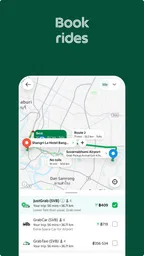
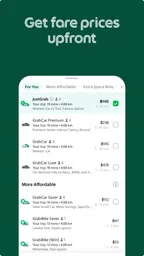
- Book rides with upfront fare estimates in many areas.
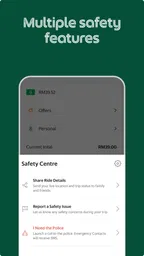
- Track your driver and share trip details with trusted contacts.
- Schedule rides in advance for planned journeys.
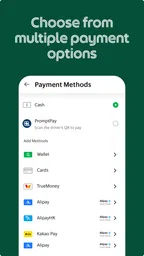
- Pay through several options including cash in supported markets.
- Save delivery addresses for quicker food orders.
What could be better
- Service availability varies by city and country.
- Fares can rise during periods of high demand.
- Driver arrival times may change with traffic or weather.
- Some payment methods may not be available in your region.
- Food delivery fees can add noticeably to the order total.





